Showing posts with label Iran. Show all posts

Friday, October 28, 2011

Education Under Fire: a Documentary

The following paragraphs describe a newly released documentary, screened tonight and tomorrow in New York City, regarding the suppression of educating Baha'is in Iran by its government (trailer linked here):
Education Under Fire is produced by Single Arrow Productions and co-sponsored by Amnesty International. The 30-minute documentary profiles the growth, struggle, and inspiring spirit of the Baha´i Institute for Higher Education. Baha´is in Iran have been subjected to systematic persecution, including arrests, torture, and execution simply for refusing to recant their beliefs. They are also prohibited from going to college (and blocked from many professions). 
In 1987, the semi-underground Baha´i Institute for Higher Education (BIHE) was formed to give young Baha´is their only chance for a university-level education. Despite repeated raids and arrests, volunteer teachers and administrators created an independent, decentralized university system that has lifted the lives of thousands of Baha´i students across Iran. In May, 2011, an organized assault was launched by the Iranian government in an attempt to shut down the BIHE. Over 30 homes were raided and over a dozen BIHE professors and administrators were detained. Several are still in prison for doing nothing more than trying to teach. The film connects a diverse audience to a grave human rights issue, a powerful story of resilience against oppression, and the need to respect human rights everywhere. 
We filmed in nine cities with a dozen BIHE students or teachers (several whose parents were imprisoned or executed by the Islamic Republic of Iran), plus: Bani Dugal (Representative of the Baha´i International Community to the United Nations), Elise Auerbach (Iran Specialist for Amnesty International), Hadi Ghaemi (with the International Campaign for Human Rights in Iran), Hamid Dabashi (Professor of Iranian Studies and Comparative Literature at Columbia University), and Dr. Ramin Ahmadi (Co-founder of Iran Human Rights Documentation Center). The film features footage and photos spanning two decades of BIHE classes, rare video from inside Tehran's notorious Evin Prison, and photos and a film that bring alive a series of personal stories. 
In the documentary, BIHE graduate Shahrzad Missaghi expresses a shared resolve, "The government can crush our bodies, but they cannot crush the mind and soul." Mojdeh Rohani, a BIHE graduate whose father was executed in 1981, says, "We can use this experience to not only just think about ourselves and what is important to us, but to look at the bigger picture; to think of people of this world as they were our own family." That is the larger, universal message of this film. Education Under Fire will inform and move a diverse audience around the world.

Tuesday, October 25, 2011

Iran Demonizes an Entire Community: Is History Being Repeated?

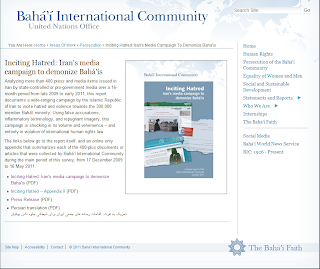
The United Nations Office of the Baha'i International Community has just issued a report titled "Inciting Hatred: Iran's media campaign to demonize Bahá'ís" which Analyzes more than 400 press and media items issued in Iran by state-controlled or pro-government media over a 16-month period from late 2009 to early 2011, this report documents a wide-ranging campaign by the Islamic Republic of Iran to incite hatred and violence towards the 300,000 member Bahá'í minority. Using false accusations, inflammatory terminology, and repugnant imagery, this campaign is shocking in its volume and vehemence – and entirely in violation of international human rights law.

  • Inciting Hatred: Iran's media campaign to demonize Baha'is (PDF)
  • Inciting Hatred -- Appendix II (PDF)
  • Press Release (PDF)
  • Persian translation (PDF)
    تحریک به نفرت: اقدامات رسانه های جمعی ایران برای شیطانی جلوه دادن بهائیان

  • A story, published 21 October 2011, on the Baha'i World News Service states the following:

     — In a wide-ranging media campaign that has gone largely unnoticed outside of Iran, hatred and discrimination are being systematically stirred up against the country's 300,000-member Baha'i minority.
    In a report released today, the Baha'i International Community documents and analyzes more than 400 press and media items over a 16-month period, that typify an insidious state-sponsored effort to demonize and vilify Baha'is, using false accusations, inflammatory terminology, and repugnant imagery.
    "This anti-Baha'i propaganda is shocking in its volume and vehemence, its scope and sophistication," said Bani Dugal, Principal Representative of the Baha'i International Community to the United Nations.
    "It's all cynically calculated to stir up antagonism against a peaceful religious community whose members are striving to contribute to the well-being of their society," she said.
    Titled Inciting Hatred: Iran's media campaign to demonize Baha'is, the report's main conclusions are:
    • anti-Baha'i propaganda originates with – and is sanctioned by – the country's highest levels of leadership, including Supreme Leader Ayatollah Ali Khamenei, who gave a highly discriminatory speech in the holy city of Qom a year ago;
    • the campaign spurns international human rights law and norms, including a precedent-setting resolution passed earlier this year at the United Nations Human Rights Council that specifically condemns and combats the negative stereotyping and incitement to hatred of religious minorities;
    • Baha'is are branded as "outsiders" in their own land and as enemies of Islam in a manner that is clearly calculated to provoke the religious sensibilities of Iranian Shiite Muslims;
    • the campaign aims to deflect attention away from calls for democracy in Iran by using Baha'is as an all-purpose "scapegoat" – and, in so doing, to smear those who oppose the government as well as human rights campaigners as Baha'is, "as if that were the most heinous crime."
    • the authorities disseminate ludicrous conspiracy theories including that foreign broadcasters, in particular the British Broadcasting Corporation (BBC) and Voice of America (VOA), are controlled by or under the influence of Baha'is because they report stories about human rights violations in Iran;
    "The diverse content of these attacks demonstrates tremendous effort and commitment of resources by the Islamic Republic," says the report.
    "Many attacks are built on gross distortions of Baha'i history; some attempt a strategy of guilt by association through lumping Baha'is together with completely unrelated groups – such as 'Satanists' or the Shah's secret police; still others deploy a tactic of connecting Baha'is with 'opponents' of the regime, which allows the Government to discredit both the Baha'is and its opponents in a single transaction. The campaign makes extensive use of the World Wide Web, and often uses graphic images that portray Baha'is as fiendish ghouls or agents of Israel."
    Bani Dugal said the demonization of Iran's Baha'i community is a matter that deserves the attention of governments, international legal institutions, and fair-minded people everywhere.
    "The campaign not only clearly violates international human rights law," she said, "it also utterly contradicts Iran's long-standing claim at the UN and elsewhere that it is working to support measures to outlaw or condemn hate speech directed against religions or religious followers."
    "The parallels between the campaign of anti-Baha'i propaganda in Iran today and other state-sponsored, anti-religious campaigns of the past are undeniable. History shows us that such campaigns are among the foremost predictors of actual violence against religious minorities – or, in the worst case, precursors of genocide.
    "It is time for Iran to be told that such egregious violations of international law and norms cannot be tolerated," said Ms. Dugal.

    The report in its entirety can be accessed HERE....

    Monday, September 20, 2010

    Standards of Justice Demand More Than Just a Reduced Sentence!

    According to recent reports, the prison sentence of the seven Iranian Baha'i leaders has been reduced from 20 years to 10 years. Even though this development appears to show an element of good will, the fact of their innocence must never be ignored and nothing short of their immediate and unconditional release would satisfy the accepted standards of justice. Posted below is a reprint of the article published recently in the Baha'i World News Service reporting on this decision--a decision that must not mitigate the need to go beyond the mere reduction of an unjust sentence. The judiciary must fulfill its responsibilities toward the Iranian public and do justice by releasing these innocent seven.


    Prison sentences for Iran's Baha'i leaders reportedly reduced to 10 years

    16 September 2010

    — The 20-year prison sentences received by Iran's seven Baha'i leaders have reportedly been reduced.

    The Baha'i International Community has learned that the lawyers representing the seven were informed orally yesterday that the 20-year jail terms have now been changed to 10 years.

    The seven - Fariba Kamalabadi, Jamaloddin Khanjani, Afif Naeimi, Saeid Rezaie, Mahvash Sabet, Behrouz Tavakkoli, and Vahid Tizfahm - were all members of a national-level group that, with the Iranian government's knowledge, helped see to the minimum spiritual needs of Iran's 300,000-strong Baha'i community.

    The trial of the seven consisted of six brief court appearances which began on 12 January this year after they had been incarcerated without charge for 20 months. They were allowed barely one hour's access to their legal counsel during that time. The trial ended on 14 June.

    The defendants were accused of propaganda activities against the Islamic order and the establishment of an illegal administration, among other allegations. All the charges were completely and categorically denied.

    The seven were moved from Evin Prison after receiving their sentence to Gohardasht prison in Karaj.

    Reports of the 20-year sentence provoked a chorus of condemnation from governments around the world - including Australia, Canada, France, Germany, the Netherlands, New Zealand, the U.K. and the U.S.A. The European Union and the President of the European Parliament also joined the protest, along with numerous human rights organizations, other groups and countless individuals.

    Special Report - "The Trial of the Seven Baha'i Leaders"

    The Baha'i World News Service has published a Special Report which includes articles and background information about the seven Iranian Baha'i leaders - their lives, their imprisonment, trial and sentencing - and the allegations made against them. It also offers further resources about the persecution of Iran's Baha'i community.

    The Special Report can be read here.

    Sunday, August 22, 2010

    Omid Djalili on the Baha'is in Iran

    This video, regarding the current situation of the Baha'is in Iran and the imprisonment of their leaders, was just released by the well known British comedian Omid Djalili. It speaks clearly and pointedly to the current dire situation and is indeed worth viewing:

    Sunday, August 15, 2010

    Strong Statement by the International Baha'i Community

    The Baha'i International Community has just released its strongest statement to date regarding the recent flagrant violation of the judicial process in Iran that led to the sentencing of the seven innocent Baha'i leaders to 20 years imprisonment. In this statement, Ms. Bani Dugal, the principal representative of the Baha'i International Community to the United Nations, also said "the Baha'i International Community condemns the widespread injustice perpetrated by the Iranian authorities against others throughout Iran, whether religious minorities, journalists, academics, civil society activists, women's rights defenders, or others."

    The link to the news article can be found here, and the entire text of the article is posted below:

    Harsh sentences are a judgment against an entire religious community
    15 August 2010

    — The harsh prison sentences handed down to seven Iranian Baha'i leaders who are absolutely innocent of any wrongdoing is a judgment against an entire religious community, the Baha'i International Community said today.

    Nobel laureate Shirin Ebadi, whose Defenders of Human Rights Center represented the Baha'i defendants, said she was "stunned" by the reported 20-year jail terms.

    "I have read their case file page by page and did not find anything proving the accusations, nor did I find any document that could prove the claims of the prosecutor," said Mrs. Ebadi in a television interview, broadcast on 8 August by the Persian-language service of the BBC.

    The flagrantly unjust sentence has provoked vehement protest from governments throughout the world - including Australia, Canada, France, Germany, the Netherlands, the U.K. and the U.S.A. The European Union and the President of the European Parliament have also joined the chorus of condemnation, along with numerous human rights organizations - including Amnesty International, Human Rights Watch and FIDH - as well as other groups, and countless individuals. Read international reaction here.

    "The trumped-up charges, and the total lack of any credible evidence against these seven prisoners, reflects the false accusations and misinformation that Iran's regime has used to vilify and defame a peaceful, religious community for an entire generation," said Bani Dugal, the principal representative of the Baha'i International Community to the United Nations.

    Ms. Dugal noted that the seven have reportedly been transferred to Gohardasht Prison in Karaj, a facility about 20 kilometers west of Tehran. "The reason for the move is not yet known and it is too early to assess the implications for the prisoners," she said. "It does, however, clearly impose an added burden to their families, who now have to travel outside Tehran to visit their loved ones."

    • The seven Baha'i leaders imprisoned in Tehran are pictured together with their spouses, before their arrest in 2008.

    • The arrest of the seven Baha'i leaders in March and May 2008 was ominously reminiscent of episodes in the early 1980s when Iranian authorities rounded up and… »

    • Ten Baha'i women, aged between 17 and 57, were hanged in Shiraz on 18 June 1983, convicted of teaching classes to Baha'i children. The youngest was Mona… »

    • The House of the Bab in Shiraz, Iran, one of the most holy sites in the Baha'i world, was destroyed by Revolutionary Guardsmen in 1979 and later razed by the… »

    • Interior of the house of Mirza Abbas Nuri, the father of Baha'u'llah. This architectural landmark in Tehran, acclaimed as an outstanding example of period… »

    • Gravestones in the Baha'i cemetery near Najafabad were left in a heap by a bulldozer that destroyed the burial ground in September 2007.

    • In May 2007, the home of a Baha'i in the village of Ivel was burned by unknown arsonists. In June 2010, homes belonging to some 50 Baha'i families were demolished… »

    • A Baha'i family in Fars province narrowly escaped injury in June 2008 when an arsonist poured gasoline and caused an explosion and fire that destroyed a hut near… »

    The seven - Fariba Kamalabadi, Jamaloddin Khanjani, Afif Naeimi, Saeid Rezaie, Mahvash Sabet, Behrouz Tavakkoli, and Vahid Tizfahm - were all members of a national-level group that, with the government's knowledge, helped see to the minimum spiritual needs of Iran's Baha'i community.

    "That these manifestly innocent people should each be jailed for 20 years after a sham trial is utterly reprehensible," said Ms. Dugal. "We ask the Iranian government: Does such a callous disregard for justice contribute to the advancement of Iranian society? Or does it, rather, further diminish your credibility among your own people and among the nations of the world?"

    Ms. Dugal said the Baha'i International Community condemns the widespread injustice perpetrated by the Iranian authorities against others throughout Iran, whether religious minorities, journalists, academics, civil society activists, women's rights defenders, or others.

    A catalogue of abuses

    Even before the sentences were pronounced, the arrest, detention and trial of the seven leaders was a two-year long catalogue of abuses and illegal actions, both under international law and Iranian statutes.

    "Iranian law requires that detainees be quickly and formally charged with crimes. The seven Baha'is were held at least nine months before any word of the charges against them were uttered by officials, and even then it was at a press conference, not in a court setting," said Ms. Dugal.

    "For a long time, the seven were also denied access to lawyers. When they were allowed contact, it lasted barely an hour before their so-called trial began," she said.

    "Detainees who have been charged also have the right to seek bail and to be released pending trial. The seven have continually been denied bail, despite numerous requests."

    "These are black and white concerns, not subject to interpretation," she said.

    Systematic persecution

    Since 1979, Iran's 300,000-strong Baha'i community has endured a government-sponsored, systematic campaign of religious persecution. In its early stages, more than 200 Baha'is were killed and at least 1,000 were imprisoned, solely because of their religious beliefs.

    In the early 1990s, the government shifted its focus to social, economic and cultural restrictions aimed at slowly suffocating the community and its development. Measures included depriving Baha'is of their livelihood, destroying their cultural heritage, and barring their young people from higher education.

    Since 2005, there has been a resurgence of more extreme forms of persecution, with increasing arrests, harassment, violence, and arson attacks on Baha'i homes and businesses.

    This systematic campaign of attacks has included:

    • the creation and circulation of lists of Baha'is with instructions that the activities of the members of the community be secretly monitored;
    • dawn raids on Baha'i homes and the confiscation of personal property;
    • summary arrest and interrogation of Baha'is throughout the nation;
    • daily incitement to hatred of the Baha'is in all forms of government-sponsored mass media;
    • the holding of anti-Baha'i symposia and seminars organized by clerics followed by orchestrated attacks on Baha'i homes and properties in the cities and towns where such events are held;
    • destruction of Baha'i cemeteries across the country;
    • demolition of Baha'i Holy Places and Shrines;
    • acts of arson against Baha'i homes and properties;
    • denying Baha'is access to higher education;
    • vilification of Baha'i children in their classrooms by their teachers;
    • the designation of numerous occupations and businesses from which Baha'is are debarred;
    • refusal to extend bank loans to Baha'is;
    • the sealing of Baha'i shops;
    • refusal to issue or renew business licenses to Baha'is;
    • harassment of landlords of Baha'i business tenants to force their eviction.

    Specific examples of persecution in recent weeks include:

    • homes belonging to some 50 Baha'i families in the remote northern village of Ivel being demolished as part of a long-running campaign to expel them from the region;
    • the intelligence service that has an office in every university and governmental organization in Iran instructing university officials at Shaheed Beheshti University not to have any business dealings with companies owned by Baha'is;
    • two Baha'i-owned optical shops in Tehran receiving warning letters from the Opticians' Trade Union to close down, after similar shops in Khomein and Rafsanjan were forced to close;
    • an anti-Baha'i tract, titled Supporters of Satan, being widely distributed in the city of Kerman. The tract purveys misrepresentations of Baha'i history, including falsely asserting that the Baha'i Faith was a creation of the British;
    • truckloads of construction refuse and soil being dumped on graves in the Baha'i cemetery of Boroujerd. Buildings in the Baha'i cemetery in Mashhad - including the place where the prayers were recited - were severely damaged by heavy machinery.

    Currently, including the seven leaders, some 50 Iranian Baha'is are in prison, some of them incarcerated for months at a time in solitary confinement cells, designed only for temporary detention.

    "The pattern is clear: the Iranian government is systematically persecuting Baha'is for no reason other than their religious beliefs," said Ms. Dugal.

    "The government knows that the Baha'i teachings advocate non-violence and non-involvement in politics. Yet this campaign is rigorously pursued with one aim in sight - the eradication of the Baha'i community as a viable entity in Iran," she said.

    "In this light, the imprisonment of the seven must be seen as an attempt to decapitate a community's leadership, and strike a devastating blow to Iran's largest non-Muslim religious minority."

    Special Report - "The Trial of the Seven Baha'i Leaders"

    The Baha'i World News Service has published a Special Report which includes articles and background information about the seven Iranian Baha'i leaders - their lives, their imprisonment, trial and sentencing - and the allegations made against them. It also offers further resources about the persecution of Iran's Baha'i community.

    The Special Report can be read at: http://news.bahai.org/human-rights/iran/yaran-special-report/.

    Friday, August 13, 2010

    U.S.A. joins Netherlands, U.K. and European Union in chorus of condemnation at prison sentences

    The Baha'i World News Service continues to provide regular up-to-date information on developments related to the sentencing of the Baha'i leaders in Iran and the systematic, State-sponsored persecution and oppression of the Baha'is in that country. Today, the news release reported on further strong condemnation by the governments of the United States, the Netherlands, the United Kingdom and the European Union. The entire article can be viewed here and is quoted below:

    13 August 2010

    — The United States of America has said it "strongly condemns" the sentencing of seven Iranian Baha'i leaders to 20 years imprisonment.

    U.S. Secretary of State Hillary Clinton described the act as a "violation of Iran's obligations under the International Covenant on Civil and Political Rights."

    In a statement dated 12 August, Secretary Clinton said that the United States is "deeply concerned with the Iranian government's continued persecution of Baha'is and other religious minority communities in Iran."

    "Freedom of religion is the birthright of people of all faiths and beliefs in all places," she said.

    "The United States is committed to defending religious freedom around the world, and we have not forgotten the Baha'i community in Iran."

    "We will continue to speak out against injustice and call on the Iranian government to respect the fundamental rights of all its citizens in accordance with its international obligations," said Secretary Clinton.

    The statement from the United States came as reports reached the Baha'i International Community that the seven Baha'i leaders have been transferred from Tehran's Evin Prison, where they had been incarcerated for more than two years.

    • The seven Baha'i prisoners, photographed several months before their arrest, are, in front, Behrouz Tavakkoli and Saeid Rezaie, and, standing, Fariba Kamalabadi,… »

    They have been taken to Gohardasht Prison - also known as Rajaishahr Prison - in Karaj, some 20 kilometers west of the Iranian capital.

    Other support

    Support for the prisoners has also been expressed by the European Union, in a statement made by Baroness Catherine Ashton, the E.U.'s High Representative for Foreign Affairs and Security Policy.

    "The European Union expresses its serious concern about the sentencing of seven Baha'i leaders in Iran to 20 years imprisonment and calls for their immediate release," the declaration said.

    "The verdict appears to be based on the defendants belonging to a religious minority and the judicial process was seriously flawed, respecting neither Iran's international commitments under the International Covenant for Civil and Political Rights (ICCPR) nor its national legislation regarding fair trial rights."

    "The EU recalls that freedom of thought, conscience and religion are fundamental rights
    which must be guaranteed under all circumstances according to article 18 of the ICCPR
    which the Islamic Republic of Iran has signed up to and ratified."

    "The EU calls on Iran to put an end to the persecution of the Baha'i community," said Baroness Ashton.

    In the United Kingdom, Foreign Secretary William Hague said he was "appalled" to hear of the prison sentences, describing them as a "shocking example of the Iranian state's continued discrimination against the Baha'is."

    "It is completely unacceptable," said Mr. Hague in a statement released on Wednesday.

    "The Iranian judiciary has repeatedly failed to allay international and domestic concerns that these seven men and women are guilty of anything other than practicing their faith. It is clear that from arrest to sentencing, the Iranian authorities did not follow even their own due process, let alone the international standards to which Iran is committed. The accused were denied proper access to lawyers, and there is evidence that the trial was neither fair nor transparent."

    "I call on the Iranian authorities urgently to consider any appeal against this decision, and to cease the harassment of the Baha'i community. I further call on the Iranian Government to ensure that the rights of all individuals are fully protected, without discrimination, and that it fulfils its obligations to its own citizens as set out in the Iranian constitution," said Mr. Hague.

    The Netherlands' Minister of Foreign Affairs, Maxime Verhagen, expressed his country's concern at "the poor execution of the judicial process in the case of the seven Baha'i leaders" and its fears that the arrest and sentence is "based solely on discrimination of religious belief."

    "That these people seem to be condemned because of their faith is shocking," said Mr. Verhagen.

    "I urge the Iranian authorities to abide by their international human rights obligations. The Baha'i leaders have a right to a fair trial and they must be released as soon as possible."

    Australia, Canada, France, Germany and the President of the European Parliament earlier expressed strong statements of concern at news that Iran's seven Baha'i leaders have each received prison sentences of 20 years, as reported by the Baha'i World News Service on 11 August.

    Human rights organizations

    Human rights organizations - including Amnesty International, FIDH and Human Rights Watch - have issued calls for the prisoners to be released, for the judgment to be annulled, and for Iran to demonstrate that the trial was fair and in accordance with international standards.

    "This is an outrageous miscarriage of justice and one more example of how the Iranian regime is a gross violator of human rights and religious freedoms," said Leonard Leo, chair of the U.S. Commission on International Religious Freedom. "The prosecutions and sentences are, pure and simple, politically and religiously motivated acts, and the Commission calls for the unconditional release of these seven individuals."

    Diane Ala'i, representative of the Baha'i International Community to the United Nations in Geneva said the actions of the Iranian authorities, against individuals who are innocent of any crime, represent an "outrageous travesty of justice that defies adequate description."

    "At every stage of the case - from their illegal detention and the brutal conditions of their confinement, through the trial, and now to a completely unlawful imprisonment - not even the most basic and fundamental norms of justice were respected."

    "We welcome the message coming loud and clear from governments and human rights organizations throughout the world. It is time for Iran to right the wrongs it has done."

    (The International Reaction page of the Baha'i World News service is regularly updated with responses from governments, nongovernmental organizations, and prominent individuals. The Media Reports page presents a digest of media coverage from around the world.)

    Thursday, August 12, 2010

    International Outcry at Prison Sentences for Iranian Baha'i Leaders

    An article, published by the Baha'i World News Service (BWNS), reported on the international outcry at the prison sentences for the ad hoc group, formerly known as Yaran [Friends in Iran], that helped attend to the minimal needs of Iran's Baha'is, numbering over 300,000 individuals and representing the largest religious minority in that country. In order to access the BWNS website, please click here. The entire news release is printed below:


    International outcry at prison sentences for Iranian Baha'i leaders
    11 August 2010

    — Reports that seven Iranian Baha'i leaders have each received prison sentences of 20 years have been met with condemnation from governments and human rights organizations around the world.

    Australia, Canada, France, Germany – and the President of the European Parliament – have all expressed strong statements of concern.

    They are calling for the prisoners to be released on bail, for an annulment of the judgment, and for Iran to demonstrate that the trial was fair and in accordance with international standards.

    Canada's Minister of Foreign Affairs, Lawrence Cannon, said that his country was "deeply disturbed" by the sentences that were "passed without either written judgments or due process." He urged Iran to grant bail to the prisoners.

    Germany described the outcome of the trial as a "massive setback for all those who engage themselves for the promotion of human dignity and human rights in Iran."

    Markus Loning, commissioner for human rights and humanitarian aid at Germany's Foreign Office, said Iran must annul the judgment and "provide a fair and transparent court procedure."

    "There are major doubts as to the compliance with the basic legal rights during the judicial proceedings," he said.

    France expressed its "consternation" at the 20-year jail term.

    At a press briefing, Christine Fages, a French Foreign Ministry spokeswoman, stated that Iranian authorities should stop persecuting Baha'is and other religious minorities and "respect the freedom of religion and conscience as defined by the International Covenant on Civil and Political Rights, to which Iran has freely signed up."

    Australia has also shared its deep concern at the sentences. "We continue to call on Iran to ensure that all trials are fair and transparent and are conducted in accordance with Iran's international obligations," said a spokesman for the Australian government's Department of Foreign Affairs and Trade.

    In a statement issued today, the President of the European Parliament – Jerzy Buzek – called the sentences "a shocking signal and an immense disappointment for all who have hoped for an improvement of the human rights situation in Iran."

    "Iran has committed itself to international standards and I underline that this includes also the respect and protection of religious freedom," he said.

    International human rights organizations have additionally joined the chorus of protest against the reported prison sentences.

    The International Campaign for Human Rights in Iran said the sentencing of the Baha'i leaders was "politically motivated, discriminatory, unjust, and illegal under Iranian and international law."

    "They have been sentenced for being Baha'is, nothing else, and their incarceration thus expresses a policy of oppression of the Baha'i Faith and its members," said Aaron Rhodes, spokesperson for the Campaign.

    Amnesty International described the Baha'i leaders as "prisoners of conscience jailed solely on account of their beliefs or peaceful activities on behalf of the persecuted Baha'i minority."

    "The seven were held for months without charge before being subjected to a parody of a trial. They must be immediately released," said Hassiba Hadj Sahraoui, Amnesty's Middle East and North Africa deputy director.

    In a statement, the International Federation for Human Rights (FIDH) and the Iranian League for the Defence of Human Rights (LDDHI) asked for the Iranian government to "act in conformity with the Universal Declaration of Human Rights as well as international human rights instruments ratified by the Islamic Republic of Iran."

    Human Rights Watch demanded the Iranian judiciary to release the seven immediately "given that no evidence appears to have ever been presented against them, and they have not been given a fair and public trial."

    "For more than two years now the Iranian authorities have utterly failed to provide the slightest shred of evidence indicating any basis for detaining these seven Baha'i leaders, let alone sentencing them to 20 years in prison," said Joe Stork, deputy director of the Middle East division at Human Rights Watch.

    Iran should take concrete steps that show it is committed to protecting the fundamental rights of Baha'is, said Mr. Stork

    "The immediate and unconditional release of the seven Baha'i leaders would be a good start," he said.

    Diane Ala'i, Baha'i representative to the United Nations in Geneva, said the Baha'i International Community deeply appreciates the committed support offered so far by governments and human rights organizations.

    "These statements demonstrate that increasing numbers of people of all races and religions throughout the world want to see justice done in Iran – not just for the Baha'is but all of its citizens who face gross human rights violations," said Ms. Ala'i.

    "For how much longer will the Iranian authorities remain oblivious to these upraised voices?" she said.

    Sunday, August 08, 2010

    Iran's Baha'i Leaders Reportedly "Sentenced"

    The Baha'i World News Service has just released the following information regarding the imprisoned seven Baha'i leaders in Iran:

    Reports say Iran's Baha'i leaders "sentenced"
    8 August 2010

    NEW YORK — The Baha'i International Community has received reports indicating that seven Iranian Baha'i leaders have each received jail sentences of 20 years.

    The two women and five men have been held in Tehran's notorious Evin prison since they were arrested in 2008 – six of them on 14 May and one of them two months earlier.

    "If this news proves to be accurate, it represents a deeply shocking outcome to the case of these innocent and harmless people," said Bani Dugal, the principal representative of the Baha'i International Community to the United Nations.

    "We understand that they have been informed of this sentence and that their lawyers are in the process of launching an appeal," said Ms. Dugal.

    The prisoners – Fariba Kamalabadi, Jamaloddin Khanjani, Afif Naeimi, Saeid Rezaie, Mahvash Sabet, Behrouz Tavakkoli, and Vahid Tizfahm – were all members of a national-level group that helped see to the minimum needs of Iran's 300,000-strong Baha'i community, the country's largest non-Muslim religious minority.

    The trial of the seven consisted of six brief court appearances which began on 12 January this year after they had been incarcerated without charge for 20 months, during which time they were allowed barely one hour's access to their legal counsel. The trial ended on 14 June.

    The defendants were accused of espionage, propaganda activities against the Islamic order, and the establishment of an illegal administration, among other allegations. All the charges are completely and categorically denied.

    Saturday, March 20, 2010

    Amnesty International Calls for Nowruz Action

    Amnesty International has launched an action for Nowruz [Naw‐Rúz]—which is not only a Baha'i Holy Day but also an ancient holiday for the people of Iran. To mark this time‐honored festival, Amnesty International has launched a campaign for individuals around the world to send messages of goodwill to prisoners of conscience in Iran. Mirroring the "Haft Sin"—the seven dishes beginning with the letter "s" that are traditionally placed on the Nowruz feast table—Amnesty International has selected seven cases for this campaign, one of which is the unjust imprisonment for nearly two years now of the seven former members of the now dissolved ad hoc administrative group known as the Yárán (Friends-in-Iran). Regarding these imprisoned Baha'is, the call for action states:

    Seven leaders of Iran’s Baha’i community are currently on trial on serious, but baseless, charges that could lead to the imposition of the death penalty. Although they have done nothing more than peacefully practice their religion, they have been charged with spying for Israel, for “insulting religious sanctities,” with “propaganda against the system” and with being “mofsed fil arz” or “corruption on earth.” They have denied all charges.

    The seven include two women, Fariba Kamalabadi and Mahvash Sabet, and five men: Jamaloddin Khanjani, Afif Naeimi, Saeid Rezaei, Behrouz Tavakkoli and Vahid Tizfahm. All are leading members of a group responsible for the Baha’i community’s religious and administrative affairs. Mahvash Sabet who acted as the group’s secretary, was arrested on 5 March 2008. The others were arrested on 14 May 2008. All seven are held in Section 209 of Evin Prison in Tehran, which is run by the Ministry of Intelligence. They have only been allowed very limited access to their lawyers while they have been in custody.

    The first session of their trial—which had been repeatedly postponed—finally began before a Revolutionary Court in Tehran on 12 January 2010. Their next court date is scheduled for 10 April. Amnesty International has repeatedly criticized proceedings held in Iran’s Revolutionary Courts for their failure to adhere to international standards for fair trials. In fact, the authorities attempted to bar the Baha’is’ lawyers from the courtroom on 12 January and only allowed them access after they insisted upon entering.

    You can send Nowruz greetings to the seven Baha’is to:

    Baha’i International Community
    15 route des Morillons
    1218 Grand Saconnex Switzerland

    Saturday, January 16, 2010

    The Ominous Threat to the Baha'is of Iran

    Here is a brilliantly written analysis on CBC News (Canadian Broadcasting Corporation) about the ominous current threat to the Baha'is of Iran. Its Canadian author is Brian Stewart, whose biography describes him as:
    One of this country's most experienced journalists and foreign correspondents, Brian Stewart was, until his retirement in the summer of 2009, a Senior Correspondent with CBC's flagship news program, The National, and the host of Newsworld's international affairs program.

    He is currently a Distinguished Senior Fellow at the Munk Centre for International Studies at the University of Toronto.

    In almost four decades of reporting, he has covered many of the world's conflicts and reported from 10 war zones, from El Salvador to Beirut and Afghanistan. Though retired, he continues to write a regular column for CBCNews.ca on international affairs and will be contributing to CBC documentary reports from time to time.

    In its introduction, the report prepares the reader to understand the depth and the seriousness of the motives and strategy undertaken by Iran's regime in its grand scheme to isolate and destroy the Iranian Baha'i community. The analysis, published on the CBC website on 13 January 2010, and titled "The scapegoating of Iran's Baha'is", begins by stating:
    Oppressive regimes attack human rights on two levels. The most obvious assault, as we have seen in Iran in recent months, aims at suppressing political opponents and protest.

    But history teaches us that we need to worry about a secondary level of attack as well, the kind that takes place in the shadows.

    That's the persecution directed at weak segments of the population targeted for special repression, the old and sickening story in which minority religious or ethnic groups are singled out as scapegoats of the state, blamed for all its troubles.

    This is why we need to be very concerned now for the safety of Iran's approximately 300,000 Baha'is, followers of the gentle, internationalist Baha'i faith, the country's largest minority religion.

    The Baha'i religion has been officially banned in Iran since 1979. But now, in a textbook case of scapegoating, Iran's theocratic leaders are blaming the Baha'is for stirring up all the unrest sweeping the country today.

    They are even accusing them of stockpiling firearms, which seems ludicrous given the peaceful nature of the religion.

    But in an ominous nod to even more persecution ahead, Tehran argues that the Baha'is are doing this in conjunction with Israel, which is really directing the whole conspiracy.

    Read the rest of the report here....

    Tuesday, January 12, 2010

    Iran's Trial of Baha'i Leaders: First Session Ends...No Date Set for Future Sessions

    According to the Baha'i International Community, "the trial of seven imprisoned Baha'i leaders began today in Iran. Initial reports indicate that the trial was marked by numerous violations of legal due process."

    The report adds: "After about three hours, the hearing ended. Authorities indicated that today’s proceeding was merely the 'first session,' and no date for future sessions was given."

    The entire story is posted below with permission:

    First session ends in trial of Baha'i leaders in Iran
    12 January 2010
    __________________________________________________________

    GENEVA — The trial of seven imprisoned Baha'i leaders began today in Iran. Initial reports indicate that the trial was marked by numerous violations of legal due process.

    After about three hours, the hearing ended. Authorities indicated that today’s proceeding was merely the “first session,” and no date for future sessions was given.

    "We understand that no observers were allowed in the court," said Diane Ala'i, the Baha'i International Community's representative to the United Nations in Geneva. "We find this completely outrageous, given that these seven have been held purely because of their religious beliefs, in total contradiction to any human rights standards.

    "We understand that even the lawyers had to argue their way inside the court – lawyers who in any case had virtually no access to the accused for nearly two years.

    "At the same time, the prisoners' interrogators from the Ministry of Intelligence and a film crew were seen going in, raising questions about the nature of the trial," she said.

    Ms. Ala'i also noted that an Iranian Web site linked to state-run television posted a story Monday evening announcing that the trial had already begun and listing the same baseless accusations made in the past against the seven.

    "In any event, all of these accounts point to a trial that is highly irregular, very similar to the show trials that have been held in Iran in recent months," she said.

    The seven are Mrs. Fariba Kamalabadi, Mr. Jamaloddin Khanjani, Mr. Afif Naeimi, Mr. Saeid Rezaie, Mrs. Mahvash Sabet, Mr. Behrouz Tavakkoli, and Mr. Vahid Tizfahm.

    All but one of the group were arrested on 14 May 2008 at their homes in Tehran. Mrs. Sabet was arrested on 5 March 2008 while in Mashhad. They have been held in Tehran's Evin prison ever since, spending their first year there without formal charges or any access to lawyers.

    "Whatever happens, it is clear that the trial of these seven innocent people represents the trial of an entire religious community, and is an attempt to further intimidate and ostracize all Iranian Baha'is simply because they hold a different religious viewpoint from those in power."

    Note: The headline and article were updated at 9 p.m. on 12 January 2010 (Geneva time).
    _______________________________________
    Blog Update


    Some world media coverage, opinions and statements:

    1) CNN
    2) Washington TV (Shirin Ebadi's statements).
    3) Guardian (Cherie Blair's statements).
    4) The Globe and Mail (Howard Adelman).
    5) US Department of State (Philip Crowley).
    6) United States Commission on International Religious Freedom (USCIRF).
    7) BBC (Lembit Opik).
    8) CBC (Brian Stewart: extensive article)
    9) Canada's Foreign Affairs

    Shirin Ebadi's interview:

    Saturday, January 09, 2010

    Iran: Another Wave of False & Outrageous Allegations

    In a statement published today by the Baha'i International Community, the false and outrageous allegations lodged against the Baha'is by Iran's government were categorically rejected.

    The story in its entirety is posted below with permission:

    Baha'i International Community rejects allegations that arrested Baha'is had weapons in homes
    9 January 2010
    _________________________________________________________

    GENEVA — The Baha'i International Community today categorically rejected new allegations by the Iranian government that arms and ammunition were found in the homes of Baha'is who were arrested in Tehran last Sunday.

    "This is nothing less than a blatant lie," said Diane Ala'i, the Baha'i International Community's representative to the United Nations in Geneva. "Baha'is are by the most basic principles of their faith committed to absolute nonviolence, and any charge that there might have been weapons or 'live rounds' in their homes is simply and completely unbelievable.

    "Without doubt, these are baseless fabrications devised by the government to further create an atmosphere of prejudice and hatred against the Iranian Baha'i community. For more than a century Baha'is have suffered all manner of persecution in Iran and have not resorted to armed violence, and everyone knows this. Unfortunately, the Iranian government is once again resorting to outright falsehoods to justify its nefarious intentions against the Baha'i community. It should know that these lies will have no credibility whatsoever.

    "We are particularly concerned by the fact that these accusations come just days before the scheduled trial of seven Baha'i leaders, who have been locked up for nearly two years on equally unfounded charges," she said.

    "All of these latest accusations are so far-fetched as to be ludicrous if they were not so obviously aimed at putting innocent lives at risk," she said. "As we have said before, rather than accepting responsibility for the turmoil in the country, the Iranian government seeks to lay the blame on others, including foreign powers, international organizations and media outlets, students, women, and terrorists."

    On Friday, several news agencies reported that Tehran's general prosecutor, Abbas Jafari Dolatabadi, said the Baha'is who were arrested on Sunday "were arrested because they played a role in organizing the Ashura protests and namely for having sent abroad pictures of the unrest."

    "They were not arrested because they are Baha'is," said Mr. Dolatabadi, according to Agence France Presse. "Arms and ammunition were seized in the homes of some of them."

    Ms. Ala'i also rejected Mr. Dolatabadi's assertions that Baha'is were involved in the planning of the Ashura demonstrations, or in any violent or subversive activity related to the recent turmoil in Iran.

    "For the past 30 years, Iranian Baha'is have been subjected to the worst forms of persecution, ranging from arbitrary execution to the exclusion of their children from school," said Ms. Ala'i. "Yet they have responded only through means that are peaceful and legal."

    Seven Baha'is leaders are scheduled to go on trial on Tuesday on trumped-up charges of espionage, "insulting religious sanctities," and "propaganda" against the government. They have been held in Evin prison since mid-2008. The seven are Mrs. Fariba Kamalabadi, Mr. Jamaloddin Khanjani, Mr. Afif Naeimi, Mr. Saeid Rezaie, Mrs. Mahvash Sabet, Mr. Behrouz Tavakkoli, and Mr. Vahid Tizfahm.

    On Sunday, 13 Baha'is were arrested in early morning raids on their homes in Tehran. Three have been released but 10 remain detained at Evin prison.

    They are: Leva Khanjani, granddaughter of Jamaloddin Khanjani, and her husband, Babak Mobasher; Jinous Sobhani, former secretary of Mrs. Shirin Ebadi, and her husband Artin Ghazanfari; Mehran Rowhani and Farid Rowhani, who are brothers; Payam Fanaian; Nikav Hoveydaie; and Ebrahim Shadmehr and his son, Zavosh Shadmehr.

    Tuesday, December 22, 2009

    Grand Views of Grand Ayatollah Hossein Ali Montazeri

    Grand Ayatollah Hossein Ali Montazeri died on 20 December 2009. As some may recall, in May 2008, he expressed his opinion regarding the rights of the Baha'is of Iran in a "fatwa" (a decree) previously translated and published here.

    The fatwa reads as follows:
    In the Name of God

    With greetings,

    The congregation of Baha'ism not having the heavenly book like those of Jews, Christians, and Zoroastrians in the constitution [of Islamic republic of Iran], are not considered one of the religious minorities. However, since they are the citizens of this country, they have the rights of a citizen and to live in this country. Furthermore, they must benefit from the Islamic compassion which is stressed in Quran and by the religious authorities.

    God-willing you will be successful,
    (Wal Salam–u Alaykum Warahmatullah)
    [Peace and Mercy of God be upon you]

    25 Urdibehesht 1387 [14 May 2008]

    Signature: Montazeri [Seal]

    In its 20 December edition, the UK's Guardian published an article about the life of this eminent religious figure. In its ending paragraph, it states:
    His political opposition to injustice may represent an important act of defiance. But what Montazeri would wish to be remembered for may be his attempt to change the basis of Shia jurisprudence from protecting the right of the faithful to protecting the right of the citizens. This made him issue a historic statement earlier this year calling for respect for the right of the Baha'i people in Iran as citizens of the country. No other leading theologian has ever dared to issue such fatwa. He expanded the boundaries of Shia jurisprudence into the realm of human rights and wrote a book on the subject. He may not have become the leader of Iran, but he led conservative jurists into new areas in order to reform old rules.

    He is survived by his wife, four daughters and two sons.

    • Hossein Ali Montazeri, religious leader, born 1922; died 20 December 2009

    To read the entire article, please check this link....

    Thursday, December 10, 2009

    Imprisoned Iran's Baha'i Leaders Listed on Time's Top Ten List

    Time magazine has just published its lists of "The Top 10 Everything of 2009". Under the religion section, the plight of the imprisoned ad hoc group of leaders of the Baha'i Community of Iran made this list. Posted below is the story as published on Time website:

    9. Banning the Baha'i
    By AMY SULLIVAN Tuesday, Dec. 08, 2009

    The government of Iran has held seven leaders of the Baha'i faith — a monotheistic religion founded in 19th century Persia — in prison for more than a year without formal charges, access to their attorneys or a trial. The Baha'i tradition is outlawed in Iran, and some government officials have claimed that the prisoners are guilty of spying for Israel or insulting Islam. Several times, the government has scheduled capital-punishment hearings for the seven, only to cancel at the last minute. "The charges against these imprisoned Baha'is are baseless and a pretext for the persecution and harassment of a disfavored religious minority," said Leonard Leo, chairman of the U.S. Commission on International Religious Freedom, which has demanded their release. As of early December, the Baha'i leaders remained in prison with no trial scheduled.

    Sunday, October 18, 2009

    Trial of Iran's Baha'i Leaders Delayed Again

    According to the Baha'i World News Service, the trial of the dissolved ad hoc group of Baha'i leaders in Iran, scheduled for today, has been delayed again. The full story is posted below:

    Trial of seven Baha'is delayed, no new date set
    18 October 2009

    GENEVA — Although the trial of seven Baha'i leaders imprisoned in Iran for more than 17 months was scheduled for today, when attorneys and families arrived at the court offices in Tehran they were told it would not take place. No new trial date was given.

    "The time has come for these seven innocent people to be immediately released on bail," said Diane Ala'i, the Baha'i International Community's representative to the United Nations in Geneva.

    "The seven, whose only 'crime' is their religious belief, are once again in legal limbo, held with no idea of the legal process ahead of them. The whole charade cries out for an end to their unlawful detention," she said.

    The seven are Mrs. Fariba Kamalabadi, Mr. Jamaloddin Khanjani, Mr. Afif Naeimi, Mr. Saeid Rezaie, Mrs. Mahvash Sabet, Mr. Behrouz Tavakkoli, and Mr. Vahid Tizfahm.

    Official Iranian news accounts have said the seven are to be accused of "espionage for Israel, insulting religious sanctities and propaganda against the Islamic republic." They have also been charged with "spreading corruption on earth."

    Last week, it appeared likely that the trial would indeed be postponed again, since attorneys for the seven had not yet received the proper writ of notification.

    "The fact that their attorneys did not receive proper notification and that there is no new date for the trial is just one among many gross violations of Iran's own legal procedures, not to mention the violations of due process recognized by international law, that have marked this case from the beginning," said Ms. Ala'i.

    Monday, August 17, 2009

    Iran: Trial of Baha'i Leaders Postponed

    A story published on the Baha'i World News Service has reported today that the trial of the seven Baha'i leaders imprisoned in Iran has been postponed until 18 October. The following is the full text of the article:
    Trial of seven imprisoned Baha'i leaders postponed
    17 August 2009

    GENEVA — The trial of seven Baha'i leaders imprisoned in Iran has been postponed until 18 October, the Baha'i International Community learned today.

    According to Diane Ala'i, the Baha'i International Community representative to the United Nations in Geneva, following a request for postponement of the trial from Mr. Hadi Esmaielzadeh and Ms. Mahnaz Parakand – attorneys from the Defenders of Human Rights Center who are representing the seven Baha'is – the court has decided to delay the hearing for two months.

    Two senior members of the legal team, Nobel laureate Mrs. Shirin Ebadi and Mr. Abdolfattah Soltani, were unable to attend the hearing as Mrs. Ebadi is out of the country and Mr. Soltani is in prison, having been detained on 16 June 2009 in the wake of the civil unrest following the presidential election in Iran.

    "Our hope now is that our seven innocent co-religionists will be released on bail," said Ms. Ala'i.

    The seven Baha'i prisoners are Mrs. Fariba Kamalabadi, Mr. Jamaloddin Khanjani, Mr. Afif Naeimi, Mr. Saeid Rezaie, Mrs. Mahvash Sabet, Mr. Behrouz Tavakkoli, and Mr. Vahid Tizfahm. All but one of the group were arrested on 14 May 2008 at their homes in Tehran. Mrs. Sabet was arrested on 5 March 2008 while in Mashhad. They have since been held at Tehran’s Evin prison without formal charges or access to their lawyers.

    Official Iranian news accounts have said the seven are to be accused of "espionage for Israel, insulting religious sanctities and propaganda against the Islamic republic."

    The Baha'i International Community categorically rejects all charges against the seven, stating that they are held solely because of religious persecution.
    These innocent individuals must be released immediately pending their trial. They clearly do not pose any threat to anyone and they have been wrongly accused with trumped-up charges.

    Sunday, August 16, 2009

    Iran Has No Evidence!

    CNN has just published a story based on its interview with the Nobel Peace Prize laureate, Shirin Ebadi, who is the lawyer representing the detained seven former leaders of Iran's Baha'i community. The article, titled, "Lawyer: Iran has no evidence against Baha'i prisoners" was published today on CNN's world website. It starts with the following:
    (CNN) -- Iran should release seven Baha'i prisoners accused of espionage because it does not have any evidence against them, their lawyer Shirin Ebadi told CNN on Saturday.

    "In the files, in the case basically, there is nothing, no reason that basically convicts them," said Ebadi, a Nobel Peace Prize laureate.

    The trial will begin Tuesday despite the fact that one of their lawyers is behind bars and Ebadi is outside the country.

    Other attorneys can be appointed, Hassan Haddad of the Prosecutor's Office in Tehran told the state-run Islamic Republic News Agency.

    But the court must recognize the replacements, who are colleagues of Ebadi at her Tehran-based Defenders of Human Rights Center, not appoint other lawyers, Ebadi said.

    The imprisoned lawyer, Abdolfattah Soltani, is a well-known advocate with the human rights center. He was arrested in the aftermath of Iran's disputed June 12 presidential election and is being held at Evin prison, the same place where his clients are detained, according to the International Campaign for Human Rights.

    He is being held on charges of taking "measures against national security," Ebadi said. "Mr. Soltani is completely innocent."
    Read the rest of the story here....

    Saturday, August 15, 2009

    Exposing Human Rights Violations Through Art

    This is the newest artwork by Shahriar AZ, the contemporary Persian artist from New Zealand. The concept, World Art Collective, was launched by Shahriar in March 2008. The website has become the vehicle for raising awareness of human rights violations, injustices and persecution. Shahriar has always been interested in the power of technology, particularly the internet, in opening broad avenues of interaction among the world's diverse populations. He aims to engage those who have been previously unexposed to what contemporary art can achieve socially and expand beyond the confines of a traditional art gallery setting.

    The artwork is from the series called the "The Truth behind the persecution." This is an interview sound artwork about Human Rights violations against the Baha'is in Iran.


    Most recently, Shahriar exhibited his artwork in an international show in Poznan, Poland in March 2009. The exhibition, titled “STAND-UP Art about Human Rights,” focused on human rights through art. It reflected the growing need for acceptance of, and respect for diversity, dialogue and social engagement. The show comprised the work of eleven artists and activists from different countries, societies and cultures. More information about the STAND UP exhibition can be found here....

    Saturday, August 01, 2009

    US Government's Views on the Crisis Facing Iran's Baha'is

    Approximately two weeks ago, Voice of America (VOA) published the following editorial reflecting the views of the US government:

    The U.S. Commission on International Religious Freedom, a bi-partisan government body known as USCIRF, is calling for the release of 7 leaders of Iran's Baha'i community who have been imprisoned for over a year. The seven – 2 women and 5 men – were reportedly due to stand trial on July 11. According to the Baha'i World News Service, their families were recently informed by authorities that the trial was delayed.

    The seven Baha'i leaders – Behrouz Tavakkoli, Saeid Rezaie, Fariba Kamalabadi, Vahid Tizfahm, Jamaloddin Khanjani, Affif Naeimi and Mahvash Sabet – have been charged with a variety of crimes, according to official Iranian news reports. They include "propaganda against the system," "insulting religious sanctities," and "being corrupt on earth," a charge that is punishable by death. The 7 have not been allowed to see a lawyer.

    "The charges against these imprisoned Baha'is are baseless and a pretext for the persecution and harassment of a disfavored religious minority. They should be released immediately," said Leonard Leo, chair of USCIRF, in a written statement. The statement was issued after USCIRF received a letter from Roxana Saberi, the Iranian American journalist who spent almost four months in Tehran's Evin prison earlier this year.

    Read more here....