Showing posts with label Education. Show all posts

Friday, November 30, 2012

Egypt's Minister of Education will forbid schooling of Baha'i children

According to a recent article in Egypt's Al-Sabah (Morning) newspaper, the current Education Minister, Dr. Ibrahim Ghoniem, who is also a member of the Muslim Brotherhood, stated that he would not allow admission of Baha'i children into public schools.

The interview was about his vision for the future of education in Egypt, and his intentions regarding the operations of his Ministry and the administrative structure of the educational system and his relations to the various authorities and systems relating to his administration.

When he was asked "what is the position of the Ministry regarding the 'sons' of Baha'is' right to admission to the Ministry's schools?" He responded, "The law of the nation, based on the civil status laws, is that it does not recognize more than three religions, Baha'i is not one of them, therefore their sons have no right to admission to the Ministry's schools."

When reading this, one is left in a state of shock, and clearly there is so much to say and do to prevent such hideous acts from ever coming to fruition, but one's first response is to try to point out the injustice and some of the obvious and flagrant facts:

1) depriving innocent children their right to education merely because of their belief, or their parents' belief in this day in a so-called "modern country" cannot happen without major consequences.
2) only using the word "sons" and completely ignoring the "daughters!" Don't they exist? Is this the new language to be expected of this esteemed educator who is charged with the education of Egypt's next generation? Where is gender equality? Or should we assume that "daughters" are exempt from this exceptional and enlightened vision of the Minister, and they will be permitted admission to his prestigious schools?

Friday, October 28, 2011

Education Under Fire: a Documentary

The following paragraphs describe a newly released documentary, screened tonight and tomorrow in New York City, regarding the suppression of educating Baha'is in Iran by its government (trailer linked here):
Education Under Fire is produced by Single Arrow Productions and co-sponsored by Amnesty International. The 30-minute documentary profiles the growth, struggle, and inspiring spirit of the Baha´i Institute for Higher Education. Baha´is in Iran have been subjected to systematic persecution, including arrests, torture, and execution simply for refusing to recant their beliefs. They are also prohibited from going to college (and blocked from many professions). 
In 1987, the semi-underground Baha´i Institute for Higher Education (BIHE) was formed to give young Baha´is their only chance for a university-level education. Despite repeated raids and arrests, volunteer teachers and administrators created an independent, decentralized university system that has lifted the lives of thousands of Baha´i students across Iran. In May, 2011, an organized assault was launched by the Iranian government in an attempt to shut down the BIHE. Over 30 homes were raided and over a dozen BIHE professors and administrators were detained. Several are still in prison for doing nothing more than trying to teach. The film connects a diverse audience to a grave human rights issue, a powerful story of resilience against oppression, and the need to respect human rights everywhere. 
We filmed in nine cities with a dozen BIHE students or teachers (several whose parents were imprisoned or executed by the Islamic Republic of Iran), plus: Bani Dugal (Representative of the Baha´i International Community to the United Nations), Elise Auerbach (Iran Specialist for Amnesty International), Hadi Ghaemi (with the International Campaign for Human Rights in Iran), Hamid Dabashi (Professor of Iranian Studies and Comparative Literature at Columbia University), and Dr. Ramin Ahmadi (Co-founder of Iran Human Rights Documentation Center). The film features footage and photos spanning two decades of BIHE classes, rare video from inside Tehran's notorious Evin Prison, and photos and a film that bring alive a series of personal stories. 
In the documentary, BIHE graduate Shahrzad Missaghi expresses a shared resolve, "The government can crush our bodies, but they cannot crush the mind and soul." Mojdeh Rohani, a BIHE graduate whose father was executed in 1981, says, "We can use this experience to not only just think about ourselves and what is important to us, but to look at the bigger picture; to think of people of this world as they were our own family." That is the larger, universal message of this film. Education Under Fire will inform and move a diverse audience around the world.

Sunday, October 12, 2008

Iran's Baha'is Caught Between Apostasy Law and Barriers to Education

Iran continues to deprive Baha'i students of their right to education. A recent article in the Baha'i World News Service states:
Baha'i students attempting to gain admittance to universities and other institutions this fall found that their entrance examination results were frozen and their files listed as “incomplete” on the Web site of the national testing organization.

Baha’is who had successfully enrolled in universities in previous years continue to be expelled.

And those who have sought redress through the courts have been disappointed, their cases rejected.

The website of the Muslim Network for Baha'i Rights, an independent site launched by a group of Muslim youth, has recently published a post about the resentment expressed by Muslim youth of the flagrant violation of the rights of the Baha'is of Iran. In that article, the site published a comic that depicts the students' dilemma. They wrote the following:
Over the past two years a new tactic was employed: namely, denying Baha’i students admission by alleging their files are incomplete. Last year, almost 800 (of over 1,000) students had their dreams shattered this way. But this year, when trying to login to the national university examination website, Baha’i students were redirected to: http://82.99.202.139/karsarasari/87/index.php?msg=error_bah

Whether the Iranian authorities were caught in the folly of their ways, or “error_bah” was intentional is a tough call. But should the authorities want to upgrade their message for the next academic year, we have a fitting suggestion:


Subsequently, the same site published another post with a new comic addressing the apostasy law contemplated by Iran's government. The introduction to the comic is quoted below:

You may have heard about the “Apostasy bill” in Iran, which left many shivering in fear. If passed, it will be considered a “criminal” act to convert to another faith (or to simply be a part of another one.)

The Christian and Baha’i communities of Iran are most likely to be affected by this decision.

This comic was inspired by this news, to show the absurd measures that the IRI is taking to persecute innocent minorities in Iran.


Wednesday, September 10, 2008

An Independent Scholarly Essay on Iran's Persecuted Baha'is

An essay by a well-known dissident, Ahmad Batebi, on the persecution of the Baha'is in Iran and the deprivation of their youth of higher education, was just published by Iranian.Com on the fourth of September. The essay was originally authored in Farsi and translated to English.

The essay generated several comments that can be viewed at this link to the publishing website. The entire essay is re-posted below:

Freedom for all

The Bahais and higher education in Iran
by Ahmad Batebi
04-Sep-2008

Ahmad Batebi (b. 1977) came to international notice through his appearance on the 17 July, 1999, cover of The Economist magazine, holding up a shirt splattered with the blood of a fellow protester. This photo, which has been called “an icon for Iran’s student reform movement”, was taken during the Iranian student protests of July 1999 in Tehran. Following its publication, Batebi was arrested, tried in closed-door proceedings, found guilty of “creating street unrest”, and sentenced to death. After seven years of torture and imprisonment, he managed to escape, and it is believed that he now lives in the United States. Mr. Batebi is not associated with the Bahai community.(1) The following essay was first published on Tuesday, 2 September 2008, in Persian in RoozOnline. All footnotes were contributed by the translator. -- Ahang Rabbani.

From the first hours of 27 July 2008, the results of the nationwide university entrance examination(2) were available on the official website of the National Organization for Educational Assessment.(3)

However, after entering their personal data on the registration website, most of the Bahai applicants were confronted with the strange system response, “incomplete file”. At present there are no exact statistics on how many Bahai applicants have been rejected on the base of “incomplete file”; in light of the imprisonment of the leaders of the Bahai community in Iran, perhaps such statistics will never become available through official means.

However, “incomplete file” is the most perplexing response to student applicants in place of an actual diploma. This is because if the file of a student is indeed missing some important piece of information such that that he is disqualified from receiving a diploma, then according to the regulations of the Organization for Assessment that student is disbarred from participation in the national examination, and under no circumstances would a permit card be issued for him to attend such an entrance exam.

Interestingly enough, alleging that the file is incomplete means that Bahai applicants can no longer appeal to the country’s judiciary for recourse or to outside sources, because under such conditions it is impossible to show that the file has actually been completed.

The same situation for the Bahai students occurred last year as well, but unfortunately repeated and extensive appeals yielded no action and no investigation by the government, the parliament, the judiciary, or any of the oversight agencies. It is understood that the same pattern will be repeated again this year and that once more, a large contingent of the brightest students of Iran will be deprived of higher education – the most natural right of every citizen.

Even if the Bahai youth of Iran were allowed to participate and pass college entrance examinations, they would still not be immune from the menace of a vengeful ideological government. To illustrate this point, I draw the attention of the esteemed readers to a letter of suffering by Hesam Mithaqi – a student deprived of the right to education:

"In 1385 Sh [2006] I participated in the nationwide college entrance examination and was accepted in the bachelor program for English translation in the Sanai Institute of Advanced Studies in Isfahan.

"Early in the first semester, our professor in the Islamic studies class inquired, 'Do we have any religious minorities in the class?' Miss Rezai [a Bahai], a Christian student and I declared that we were among the religious minorities. I also added that I intended to minor in Islamic studies. The instructor then asked me to name my religion, but since I knew that mentioning the word 'Bahai' would not be prudent, I avoided a direct answer. However, the instructor insisted and I stated that I followed the Bahai Faith.

"After that session, Miss Rezai and I together went to the instructor and suggested that in view of the pervasive circumstances it would be best for him to avoid a discussion of the Bahai Faith in the class and university, since it might result in complications for us, and even for him. He accepted and from that date no such discussion took place in our sessions.

"At the conclusion of the second semester and after we had received our transcripts, we were notified on 14/4/86 [5 July 2007] that back in Farvardin [March 2007] the university had received official instructions for our expulsion. In response, the school authorities had written to their superiors explaining their unwillingness to expel any student in the middle of a semester, and requesting a reconsideration of the original decision. However, they had been confronted with a hostile response. Consequently, they decided to send us along with a letter to the Organization for Assessment so they could determine our status.(4)

"After we had gone to the aforesaid Organization and some time had passed, we were told to refer back to the university as their decision would be communicated to the school. However, we stated, 'We must return to school with your decision.' We were then delivered into the custody of the Organization and told to refer to the Organization’s office in Tehran, on Karim-Khan Zand Avenue, for a response. Also, the reference number of a letter was given to us (86/4/18, m/1/270) and we were informed that the letter had already been sent to the Organization for Assessment’s office in Tehran.

"When we visited the Organization’s office in Tehran, we met with Dr. Nurbakhsh. He said that he had worked diligently to secure the rights of the Bahais and was laboring to secure an avenue for our university attendance. He also suggested that we should not approach various governmental offices as it would bear no fruit.

"After visiting the above-mentioned office, we went to the Science Ministry and there learned that a letter sent by our university to that Ministry had gone missing! However, one of the officials indicated that the said letter was with Dr. Muslemi. When we approached Dr. Muslemi, he denied all knowledge and said that he had sent the file to the Organization for Assessment.

"At the same time, I wrote a letter to Isfahan’s representative to the Islamic Parliament, Dr. Kamran, although his secretary would not give me the letter’s reference number. I also wrote via email to many other members of the Parliament and the office of the President, all of which went unanswered.

"To this day, I continue visiting the offices of the Science Ministry, the Organization for Assessment, the Agency for Revolutionary Education, and offices of representatives of the Parliament and other governmental agencies. However, no logical response has been given to this date, and everyone pretends that they are uninvolved and refers me to other offices.

"Now that two semesters have passed since my dismissal from the university, I have not received an official letter of expulsion. In accordance with the regulations of the Science Ministry, if a student fails to attend two semesters his expulsion is issued automatically. Therefore, I am now considered an expelled student.

"Also, I have tried to receive exemption from military service and – unbelievably! – they have me recorded as a student in the Sanai Institute of Advanced Studies. Because of my exemption as a “student”, therefore they have refused to grant me a general exemption.

It is bizarre that Bahai youth are barred from attending universities, but must enlist for military service."

Article 30 of the Islamic Republic’s constitution requires the government to provide all citizens with free education up to secondary school, and to expand free higher education to the extent required by the country for attaining self-sufficiency.

However, after the Islamic Revolution we have persistently witnessed that nearly all Bahai students have been expelled from Iran’s institutions of higher learning because of their religion, and none were permitted to attend universities.(5)

Moreover, starting four years ago, outwardly permission was granted for Bahai students to enroll in universities. However, every year saw a large segment of these students prevented from enrolling in schools for various excuses, such as incompleteness of files, and those who were able to enroll were mostly expelled on the basis that they were Bahais.

Separate from these difficulties that the Bahai youth of Iran have been confronting, this summer has witnessed many diverse incidents of persecutions visited upon the Bahai communities in many cities of Iran.

Moreover, the leadership of the Bahai community was seized [on 14 May 2008] and to this date remains in Evin prison. These seven Bahais are: Mahvash Sabet; Fariba Kamalabadi; Afif Naeimi; Saeid Rezaie; Vahid Tizfahm; Jamaloddin Khanjani; and Behrouz Tavakkoli.(6)

Your browser may not support display of this image.

These individuals are incarcerated in section 209, administered by the Security and Intelligence Ministry. For the first time, on 20 June 2008 they were allowed a brief contact with their families; in more recent days they have been permitted a second brief contact with their loved ones. However, Behrouz Tavakkoli has been denied all communications with the outside world.

According to reports, the period of their imprisonment has been renewed, and they continue to languish in solitary confinement – despite the fact that Jamaloddin Khanjani and Behrouz Tavakkoli suffer from various ailments, including digestive and skin conditions.

In the course of these events, an interesting development is the proclamation of Ayatollah Montezeri regarding the civil rights of the Bahais of Iran. He, as one of the highest ranking clerics outside of government, openly proclaimed:

"In the Name of God,

"With greetings,

"The congregation of Bahaism not having the heavenly book like those of Jews, Christians, and Zoroastrians in the constitution [of the Islamic republic of Iran], are not considered to be among the religious minorities. However, since they are citizens of this country, they have the rights of citizens and the right to live in this country. Furthermore, they must benefit from Islamic compassion, which is stressed in Quran and by the religious authorities."(7)

The civil rights mentioned above should inevitably include all provisions enunciated in the constitution of the Islamic Republic. In this regard, Article 20 of that document proclaims:

All citizens of the country, both men and women, equally enjoy the protection of the law and enjoy all human, political, economic, social, and cultural rights, in conformity with Islamic criteria.

And Articles 22, 23, 28, and 30, respectively, state:

Article 22: The dignity, life, property, rights, residence, and occupation of the individual are inviolate, except in cases sanctioned by law.

Article 23: The investigation of an individual’s beliefs is forbidden, and no one may be molested or taken to task simply for holding a certain belief.

Article 28: (1) Everyone has the right to choose any occupation he wishes, if it is not contrary to Islam and the public interests, and does not infringe the rights of others. (2) The government has the duty, with due consideration of the need of society for different kinds of work, to provide every citizen with the opportunity to work, and to create equal conditions for obtaining it.

Article 30: The government must provide all citizens with free education up to secondary school, and must expand free higher education to the extent required by the country for attaining self-sufficiency.

Without doubt, the problem of the Islamic regime with the Bahai Faith is based in ideology. However, the question is: Why is the Shiite sect ruling over the people of Iran, despite the fact that the Bahai Faith believes and respects the foundation of all other religions, especially Islam, is solely attacking the Bahais when other religious minorities, such as the Christians, the Jews or the Zoroastrians are not under similar pressure? From the perspective of this writer, the Shiite persecution has two reasons:

* The appearance of this religion after Islam, as the last divine religion, which according to their belief, is sent by Almighty God for the salvation of the world of humanity.

* The close proximity of certain teachings of the Bahai Faith to key beliefs of the governmental authorities, such as the phenomenon of the Lord of the Age, or the doctrine of Mahdaviyat, or eschatological views.(8) The authorities firmly believe that these issues are the foremost foundation of the divine legitimacy of the Islamic regime, while simultaneously they are also the largest differences between this sect (namely, the Shiites) and all other sects of Islam.

The Bahais believe that the Qaim of the House of Muhammad(9) was manifested in 1844 and has left behind a copious body of writings. Further, the Qaim prophesized the imminent appearance of another Person and that Person is Baha’u’llah, the founder of the Bahai Faith. Also, the Bahais believe that the teachings and exhortations of the Bahai Faith are consistent with the needs of the present age of humanity, the current state of maturity and development of the world, and the requirements of the people over the course of the next several centuries, and that it is this religion that will prepare mankind for the next stage of its global civilization.

This belief of Bahais from the perspective of Shi‘i law is erroneous. This belief is also the principle foundation for the pressure on the followers of the Bahai Faith, and has caused the basic human rights and civil liberties of the vast majority of our Bahai fellow-citizens, despite being native Iranians, to be denied to this day.

In accordance with a certain traditional reading of Shi‘i law, in a society in which a majority are Muslim, the people of the Book are not permitted to proselytize their religion. Therefore, in accordance with the same understanding, in such a society discussion of Bahai beliefs is also forbidden. However, it is imperative to point out that the phenomena of understanding and discernment is personal, and is the sole prerogative of the individual. One person cannot think for another person.

Similarly, every belief is personal – and religious convictions are in like manner personal and not societal. Consequently, to attain to faith is a matter of personal conviction – one cannot order a society to accept or reject certain beliefs. Nor can a society be instructed through a public declaration or announcement to renew or change the beliefs of a people. Therefore, it should be evident that when it comes to matters of belief and religious persuasion, the views of a certain leader or a school of thought or even government cannot be overrule the will of individuals in that society.

Belief and convictions to any religion is a matter of faith and personal understanding. Therefore, it is illogical to expect that such an acceptance could be left to the judgment of others. It is absurd to think that some other person can act as the agent of belief of all others, and on behalf of other people he would be charged to study, to ponder, to doubt, to question, to meditate, to trust in God and to ask for His confirmations and eventually to come to believe. When it comes to gaining faith, one cannot accept a deputy or surrogate.

To recognize and come to faith requires the most personal and deepest exercise of one’s conscience. Each of us, in our own unique way, arrives at this recognition and acceptance which entails the innermost aspects of our spiritual and psychological commitment. How can such a thing be delegated to someone else?

From another direction this question can be raised: Are individual Muslims exempt from the duty to study, contemplate and decide on the validity or the falsehood of claims to Qaimiyyat? Or has God, His traditions, divine teachings and Islamic law left this matter exclusively for the inquiry of religious leaders and the jurists of the age?

In accordance with Shi‘i jurisprudence, is every Muslim not duty bound to first consider the claim of every claimant with his own eyes, mind and discernment, and to look for the right signs and evidences, and only afterwards, in case it is needed, to consult with ecclesiastics and ask for their views? Is each and every Muslim not obligated to carefully consider, read and assess with his own mind the writings of such claimants to Qaimiyyat, and only then, if necessary, to consult with others, perhaps even ranking clerics?

Based on what principle or judgment should Muslims make their beliefs, or disbeliefs, the same, and dependent on the views of religious clerics and mullahs? Every Muslim has the spiritual and religious duty to fully investigate the truth or the falsehood of the claim to Qaimiyyat by himself. The right to come to a conclusion regarding the genuineness or fabrication of a claim to the Qaimiyyat by its various claimants belongs to all people.

Divine tradition has always been that the Messengers of God have addressed each and every person directly, and not merely the religious clerics of the age (such as the absurd claim of the Islamic Republic to have exclusive contact with the Lord of the Age). Therefore, the acceptance or rejection of the claim to Qaimiyyat is a matter for all people and not the sole domain of the ‘ulama. The divine message is for all and not just for a few.

Whether to accept or reject the Bahai Faith and all its exhortations and teachings, like any other spiritual doctrine, requires deep contemplation, study and research.

For what reason then is the Islamic Republic, having thorough command over all financial and media resources of the nation, and maintaining belief and insistence on its own divine and absolutely unquestioned mandate and ideology (which is a belief in Islam through the Rule of the Religious Jurists) and its persistent injection of this belief into all elements of the nation, so afraid of any contact between the people and not only the Bahais but every religious minority group?

Is it not the case that the government believes that Islam (its version of the Rule of the Religious Jurists) is the most complete, unadulterated and precious religious thought, and no other religion enshrines the same truth and validity? Therefore, why are the authorities so afraid of the followers of other religions, particularly the Bahais?

Is it not true that a Muslim should be able to ask his questions from others in complete liberty, and that others are also enjoined to have the freedom to share and expound without any restriction or constraint their beliefs and religious convictions? Given this fact, then the Bahais in all Islamic societies must be given complete and unhindered freedom of expression.

NOTES
(1) For further details on Ahmad Batebi see here and related links.

(2) Since university seats are limited in Iran, a nationwide examination is administered to identify the best candidates for higher education. This examination is typically given once a year and is known as the National Entrance Examination [Konkúr].

(3) The National Organization for Educational Assessment and Evaluation is a division of Iran’s Ministry of Science, Research and Technology. This organization is responsible for administering nationwide tests which identify candidates for college entrance.

(4) The letters given to the students are numbered: 86/391/4, 86/390/4 and 86/390/4.

(5) For the entire period of 1980-2004, no Bahai was admitted to any institution of higher education in Iran. Since 2004, a handful of Bahais have gained admittance. In order to educate its youth, the Bahai community of Iran has formed its own university, where a worldwide network of instructors provide lectures through electronic and internet means. This university has now been forced to suspend its operations as well at the demand of authorities in Tehran.

(6) For details of the arrest and imprisonment of these Bahai leaders, see here.

(7) This decree was issued on 14 May 2008. The Persian original can be found here.

(8) Islam teaches that at the end of time, the Promised Mahdi will appear and will right all wrongs. The Bahais believe that this promise was fulfilled in the Person of Baha’u’llah, the Founder of their religion.

(9) Qaim means the One Who will arise. For the Muslims He represents the Promised One, and for the Shi‘is He also represents the Twelfth Imam, Who went into hiding in 873 AD, and is expected to reappear at the “end of time” to bring justice and equity to the world.

Sunday, August 31, 2008

Egyptian Media Questions the Treatment of Baha'i Children

The question of child education is hitting the headlines again in Egypt. As was previously reported, two young girls from a Baha'i family were finally admitted to a private school in Egypt. Conditions regarding their continued enrollment in school were stipulated however.

Cairo's prominent newspaper, Al- Masry Al-Youm, took keen interest in their case and has been providing extensive coverage of the progress of their drama. The last of which was in yesterday's edition, both in Arabic and English.

The writer of these articles, Salah Eissa, questions the sanity of how these little girls are treated, as has been handled by the Egyptian educational authorities. These girls' only current need is their right to education, just like any other child in Egypt. Their parents resorted to pay for private education simply because there was no way they could have enrolled them in public schools due to their inability to obtain computerized birth certificates as mandated by law.

The entire English translation of this eloquent article is posted below.

Bahaism

By Salah Eissa 30/8/2008

Approximately three weeks ago, I raised the issue of two children, namely 6-year-old Nour and 3-yeard-old Hana. The British School in New Cairo refused to move Nour from the kindergarten to the primary stage and to admit Hana in the kindergarten. The reason was that their documents did not include an electronic birth certificate, but only a paper one.

There is no solution to that problem because their father, Wassim Kamal Eddin, is a Bahai, but his religion is not officially recognized as a religion by the Civil Affairs Administration, which therefore refuse to issue a national ID number for its followers.

No officials offered a solution to Kamal's problem. Yet, they just had to accept a simple solution suggested by Kamal, namely that the two children should be admitted with the paper certificate till a court ruling recently issued by the Administrative Judiciary Court is put into effect.

The ruling says that a dash will be put in the religion space in the certificate for those who embrace a religion other than those recognized in Egypt.

Last week, I received a message from Kamal saying that after the efforts made by the Secretary General of the National Council for Human Rights Mokhles Qotb and the Egyptian initiative for personal rights run by Hossam Bahgat, Education Minister Yosri el-Gamal sent two employees from his office and the head of the Primary Education Directorate in New Cairo to the school.

After negotiations, the school administration decided to enroll Nour again in the school and to admit Hana to the kindergarten, provided that they study one of the two recognized religions. This was accepted by their father. The school stipulated that the father brings the electronic certificates before mid-December.

Although el-Gamal deserves appreciation for his intervention to save those two innocent children's future, the problem is still unsolved, not only because the two children could be dismissed in a few weeks' time, but also because the problem concerns several other Egyptian Bahais. Indeed, administrative bodies insist on not giving them any official documents recognizing their religion.

These organs offer them to write one of the three recognized religions in the religion space in their documents, otherwise they will have no official documents. The bodies had taken official documents away from them that recognized their religion.

The gross error made by governmental organs is that they deal with the issue of Bahaism as a religious issue and adopts their views and take their decisions on the basis of statements and opinions by Al-Azhar Grand Sheikh and the Islamic Research Academy regarding Islam's stance on Bahaism.

As far as the State is concerned, this is a civil and constitutional, rather than religious, affair.

Followers of any religion do not recognize other religions and ideologies; Jews do not recognize Christianity or Islam, and neither do Muslims and Christians with other religions.

The State does not have the right to favor followers of a certain religion at the expense of other religions. This means that it deprives the others of freedom of belief and persecutes them.
A national State basically includes citizens of different colors, races, religions and political ideologies. These citizens agreed on protecting each other's freedom of belief. They are equal in rights and duties.

Their constitution is based on these facts and they elected a government to enforce it. This government does not have the right to impinge on the rights of any individual simply because he or she embraces a different religion.

This is the issue or, so to speak, the farce. When we failed to understand it, we deprived two Egyptian children from the simplest citizenship rights, namely having a birth certificate; and the reason is that they embrace a religion other than the one we follow.

Wednesday, August 20, 2008

Baha'is of Egypt: Some Progress & Many Obstacles Remain

Even though there might be some progress regarding the condition of the Baha'is of Egypt, there continues to be challenges, particularly in regards to the education of children and youth.

A blog named Egyptian Baha'i confirmed, through direct personal contact, that the two sisters that were denied admission to preschool and first grade in a Cairo private school have been finally enrolled. The committee charged with the case decided to allow their admission to school using the old paper birth certificates instead of the required computerized ones. As a condition for their enrollment, the parents were requested to assure the committee and the school that they will not refuse that their daughters study religion classes (either Christian or Islamic) because of their Baha'i beliefs. It is a known fact, however, that all Baha'i students in Egypt have always attended these classes for nearly one and a half century. One wonders why, all of a sudden, this issue is being brought up by the Egyptian educational institutions!

There are also unconfirmed reports that a small number of Baha'is in Egypt were issued passports, and that Baha'i in Egypt might soon be able to receive the new ID cards as mandated by the administrative court.

On the other hand, IHT's Daily News Egypt reports that Baha'i students in the secondary and university education levels are confronted with serious obstacles to their educational continuum. The following article clearly illustrates these obstacles:

Religion dilemma follows Bahai university applicants

By Sarah Carr
First Published: August 19, 2008
CAIRO: In violation of a court order, the official university admissions office is denying Bahai applicants the right to leave the religious denomination field blank on applications, giving them the option to list their religion as either Muslim or Christian.

Abdel Hamid Salama, supervisor of the admissions office, refused parents’ requests that a ‘Bahai’ field be included in application documents, local media reported.

Salama reportedly told them to choose either Muslim or Christian and then change this to Bahai upon the student’s enrolment at university.

Adel Farag, whose daughter Latifa is currently applying, told Daily News Egypt that Coordination Office administrative staff listed her religion as Muslim despite the fact that she is Bahai.

“Since Latifa was born we have always been allowed to put a dash in the religious field of her birth certificate and other official documents,” Farag said.

“This changed when she went to sit her secondary school exams and we were told that we had to list her religion as either Muslim or Christian,” he continued.

Egypt recently replaced handwritten personal identification documents printed on paper with computerized ones, but the Ministry of Interior has reportedly been stalling on issuing them for Bahais.

While under the system involving paper documents the religious affiliation field on birth certificates and ID cards could be left blank, a 2006 Supreme Administrative Court decision held that Bahais had to either list themselves as Muslim, Christian or Jew (the only religions recognized in Egypt) or be denied the official documents necessary for them to access state services such as education and healthcare.

The Administrative Court overturned this verdict in January, stating that even though Bahais do not belong to one of the three religions officially recognized by the state, they enjoy the right to refuse to identify themselves as one of these religions. It also said that members of the Bahai faith have the right to access state services.

The Interior Ministry, however, has been slow in implementing the court decision and producing identity cards with a blank religious affiliation field.

Bahai parents attempting to enroll their children in state primary schools have also experienced similar problems.

Adel Ramadan, a lawyer with the Egyptian Initiative for Personal Rights (EIPR) told Daily News Egypt in July that the decision to refuse paper documents was taken in pursuance of the state’s policy of forcing people to issue the new computerized identification papers, but has the effect of discriminating against Bahais who either hold the old identification documents or have not been issued new documents following the Interior Ministry’s failure to implement the Administrative Court’s decision.

Latifa was eventually allowed to sit the secondary school exams without being forced to lie about her religion.

“I petitioned the minister of education and Latifa sat the exams and passed,” Farag told Daily News Egypt.

“However, I have now discovered that they have listed her as Muslim in her Coordination Office papers.

“I have contacted the National Council for Human Rights and the ministries concerned and I am waiting for them to take action.”

Farag says that if the Coordination Office does not change its position he will take legal action.

However, with the academic term scheduled to begin on Sept. 20, this may mean that his daughter will not be able to begin her university studies this year.

These developments show that on the one hand there are those in the Egyptian authority that, in good faith, are trying to solve the crisis facing the Baha'is, while on the other hand there are those that continue to intentionally place barriers in their path. There is obvious need for stability and conformity in granting Egyptian minorities, regardless of their beliefs, their full civil rights.

Tuesday, July 01, 2008

Baha'is of Egypt Continue Their "Roller Coaster Ride"

The state of uncertainty and confusion continues for the Baha'is of Egypt, just like a "roller coaster ride," when on a given day they might become elated at the news of progress and vindication, and on another they are brought down very rapidly by set-backs and regress.

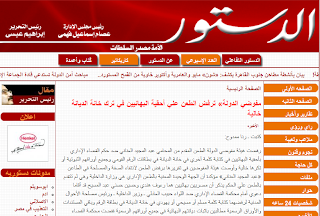
A case in point is this most recent important piece of news that was announced yesterday in Cairo's Al-Dostoor newspaper (attached), which affirmed that Egypt's Judicial State Council has just upheld the 29 January 2008 court verdict, permitting the Baha'is to obtain identification documents with dashes "--" inserted in the religion section of these documents. The 29 January verdict was previously challenged by an Islamist lawyer who, in an attempt to stall the ruling on procedural excuses, attacked the judge and questioned his competence. This stalling tactic was discussed before in this post.

In addition to that, the 29 January ruling had also faced another legal challenge by another lawyer. This second challenge was indeed an appeal of the ruling itself, intended to penetrate its core and reverse it altogether. This appeal was filed shortly after the 29 January verdict by another Islamist lawyer, named Abd El-Mageed El-Aanany. As a result of that appeal, the case was referred to the judicial State Council, which is a panel of judges at the highest level of the State, charged with acting on such judicial matters and appeals.

This council rejected the appeal by El-Aanany and upheld the administrative court's ruling to allow the Baha'is obtain identification documents. In its decision, the Council affirmed that the only authority that has interest in this case is the Ministry of Interior, not this lawyer or any others for that matter.

Since the defendants in these cases, i.e. the Ministry of Interior, its Minister, General Habib El-Adly, as well as the head of the civil [personal] affairs authority had not appealed the verdict during the alloted time period, that in itself led to the enforcement of the verdict. Thus the independent appeal by this lawyer was rejected by the State Council.

This is a very significant ruling that affirms that the administrative court verdict must stand and cannot be challenged, implying that the Baha'is of Egypt can now obtain ID cards and birth certificates as ruled by the court.

On the other hand, a day after this announcement, another newspaper, Al-Masry Al-Youm (attached) published an article that reported on cases when Baha'i students were refused admission to schools simply because of their religion.

When the parents of these students went to the schools to enroll their children, they were told by the schools' administrators that they were instructed to accept students only if their religion was stated as "Muslim" or "Christian," and that they will not accept any students with dashes "--" entered in the religion section of their birth certificates.

When the parents went to the Ministry of Education to complain, they were given the usual "run around" by placing the blame on other agencies, such as the Ministry of Interior. Of interest, one of these schools is a French private school and the other is a British private school--both report directly to the Egyptian Ministry of Education.

According to these new developments, it is clear that the "right hand does not know what the left hand is doing." These developments betray a state of chaos, with some individuals, who think that they are in "authority," are making their own arbitrary decisions without evidence of any sort of accountability. Those responsible for the citizens of Egypt must step-up and stop this state of madness and anarchy. They are under the absolute obligation to enforce the laws.

Sunday, March 23, 2008

Egyptian Baha'i Student on TV

You may watch Cairo's TV program which was referred to in the previous post regarding the Egyptian Baha'i student (Kholoud), who was ultimately allowed to sit for her high school final exams. The program's title is "the Egyptian Street."

Her case is being presented and defended by a prominent Egyptian journalist, Mr. Nabil Omar, who is the vice-president of Egypt's Al-Ahram newspaper. Mr. Omar is not a Baha'i.

Section (1)


Section (2)

Friday, March 21, 2008

Egypt's Ministry of Education Allows Baha'i Student into Exams

As the Baha'is of the world celebrate today the end of their yearly "fast" and the advent of their new year, the case of Kholoud, the young Egyptian student who was--because of belonging to the Baha'i religion--prevented from registering for her exams by the head of "Examination Control" in Cairo, captured the outrage of the Ministry of Education as well as the public opinion in Egypt.

As a result, Egypt's Ministry of Education overruled the administrator's decision and allowed Kholoud admission to the examination process for graduation from high school. Dr. Rida Abou Sareeyh, First Deputy Minister of Education, confirmed the right of Kholoud to admission to the examination. And that the initial decision to deprive Kholoud of her right to the exam had neither legal nor procedural basis.

Kholoud during a TV interview (Cairo)

Kholoud's colleagues in her school were also outraged by the decision of the "head of control" describing his behavior as "prejudiced." The entire student body was taken back by the way Kholoud was treated and they stated that she was wronged by that decision. They indicated that "no one has the right to interfere with another's religion." One of the students stated that they all knew that Kholoud is a Baha'i and that they all admire her, love her and respect her. They were indeed shocked by the way she was treated by this administrator.

The school's headmaster and teachers were also highly supportive of Kholoud's case and promised her father that they will ensure the prompt procession of her application and acceptance into the examination process.

This case garnered extensive media coverage, including a major television interview and newspaper coverage in Cairo's Al-Badeel and Egypt's semi-official Al-Ahram newspapers.

Officials in the Ministry of Education described the behavior of the administrator as "his own doing and not--in any way--in accordance with the policies of the Ministry." Based on the recent (29 January 2008) administrative court decision allowing the Baha'is of Egypt the right to obtain official documents, the Ministry of Education resolved the matter by asking Kholoud to fill-out another application form with dashes "--" entered in the religion field of the application.

On another front, since Cairo's Court of Administrative Justice decision to allow the Baha'is of Egypt to leave the religion field on official documents vacant, or to enter dashes "--" or "other" instead of identifying their religion, several Egyptian Baha'is attempted to obtain ID cards. In all cases, they were asked to return in ten days. When they returned as requested, they were told again to return in ten days! Thus far no Baha'is in Egypt have been issued ID cards since the court's verdict.

To this date, the Ministry of Interior has not shown any intention of appealing the administrative court's verdict to the Supreme Administrative Court of Egypt.

It is indeed refreshing to note that, unlike Iran's treatment of its Baha'i religious minority, Egypt is quite different--and one can be sure that it will remain so--not because of its sense of responsibility towards its citizens and towards the rest of the free world, but because of its basic nature as a civilized society that cannot overstep certain boundaries in human relations and decency.

Sunday, March 16, 2008

Egypt: a Student Denied Entry to Exams Because of Her Religion

The Egyptian newspaper Al-Badeel reported today on a high school student who was prevented from sitting for her final graduating examinations simply because of being a Baha'i.

Kholoud Hafez Abdou is a 17 years old Egyptian student who, like all other students in her stage of education, must sit for the final exams that allow her to graduate from high school and enter university education.

Students are required to enter their religion on the application form necessary for admission to the examination. Based on the documentation in her birth certificate, Kholoud entered "Baha'i." The high school system's admissions administrator located in the central office rejected her application because she entered "Baha'i" and prevented her from sitting for her final exams.

Kholuod was even willing to be examined in "Islam" under the subject of "religion." However, when the administrator was informed of such by the student's father, the administrator simply stated: "if you are not a Muslim, I have nothing to do with you and your daughter will be deprived from entering the examination."

The instructions given for filling-out the application form clearly state that all information must be accurately & truthfully entered, and any deviation from that would invalidate the application and would be regarded as forgery. The officials, however, demanded that the only way for Kholoud to be allowed entry to the exams is that if she enters "Muslim" under religious affiliation, thus asking her to lie if she wants to be examined.

The 29 January 2008 administrative court decision allows the Baha'is to enter "other", "--" or leave the religion field on official documents vacant. Based on the court's ruling, Baha'is of Egypt cannot be forced to lie about their religion on official documents.

The student is now in a state of shock. Her future is placed "on hold" simply because she is being truthful. Is this what Egypt wants for her emerging young generation? That is: teaching them to be dishonest and untruthful if they want to advance in their education!

Thursday, September 06, 2007

Egypt: the "Other" Lawsuit that Got Postponed

Cairo's Court of Administrative Justice dealt with another lawsuit regarding a Baha'i youth on the 4th of September. It, too, had the same fate as the twins' case: it got postponed until the 30 October 2007 court session.

This second lawsuit (no. 12780/61) was filed by the the Egyptian Initiative for Personal Rights (EIPR) last February on behalf of Hosni Hussein Abdel-Massih, born in 1989, who was suspended from the Suez Canal University's Higher Institute of Social Work due to his inability to obtain an identity card because he is a Baha'i. It is quite common now for Baha'i students in post-secondary education in Egypt to face suspension or expulsion because of their failure to obtain ID cards or military service postponement papers.

Hosni Hussein had already passed his final examinations after completing his first year at the university but was not promoted to the second year, as he is entitled to, and was suspended from the university. In order for Egyptian students to complete their university education without interruption, they are required to produce a military draft postponement document that would permit them to complete their education. One cannot obtain a military draft number without being issued a national ID number and a national ID card. Since this Baha'i student, and many others, are being denied a national ID number because of their religion, they are unable to obtain a military draft number, thus cannot continue their university matriculation. The only option they have left is to lie about their religion and enter one of Egypt's recognized three (Islam, Christianity or Judaism) in order to obtain an ID card. The ID application form clearly states that any false statements will be punishable by imprisonment and heavy fines.

Interestingly this case has been coupled with the twins case in the same court through one postponement after the other. Meanwhile this student (Hosni) awaits his fate sitting at home with his education on hold.

One can read the full story of this case as well as the twins' case in a press release, dated 5 September 2007, by the Egyptian Initiative for Personal Rights (EIPR) in English at this link and in Arabic at this link.

The press release concludes with this statement:
"The Egyptian government has a legal obligation to protect citizens from religious discrimination and coercion under the Constitution as well as international and regional treaties it ratified, including the International Covenant on Civil and Political Rights and the African Charter on Human and Peoples' Rights. The government is also obliged to protect the right to education without distinction on any basis, including religion or belief, under the African Charter, the International Covenant on Economic, Social and Cultural Rights and the Convention on the Rights of the Child."

Thursday, March 01, 2007

Now Iran Denies Ever Persecuting the Baha'is!?

Despite the horrific atrocities committed by Iran in its persecution of its Baha'i community since its birth in the mid 1800s (click here), a representative of Iran's mission to the United Nations and the Iranian government have just denied that Baha'is were ever persecuted in Iran! Yet another disturbing Semblance to the claims made by Egypt in response to the official reports by human rights organizations of its gross violations of the civil and human rights of Baha'is.

An article published today in Al-Arabia website reported on the recent dismissals of Baha'i students from Iranian universities. This report is based on another article--quoted below--published in the Baha'i World News Service regarding the denial of higher education to Baha'is students in Iran.

Al-Arabia interviewed one of Iran's representative to the United Nations who stated: "This accusation is wrong" adding, "no one in Iran is dismissed from education because of his religion."

Also in response to the fact that hundreds of Baha'is were imprisoned and murdered by the Iranian government since its 1979 revolution, the Iranian government stated it "never arrested or executed any individuals because of their religion."

The article ends with this statement: "Last year the Baha'i International Community accused the Iranian authorities of arresting 54 Baha'i girls who were participating in teaching children under a community service program."


The following article was posted yesterday on the Baha'i World News Service website:

Iranian Baha'is face continuing discrimination in higher education

NEW YORK, 28 February 2007 (BWNS) -- A growing number of Baha'is admitted to Iranian universities this year have been expelled, powerful evidence that Baha'i students in Iran still face severe discrimination and limited access to higher education.

After more than 25 years during which Iranian Baha'is were outright banned from attending public and private universities in Iran, some 178 Baha'i students were admitted last fall to various schools around the country after the government changed its policies and removed religious identification from entrance examination papers.

As of mid-February, however, at least 70 students had been expelled after their universities became aware that they were Baha'is.

"The high percentage of expulsions - which are all explicitly connected to the students' identities as Baha'is - suggests at best that the government is turning a blind eye to discrimination in higher education, and, at worst, is merely playing a game with Baha'i students," said Diane Ala'i, the Baha'i International Community's representative to the United Nations in Geneva.

"While we are happy that for the first time since the early 1980s a significant number of Iranian Baha'i youth have been able to enter and attend the university of their choice, the government's long history of systematic persecution against Baha'is certainly calls into question the sincerity of the new policies," said Ms. Ala'i.

She noted, for example, that another 191 Baha'i students, having successfully passed national college entrance examinations last summer, were unable to enter university this year, either because of the limited number of places for the course of their choice or for other reasons unknown to them.

"International law provides that access to education is a basic human right, and Iranian universities have no excuse for denying students who have successfully passed their examinations the right to attend simply because they are Baha'is," added Ms. Ala'i.

"As long as any Baha'i is unjustly denied access to higher education, we can say that the years of systematic persecution and discrimination against Baha'i students has not yet ended, and we must call for this injustice to be rectified," she said.

The largest religious minority in Iran, Baha'is of all ages have faced systematic religious persecution since the 1979 Islamic Revolution. More than 200 Baha'is have been killed, hundreds have been imprisoned, and thousands have had property or businesses confiscated, been fired from jobs, and/or had pensions terminated.

According to a secret 1991 government memorandum, Baha'is "must be expelled from universities, either in the admission process or during the course of their studies, once it becomes known that they are Baha'is."

One of the chief means the government has used to enforce this policy was to require that everyone sitting for the national college entrance examination state their religion on the test registration forms. Test forms that listed "Baha'i," or that had no listing, were rejected.

In 2004, apparently in response to continued pressure from the international community, the Iranian government removed the data field for religious affiliation. About 1,000 Baha'i students successfully sat for the examination that year and hundreds passed, many with very high scores.

Later that same year, however, in an action that Baha'i International Community representatives characterize as a "ploy," exam results were sent back to Baha'is with the word "Muslim" written in, something that officials knew would be unacceptable to Baha'is, who as a matter of religious principle refuse to deny their beliefs.

Government officials argued that since the Baha'is had opted to take the set of questions on Islam in the religious studies section of the test, they should be listed as Muslims. Baha'is contested the action and were rebuffed; no Baha'i students entered university that year.

The same thing happened in 2005. Hundreds of Baha'i students took and passed the national examination, only to find that the government had listed them as Muslims. Baha'is again contested the action, but without successful redress, and no Baha'is matriculated in 2005.

Last summer, again acting on good faith, hundreds of Baha'is took the national examination. This time, as indicated in the figures above, hundreds have passed, and some 178 were accepted into universities.

Throughout the fall, reports came out of Iran indicating that many of those who had been accepted were being refused entry or expelled once the universities learned that they were Baha'is. As of February, the confirmed figure totaled 70 Baha'is expelled.

"Accounts we have received from those who have been expelled or denied registration at the university of their choice clearly indicate the issue is their Baha'i identity," said Ms. Ala'i.

"One student, for example, received a phone call from Payame Noor University on 18 October, asking whether he was a Baha'i. When he replied in the affirmative, he was told that he could not be enrolled.

"Later, after visiting the university, the student was told that the university had received a circular from the National Educational Measurement and Evaluation Organization, which oversees the university entrance examination process, stating that while it would not prevent the Baha'is from going through the enrolment process, once enrolled, they were to be expelled.

"Another Baha'i student at that same university was told that students who do not specify their religion on registration forms would be disqualified from continuing their education there," she said.

Ms. Ala'i also said that the Baha'i International Community has learned that all universities in Iran except one still include a space for religion on their own registration forms.

"This raises the grave concern that the 191 additional Baha'is who passed their examinations this year but were refused places may in fact be the subjects of discrimination," she said.

"We call on the international community to continue to monitor this situation closely," said Ms. Ala'i. "We would also ask for the continued efforts of educators and university administrators around the world who have participated in a campaign to protest the treatment of Baha'i students in Iran."

uno-bp-07 02 28 -1-EXPELLED-507-N

Wednesday, February 21, 2007

Egypt: Demise of Academic Intellectual Integrity

A professor at the Faculty of Arts and Letters in Alexandria University used a formal course on Human Rights that he has been teaching in order to foment fear and spread misinformation on the Baha'i Faith to his students.

For his course he had published an 84 page textbook in which he attacked the Baha'i Faith in four of its pages under the disguise of human rights education.

In his introduction on this specific subject, he used the following chapter title in order to introduce his learned opinion on the Baha'i Faith: "The rights of humans to freedom of belief and religion protected by the Administrative Court."

The opinion and stand of Egypt's Supreme Administrative Court on the Baha'i Faith is very well-known by now and is clearly understood by all who have been following this case closely.

However, one is at a loss to comprehend how this professor appears to succeed in convincing himself--and perhaps his students--that the Supreme Court's opinion had indeed ruled in favor of protecting the rights to freedom of belief and religion in denying them the right to obtain ID cards!

How could he use this as an example of the protection of human rights in Egypt?

In his four pages (out of 84) he repeats the exact disinformation, now familiar to many, and propagated by the supreme court as well as the extremists in Egypt. When he administered the final examination to his students (see copy at the end of this post), one out of the total three essay-type questions asked the students the following:

"The Supreme Administrative Court's ruling [16 December 2006] which happened during the course of our lectures on the status of the Baha'iyah in Egypt affirmed the old judicial direction that you have studied. Describe your understanding, from the lectures, of its judicial rulings and the principles applied by the administrative court in that regard. You should then expose the consequences of these judicial decisions influencing it [Baha'iyah]; mentioning examples of the protection provided by the court; concluding your answer by specifying when and where it [Baha'iyah] originated and what its goals are according to your understanding of the lectures."

This professor, under the guise and protection of academic freedom, has been teaching a course on human rights. He has been providing misinformation to his students on the history, the principles and the teachings of the Baha'i Faith. He informed his students that the Baha'is are a threat to the "public order" and the security of the country.

He published this information in his course-book and had copied several statements from previous court rulings and fatwas that have been propagated by the media for several decades. He had not exerted any discernible effort to investigate the truth for himself or for his students. By doing so, he presented his students with one-sided and clearly biased view of a supposedly academic subject, thus violating the principles of the Institution's intellectual integrity.

The students were not well served by this for two reasons: 1) they were not exposed to any scientific methodology in their research and education, and 2) they were taught falsehood that might remain with them for the rest of their careers. Additionally, they knew that in order to avoid failing that examination they were under the obligation to present their answers in accordance with the misinformation given to them by their professor, reinforcing the falsehood and ignorance.

Alexandria University was known to be a highly respected institution. In the ancient days, it was the world's first educational institution of its kind and was linked to the famous Alexandria library. It ceased to exist for several centuries until it was re-opened in the 1940s and has been a leading educational institution for several decades afterwards.

It may be time for the leaders of this respected institution of higher learning to have a close look at their teaching faculty to ensure their proper qualifications and proper motives to teach young minds and to maintain its scientific and intellectual integrity it has been well known for.