Showing posts with label Constitution. Show all posts

Tuesday, December 25, 2012

Egypt's New Constitution: No Religious Freedom for Minorities

In today's post, The Muslim Network for Baha'i Rights, indicated that Baha'i Rights in Egypt will be gravely violated by Egypt's newly passed controversial constitution, which was passed by an Islamically dominated constituent assembly.

The post is titled: "What Would Egypt's New Constitution Mean for Baha'i Rights?" For ease of access, the full article is re-posted below.

It should be noted though that, in reference to the fourth paragraph of the post which addresses prosecution under [contempt of religion] article-44 of the constitution, it must be made very clear that Baha'is never engage in "insult or abuse of [all] religious messengers and prophets." Thus, any accusations or claims that might arise under such a "prohibition" or an "article" would be blatant fabrications. And according to recorded recent revelations by some of those participating in drafting the constitution, its wording is specifically intended to alienate religious minorities and put a final stop to any minimal freedoms or rights the Baha'is of Egypt might have left.

Here is the post:

“Article 43: Freedom of belief is an inviolable right. The State shall guarantee the freedom to practice religious rites and to establish places of worship for the divine religions, as regulated by law.”
-Egyptian Draft Constitution 
On December 15th and 22nd, Egyptians turned out to decide whether they would adopt their new constitution. Although the results have not been formally announced, the draft charter seems to have passed, despite the protests and intense debates that surrounded it. Many aspects of the constitution were discussed, including the role of religion in the state, what powers are granted to the military, and how well the constitution upholds the ideals of the Jan 25 revolution.
However, one conversation has been given little room in the context of the larger debate; should this constitution be passed, what would its effects be on the status of Egypt’s Baha’i minority?
Despite the fact that the constitution proudly declares “The individual’s dignity is an extension of the nation’s dignity”, the general consensus is that the Egyptian constitution fails to protect many individuals, mainly its minorities. There are no explicit protections against legal discrimination against women, and although the authority of Christians and Jews is recognized “for their personal status laws, religious affairs, and the selection of their spiritual leaders” (Article 3), it is still established that “principles of Islamic Sharia are the principal source of legislation.

” (Article 2).
In the case of the Baha’is, they are not recalled in the constitution at all. Without even the minimal protections granted to Christians and Jews, the implementation of the constitution would likely continue the present marginalization of the Baha’i community. This lack of formal recognition has far reaching consequences. The Muslim Network for Baha’i Rights already revealed the Minister of Education’s remarks about denying Baha’i children education in government schools. In addition, because the constitution does not grant protections to the Baha’i community, any Baha’i religious activity could potentially be prosecuted under Article 44, where “insult or abuse of all religious messengers and prophets shall be prohibited.”
The constitution in general gives much more room for established Islamic institutions such as al-Azhar to influence judicial decisions. Despite the presence of Article 43, which affirms “freedom of belief”, the constitution repeatedly establishes the role of the government in promoting Islamic and family values. At the very least, religious practices other than Islam will receive no support from the government, and likely will even be actively suppressed. For example, the phrasing of Article 215, which lays out the guidelines for the National Media Council, explicitly says that it will “observe the values and constructive traditions of society.” When mainstream Islamic scholars and long-standing institutions are the ones who influence the values and traditions of society, Article 215 leaves open the possibility that Baha’i media may be subject to censorship for failing to uphold the “constructive traditions of society.”
In essence, the draft constitution follows the lead of the Mubarak era in that it does nothing to protect the rights of Egypt’s Baha’i citizens. Unless all groups are explicitly allowed to fully function in society as equals, with the full right to Egyptian schools, media, and religious practice, then the demands of the January 25 revolution, for freedom and dignity for all, will go unfulfilled.

Monday, October 15, 2012

Latest Media Coverage on Baha'is in Egypt

Yesterday, Daily News Egypt, Egypt’s Only Daily Independent Newspaper In English, published a comprehensive story about the life of the Baha'is in today's Egypt. As the article speaks for itself, it would only be fair to quote it in its entirety here:

Baha’is in Egypt

Lucy Provan  /   October 14, 2012  /   1 Comment
The 25 January revolution gave everyone hope for change, and the Baha’i hope for acceptance.
Share     Print       Email
Baha’s cheerful smiling face belies his family history. When Baha’s father, a Quranic sheikh in a village in Upper Egypt, converted to the Baha’i faith, their neighbours accepted his choice and the small community lived in peace. This changed early one morning in 2001, when armed men in army fatigues took away his father, mother, two uncles’ and one uncle’s wife. His father was sent to Tora prison for nine months, his mother for seven.
After this event and his father’s public admittal to being a Baha’i, “the village started to get a reputation for its Baha’is,” Baha remembers. “People from the other districts would gossip and it hurt the pride of the people in the village.”
All this came to a head in 2009, when Baha’s father and Baha’i activist, Basma Moussa, went on the TV show “Al-Haqiqa.” Gamal Abdel Rahim, a journalist on the show, accused them of being apostates. “You are an infidel and should be killed,” he told the two. “Go build a country in Israel.”
Soon afterwards, the Baha’i homes in Baha’s village were looted and torched. The Baha’is had to flee and have not returned since. Rahim, this year appointed editor-in-chief of Al-Gomhuria newspaper, congratulated the attackers.
Whether living accepted in communities around Egypt or being attacked for being Zionists spies, the fortunes of Egypt’s estimated 2,000 Baha’is have fluctuated since their arrival in the 1860s. Today, the draft Egyptian constitution only recognises three state religions; Islam, Christianity and Judaism, meaning the Baha’is could be written out of Egypt’s future. So who are the Baha’is and what are they going to do about it?
One Thursday night in Cairo, Baha is sitting on a large grey sofa, it is one of many gathered in a circle in the white apartment. Young men and women trickle in to the room, greeting each other warmly. In what seems an unwritten rule, no one questions each other’s religion; attendees have come from all faiths. “We have come to discuss our similarities, not our differences,” announces the host as the session starts. Slips of paper are handed out, printed with sayings from the Torah, Quran, Bible and other holy books. Sitting here you might not even guess it is a Baha’i devotional meeting, save for the framed photograph standing in the corner; a portrait of a turbaned man with violet coloured eyes.
 Origins
The violet coloured eyes belonged to a Persian named Abdul Baha. He was the son of Mirza Hussein Ali, or Baha’u’llah, prophet of the Baha’i religion. Hussein Ali claimed to be the latest in a line of prophets including Abraham, Moses, Buddha, Krishna, Zoroaster, Christ and Muhammad. He believed humans were progressing towards a global society without conflict or prejudice. He promoted gender equality, universal education and the elimination of poverty. Baha’is believed in the independent seeking of truth, abrogation of the clergy, and election of Baha’i representatives. For these beliefs, Baha’u’llah was persecuted in his birthplace of Iran and imprisoned in Acre, modern-day Israel, where he died.
Abdul Baha toured the Middle East after his father’s death, spreading word of the new religion. While in Lebanon he met a kindred spirit; the Egyptian Mohamed Abduh. Abdul Baha would go on to spread a faith which now has seven million followers and is the second most geographically widespread religion after Christianity. Abduh would become the father of the modern idea of an Islamic state and a great influence on Hasan Al-Bana, founder of the Muslim Brotherhood. Their friendship indicates Egypt’s openness to Baha’is at the time.
Picture of Abdul Baha as a young man.
“They discussed matters which concerned the east; how to progress and develop while protecting eastern and religious values and principles,” says historian Suheil Bushrui. “It was not an issue that he [Abdul Baha] was not a Muslim; at that time in the culture of the Arab world, and especially Egypt, there was a great deal of discussion and especially dialogue opening up and investigating new ideas.”
Early acceptance
By 1924, a Baha’i National Spiritual Assembly, the elected governing body of the Baha’i faith in Egypt, was established. It was the fourth in the world. Egypt became a hub for Baha’i pilgrims travelling to Acre. In 1925 in Beba, Upper Egypt, a Shari’a appellate court annulled the marriages of three Baha’i men who had married Muslim women. However, in so doing the judge legitimated the Baha’i faith, declaring it “a new religion, entirely independent with principles and laws of its own.” The Baha’i faith was officially recognised in 1934. By the late 1950s, there were approximately 5,000 Egyptian Baha’is, local Baha’i assemblies in 13 cities and towns and the community had purchased 17,000 square meters of land on the banks of the Nile for a Baha’i house of worship.
Basma Moussa, the Cairo University professor who appeared on television with Baha’s father, sits in her garden looking through photos. In one, her mother peers excitedly from behind a large crowd inside the National Spiritual Assembly building in Cairo.  She remembers her mother’s stories of the assembly, “there were always people coming and going, visits from different countries and an equal number of men and women, which was quite unusual at the time. People in the area accepted the assembly as something normal.”
Persecution
This acceptance was not to last. Forty years after Saad Zaghloul led a revolution under the slogan, “religion belongs to God and the homeland to all,” Egyptian President Gamal Abdul Nasser became concerned about the rise of Baha’is and their links to a nascent expansionist Israel on his borders. In 1960, he issued Decree 263, paragraph six of which proclaimed “all Baha’i assemblies and centres [are] hereby dissolved, and their activities suspended.” Baha’is were allowed to practice in their homes, but all official Baha’i properties, funds and assets were confiscated. They have still not been returned.
Nasser’s actions were driven by a desire to reinforce secularism, but subsequent administrations would target Baha’is for their perceived heresy. The 1971 constitution promised, “the state shall guarantee the freedom of belief and the freedom of practice of religious rites.” Four years later, however, the Supreme Court upheld the legality of Decree 263 and ruled constitutional protections only extended to the three “heavenly” religions of Judaism, Christianity and Islam.
From 1965 to 2001 there were 236 arrests of Baha’is, charged under Article 98(f) of the Penal Code which proscribes “disparaging contempt of any divinely-revealed religion or its adherents, or prejudicing national unity or social harmony.” It was rare for these cases to be followed by prosecution; most were simply released after being detained. Albert-Ludwig University of Freiberg’s Professor of Islamic Studies, Johanna Pink, has suggested the government was not so much concerned with the Baha’i being a real threat, but was attempting to “legitimise” its authority in the eyes of the people, presenting themselves as “defenders” of Egypt as an Islamic state.
Public attitudes
The government’s opportunistic discrimination against Baha’is was based on the fact public perception was generally negative and based on rumours. After the 1960s, “the tone of the press became much more negative and even polemical,” wrote Pink in a 2005 paper on freedom of belief. She added that by 2005, a connection between the Baha’i faith and Zionism was taken for granted in the media. In 2008, the Andalus Institute for Tolerance and anti-Violence Studies noted many national newspapers’ reports “implie[d] direct incitement to hatred against Baha’i.” Baha’is were also often seen as a security threat, and the United States Commission on International Religious Freedom, cites claims made most frequently by conservative clerics such as Abdel Moneim Al-Shahat, a prominent Salafi leader, that “Baha’is deserve no rights in a new constitution and…should be tried for treason.” From 1910 to 2010, 15 fatwas(Islamic religious rulings) labelled Baha’is heretics, based on the fact that Baha’is believed in a prophet after Muhammad.
All this affected the personal lives of the descendants of those converted by Baha’i Iranian traders years ago. Sumaya Mohamed Ramadan, winner of the Naguib Mafouz prize for literature, remembers her introduction to the Baha’i faith in England. “I saw a picture of this oriental man with a turban and I thought what is he doing in this living room in Brighton? I started to ask and I missed the train home that night.” Coming back, Ramadan’s conversion was accepted by her family, although occasionally her religion would cause others embarrassment. “One time we were talking about equality, everyone was agreeing with what I was saying and then I mentioned some of my ideas were based on the fact I was a Baha’i, and the whole room went silent,” she recalls.
Moussa graduated in the top ten of her class in dental medicine and started working in Cairo University. When her colleagues questioned her different fasting patterns, she revealed her religion, “some started not to speak to me or eat with me.” Some started to accuse her of missing work, she says. Moussa was continually overlooked for promotion and spent a long time fighting the administration of her university. “I lost five years of my life and career complaining about it and I had to do it alone,” she says. “I couldn’t mention the discrimination was because I was Baha’i.”
A more positive wave of support followed a court case in 2009, when Baha’is won the right to declare their religion on their ID card. Not declaring their religion would have removed their entitlement to a range of rights including education, housing and franchise. Their only other option was to commit fraud or lie about their religion. Many media outlets highlighted the case, helping create more public understanding. “The media was biased before… in 2009 there was a legitimate and neutral report,” a reporter in Masry Al Youm told Daniel Perrell, author of a 2010 study on Baha’i rights. Many non-governmental organisations (NGOs) also got behind the case. Despite this, Pink says other “Egyptian human rights groups have been reluctant to take up the case of unpopular minority religious groups like the Baha’i Faith… fear[ing] that this might compromise their ability to speak out on other issues which they consider more important.”
The revolution
The 25 January revolution gave everyone hope for change, and the Baha’i hope for acceptance. The Baha’is of Egypt released an open letter to the nation enthusing about the possibilities for the future.
Baha'i National Spiritual Assembly before 1950. Basma Moussa / Daily News Egypt
Baha’i National Spiritual Assembly before 1950.
Basma Moussa / Daily News Egypt
“Media concentrates on the negative aspects to Baha’is… but we want to help build the country, all Egyptians together, and since the revolution we are more able to do that,” says Baha’i NGO worker, Shady Samir.
Moussa noticed a great difference in her treatment since the revolution. “People started stopping me in the street and saying ‘I’m not a Baha’i but I respect your struggle.’ Before they were scared to speak about religious freedom, after the revolution everyone started to speak about his opinion.”  Her employer’s attitude also changed, “last March they promoted me to professor… and I didn’t have to push for it,” she smiles.
Where to now? The constitutional question
The current debate about the new constitution raises many issues of concern for the Baha’i community. For example, the proposed Article 8 which states, “freedom of religion is absolute and practices shall be conducted in accordance with public order. The state shall ensure freedom to establish places of worship for adherents of Abrahamic religions in accordance with the law.”
The clause would mean Baha’is would not be able to practice their religions in public or build places of worship. Nor does it suggest that the state would be involved in protecting freedom of religion.
Much depends on how the constitution is interpreted by the new legal system. “Anything written in a constitution is only as valuable as the enforcement of it,” says Perrell. “Constitutions have tremendous normative value and by listing only a few religions… they inhibit legitimate conversation about what constitutes a religion and validates those who would discriminate against any unlisted religion.”
Mohsen Kamal, deputy director of the Andalus Institute for Tolerance and Anti Violence Studies, suggests further implications. The 2009 ruling on ID cards could be nullified, he says. It could be even harder for Baha’is to go to the media and talk about their rights. “If they are talking about their religion they could be accused of insulting Islam.” The article of the new constitution implementing “the principles of Shari’a law,” could result in Baha’is being punished as apostates.
“In plain words,” wrote Baha’i blogger Bilo, “and according to the current rhetoric, promulgated by Islamists and many of those participating in drafting Egypt’s new constitution, if you are a Baha’i in Egypt, you are not recognized or protected under the constitution or any laws that enforce equal rights because only adherents of the three religions are entitled to such protections.”
Mahmoud Ghozlan, spokesperson of the Muslim Brotherhood and a member of the new Egyptian National Council of Human Rights, defends the implementation of Article 8. “Baha’ism is not a religion,” he asserts, before describing how the constitution will not negatively affect Baha’is. “They will have the freedom to worship but they will not be recognised as a religion.”
This sentiment was echoed by a Constituent Assembly member, Farid Ismael, in a recent broadcast television programme, Akher Kalam. Ismael claimed this article should not cause Baha’is to fear for their safety, stating the assembly did not condone attacking anyone because of their religion and if Baha’is were threatened then the government would protect them.
“There is something called the general order. We won’t let a minority promote their religion, which would go against the general order, and jeopardise social peace,” justifies Ghozlan. This attitude was similarly recorded in a paper by academic Daniel Cantini in 2009, “the view of Egyptian jurisdiction is that public interest, even as vaguely defined ones [such] as Shari’a, respect of recognised religions, social peace or national unity, have priority over the individual right of freedom of belief.”
The importance of the Baha’i case for Egypt rests on what it tells us about the attitude of Ghozlan and other decision makers. Their fate indicates how much fundamental change Egyptian institutions have undergone since the revolution.
“Why do we point to what has happened to the Baha’is?” asked Faraj Fuda, a renowned secularist, before his assassination by Islamists in 1994. “What happens to the Baha’is today may happen to others tomorrow and that the chain [of events] that starts with the Baha’is will inevitably end with enlightened Muslims.”
The future
The Constitution remains in draft and much debated. What can Baha’is do to influence its provisions?
Fundamentally, the problem Baha’is have always faced is ignorance and prejudice in a society in which religion is often a crucial aspect of identity. Legal changes are essential, but the importance is in the implementation, and this is grounded in the attitude of the people. As recorded in an interview with the former UN secretary general, Boutros Boutros Ghali in 2010, “there is still a lot of work to be done socially…according to Boutros Boutros-Ghali, there is still limited success, ‘when the small administrator may consider the Baha’i the devil.’”
Baha reflects three years on from when his family’s houses were torched. “Even the people who attacked [my family] were usually nice people” he says, “friends of friends, I think people did not know about the religion. They believed rumours… if there has been a misunderstanding, as a Baha’i it’s my fault. I need to clear that misunderstanding.”
Shady Samir is the grandson of one of the Baha’i men whose marriage was annulled in the Beba case in 1925. He works for an NGO which helps young people learn how to use information technology. It is a job he has chosen, he says, as part of the “service” all Baha’is must perform in order to promote unity and peace. Samir says Baha’is should not just focus on their rights, but wider issues, such as the position of women. By demonstrating their positive contribution to society inclusive of all Egyptians, Baha’is might gain the trust and change attitudes of those around them. “When I was growing up, the community was more afraid and enclosed,” he says, “more of a minority mentality. Now especially we are being more open.”
Running youth groups, volunteering in their community, helping their neighbours are all ways in which Baha’i are encouraged to foster understanding and acceptance of their faith.
Ramadan suggests, “evolution can be a revolution. Plant a seed and it will cost you, but with work and perseverance and faith there will be fruit. There is no point revolting to try to make the tree grow in a second. The revolution is a learning process for everyone, just because it has aspects that don’t suit me doesn’t mean it is not a good thing… you choose to be grateful and work with what there is.”
The Baha’is appear determined to keep on preparing for the time of unity predicted by their holy books. At the end we have to “grin and bear it” says Ramadan. She intends to “build little circles of influence and big circles of concern… so you can influence your circle and change society.”
Back in Zamalek at the inter-faith meeting, the slips have been read out and people gather in groups to discuss the subject of “peace.”
What is peace, we are encouraged to ask ourselves. How could we achieve it? Some think that you should understand yourself, others reject this. “Just being at peace with yourself is selfish. We need to think about world problems.” Some quote Martin Luther King Junior, others religious texts. “What’s so great about peace anyway?” grumbles one participant, initiating a string of refutations and strong admonitions from the Martin Luther King fan.
Afterwards, I ask people what the session means for them. One attendee tells me it helps him to think about his life. He goes back to the people at work, his family and talks about the other perspectives he’s heard. “Many people here come to learn about others and have the freedom to express ideas,” notes the organiser. “It might be the first time they read the Bible for example,” and certainly the first time to gain an understanding of Baha’i texts.
In 2009, Baha’s father was being accused on television of being an infidel and threatened with death. His words then reflect a hope which continues with Baha’is today. “I would like to tell the nation, [quoting from the Quran] ‘if a wicked person brings any news to you, you shall first investigate, lest you commit an injustice towards some people out of ignorance and become sorry and remorseful for what you have done,’” he said. “I ask the Muslims and Egyptians to seek the truth.”

Wednesday, October 03, 2012

Draft Egyptian Constitution Takes Away Religious Liberties Stipulated in Former Constitutions

With the drafting of Egypt's new constitution by a "Constituent Assembly," mostly led by Islamists, religious freedom is becoming an exclusive right rather than an inclusive one.

A case in point is the debate over Article-8 of the draft of the constitution, which is restricting absolute religious liberties only to the three recognized religions in Egypt, i.e. Islam, Christianity and Judaism. All the rest, will have the freedom to "belief" but not the freedom to practice or to construct houses of worship. This clearly poses a contradiction in logic, interpretation and in application: how could one believe, but not practice?

According to this draft, and as an example, Buddhists, Hindus, Baha'is and others cannot freely practice their belief in Egypt, even though Egypt's government does deal and rely on large-scale investments and commerce with governments of countries with religious majorities representing most of these beliefs (Hindu & Buddhist). Since there are hardly any organized Hindu or Budddhist communities in Egypt, the influence on such populations in Egypt is only theoretical. That leaves the Baha'is--the most significant religious minority in this category--to be singled out for lack of civil rights and wide open to more discrimination.

Furthermore, in plain words, and according to the current rhetoric, promulgated by Islamists and many of those participating in drafting Egypt's new constitution, if you are a Baha'i in Egypt, you are not recognized or protected under the constitution or any laws that enforce equal rights because only adherents of the three religions are entitled to such protections. Very similar to the rhetoric used in Iran when its leader is asked about the persecution of Baha'is, his usual response has been "we do not persecute any religious minorities...then he would continue to respond by saying "what Baha'is?" Thus their mere existence is denied, and according to him there is no problem! The same trend seems to be prevailing in Egypt when the "party line" is always "we do not discriminate against any religious minorities," but what they really refer to is the Egyptian Christian minority and nothing else, even though Christians in Egypt continue to face much discrimination and persecution.

Egypt's Baha'is, even under the more liberal constitution of 1971, which allowed for freedom of belief and practice, have been constantly struggling for their civil rights, being deprived of identity cards, marriage certificates, birth certificates and death certificates, as well as discrimination in employment, health care and education. One can only imagine what it would be like, and the magnitude of hardships that would influence their daily living, if this new constitution is passed!

In its 2 October 2012 issue, Ahram Online, the English version of Egypt's leading semi-official newspaper, published a balanced report, by Osman El Sharnoubi, on this very question, including interviews with an Egyptian human rights lawyer, a scholar, a representative of Egypt's Baha'is, and another religious leader. The entire article, titled "New Egyptian constitution offers fewer religious freedoms, critics allege," and subtitled, "Article 8 of Egypt's draft constitution may take away religious freedoms stipulated in previous constitutions," is posted below:
Members of Egypt’s Constituent Assembly, the body tasked with drafting Egypt’s post-uprising constitution, are purportedly finished with drafting the chapter on the freedoms, rights and duties of citizens.
The assembly is largely seen as being dominated by Islamist forces, which have won large gains in legislative and presidential elections after the 2011 January Revolution. 
Liberals and secularists have expressed concerns about the impact an Islamist-dominated drafting body will have on the character of the future charter, in particular in relation to key freedoms. 
Article 8 of the draft constitution is at the heart of the debate, as it stipulates citizens’ religious freedoms. Religious rights and freedoms, and the issue of sectarian tensions between members of Egypt’s majority Muslim population and its Christian minority, remain controversial. 
One of the many problems that Egypt’s Christian minority complains of are the difficulties of building and repairing churches, as both acts are subject to state control. A law was drafted in 2011 to address the problem but is yet to be put into effect. 
Facing even graver difficulties than Christians are followers of the Bahai faith, a monotheistic religion established in the nineteenth century by the religion’s prophet Bahaaullah. The Egyptian state does not recognize the faith, leaving its Egyptian followers to face discrimination and difficulties in the most rudimentary aspects of civil life, such as registering marriages. 
Article 8 
Article 8 is the constitutional article on freedom of belief and religious practice, the mother clause stipulating the freedoms and rights of all matters religious within the Egyptian state. 
The article was recently revised, and its multiple revisions published on the official website of the constituent assembly for public scrutiny. 
“In the current draft, the state is not tasked with protecting freedom of belief,” political researcher and director of the Arab Forum for Alternatives Mohamed El-Agati said. El-Agati contends that the Mubarak-era 1971 constitution fares better on this point. 
Article 8 of the current draft starts by stating: "Freedom of belief is absolute, and religious rights are practiced if not in contradiction with public order." 
El-Agati says that the article withdraws from the state the duty of protecting religious freedoms, which was required of it as stipulated in Article 46 of the 1971 constitution, which read that “the state shall guarantee the freedom of belief and the freedom of practice of religious rites.” 
The new draft article adds the condition “if not in contradiction with the public order” to the practice of religious rites, said El-Agati, putting further limits compared to the last constitution. 
In the Turkish constitution, the state restricts putting limits on worshiping and in Indonesia the constitution gives the state the duty to guarantee the freedom of practicing religion, said El-Agati. This won’t be the case if the current draft article is enshrined in Egypt’s constitution. 
The problem didn’t exist in an earlier version of Article 8, written earlier in the drafting process and amended to its present form. 
Human rights lawyer Ahmed Seif El-Islam, founder of the Cairo-based Hisham Mubarak Law Centre, points to the form of the previous version, which had stated that the freedom of belief and the freedom of practicing religion is granted. 
“The freedom of belief and practicing religious rights is safeguarded,” the article had said before being amended. 
Seif El-Islam criticised the amended phrasing, saying that it deals with freedom of belief only in a private, personal way, rendering it useless. "The freedom of belief must be followed by the freedom of practice, otherwise it loses its essence," Seif El-Islam said. 
Nevertheless, Seif El-Islam sees a positive - albeit limited - development in the article’s current form, which stipulates that the state guarantees the freedom to construct places of worship for Abrahamic religions (Islam, Christianity and Judaism). 
“This is a step forward for Christians and Shiites, yet not so much for members of other religions,” said Seif El-Islam. “A community of expatriate Chinese Buddhists for example wouldn’t be able to establish a temple,” said Seif El-Islam, adding that since Egypt doesn’t have large expat communities from other religions the problem remains only theoretical. 
“In reality, it is members of the Bahai faith who would suffer under this article,” Seif El-Islam asserted. 
El-Agati sees a further implication to the restriction of building places of worship to the 3 major religions by the article, related to Egyptian Muslims living abroad. 
“The article weakens the positions of Muslims living in non-Muslim countries and suffering under certain forms of discrimination such as restrictions on building mosques,” says El-Agati. 
“Egyptians wouldn’t be able to object to restrictions on building minarets in Switzerland, or wearing the veil in France,” he told Ahram Online. 
El-Agati believes the article is generally detrimental to the concept of citizenship and opens the door for discrimination on the basis of religion. 
Constitution vs. reality 
Labib Iskandar, a Bahai professor of engineering at Cairo University, highlights what he says is a contradiction in the draft article - “how can you say freedom of belief is absolute and then only mention main religions?” he asked. 
To Iskandar, however, it is not the constitution that matters but what happens in reality. The 1971 constitution hadn’t limited the religions which have the right to practice their rituals, and yet Bahais still struggled for recognition and rights. 
Still, for Iskandar, what’s more important than the state recognizing the Bahai religion is to enjoy civil rights, which the state so far does not grant. 
The state continues to pose many obstacles for Bahais, including not recognising their matrimonial contracts and thus refusing to give them a “married” status on their national IDs, as well as refusing to issue electronic copies of their death certificates, causing legal hurdles and risks for members of the faith. 
“Implementing constitutional laws is key. In the 1971 charter freedom of religion was protected yet it is up to officials to interpret it, easily deciding that the Bahai faith is not a religion to begin with,” Iskandar explained. 
Seif El-Islam took up this point, saying that “a state could have a wonderful constitution and shelve it,” a situation wherein practices on the ground would be in complete contradiction to the spirit of the constitution. 
A good case in point is the position of Egypt’s Shiites, which contradictory sources say range from just over 10,000 to more then 1 million Egyptians. Many pundits don’t consider the constitutional article to be a threat to Shiites, since Shiism is a Muslim sect. 
However, as Seif El-Islam points out, what is written on paper could differ by leagues from the case in reality, where the mainstream Sunni stance on Shiism isn’t favourable. 
“There will never be a struggle between Sunnis and Shiites in Egypt,” El-Tarek El-Hashimi, a leading Egyptian Shiite told Ahram Online, saying Shiites are keen on preventing sectarian strife. 
El-Hashimi stresses that Shiites follow the same school of Islamic theology, the Ashaarite theology, as does the leading Sunni institution of Al-Azhar, foreseeing no problem concerning freedom of belief and religious practice. 
“Religious rights between both sects are the same,” argues El-Hashimi. 
Despite El-Hashimi’s optimism, a Shiite was sentenced to a year in prison in September for allegedly starting a fight due to his mode of prayer - or “his actions that violate the Sunni sect” - in a village mosque. 
The Egyptian Initiative for Personal Rights appealed the sentence of Mohamed Fahmy Asfour, the Azharite teacher, saying he was handed it due to his belonging to the Shiite faith and expressing its concern regarding attacks on freedom of belief and expression. 
The court said some of Asfour’s practices during prayer which are different from Sunni’s “incited discomfort” among other worshipers, which caused the scuffle. 
Constitution vs. law 
Seif El-Islam raised yet another concern about the constitution, saying it doesn’t necessarily follow that laws are based on the constitution, explaining that a constitution could be drawn up but the legal structure preceding it could remain unchanged. 
Seif El-Islam is wary that the laws would not respect the new constitution, saying it would be left for individuals on a case-by-case basis to change laws, as courts may decide the unconstitutionality of certain laws according to each case, a long and tedious process. 
“As soon as the constitution is drafted, there should be a period of 5 years within which the process of amending laws to conform to the constitution should be institutionalised,” Seif El-Islam suggested. 
Institutions such as the parliament, trade unions, NGOs and others should be tasked with this process, he said, allowing the country’s social forces to make sure their constitution is being followed. This is assuming the current draft would be viewed favourably by Egypt’s citizens.


Wednesday, February 16, 2011

Article-2 of Egypt's Constitution is in Question!

Egypt's Supreme Council of Armed Forces, in its Communique No. 5 following its interim assumption of the country's leadership, suspended the constitution and dissolved both houses of the parliament. Reportedly, it did not, however, suspend Article-2 of the Egyptian constitution which states: "Islam is the Religion of the State. Arabic is its official language, and the principal source of legislation is Islamic Jurisprudence [Sharia]." This article was amended years ago by former President Sadat in his attempt to appease particular segments of the society. [See Egypt's Constitution, under: PART ONE - THE STATE]

The bulk of the revolutionaries, including the Egyptian youth, have been angered by finding out that this Article was not also suspended. They insist that Article-2 contradicts the whole intent and purpose of the revolution. They want to ensure that the revolution does not get hijacked by religious extremism, and want to make certain that the main goal of the revolution remains unchanged, that is: "to provide for a civilian and secular State devoid of any extreme religious ideology, a State that provides equality and fairness to every Egyptian citizen without alienating any minorities or religious groups within the society." They intend to make their case clearly known this Friday.

Saturday, September 22, 2007

Emerging Egypt’s Official Stand: Grant Baha’is Their Rights

Based on recent information in the official Egyptian media outlets, the Baha'is appear to be on their way of being allowed to freely document their religion in official government documents, including ID cards.

The most recent of these indicators is an article published on 22 September 2007, in the government's official newspaper Akhbar el-Youm. It reports on the recent debate under the auspices of the National Council for Human Rights (NCHR).

As previously indicated, there were those who are in favor of eliminating religious classification from ID cards altogether, while others affirm the need for its preservation.

Of particular importance are the words of one influential and important person, supported by others who are similarly positioned. Dr. Zainab Radwan, University Professor of Islamic philosophy, First Deputy of Maghlis el-Shaab [Egyptian Parliament] and member of the NCHR, declared her point of view on this crisis, stating "it is the right of every human being to document his religion, even if he believes in a religion that has not been specified [by authorities]." She justifies her opinion by using two principles: "the first is the freedom of belief as declared in the constitution. The second is the equal opportunity in societal transactions...that we all know the identity of each other in our dealings, particularly the Baha'is because their names are similar to Muslim names, benefiting our daughters so that they don't marry Baha'is, or the reverse."

Regarding the 16 December 2006 ruling of Egypt's Supreme Administrative Court preventing the Baha'is from obtaining ID cards, she proposed a solution that "the Parliament and the judiciary must be requested to allow anyone who desires to document his religion the right to do so," stressing the importance of accurate representation on ID cards since they are an essential component to many interactions in society, such as marriage, inheritance, and parenthood of children. She pointed to the need for "clarity and honesty" as facilitators to these important society matters.

Dr. Ahmed Kamal Abul-Magd, former Minister of Information, Professor of Constitutional Law and Vice-President of the NCHR, agreed with Zainab Radwan, stressing the importance of adhering to the constitutional guarantees which provide all Egyptian citizens with equal rights and that "there must be no discrimination based on ancestry, gender and religion, and that all must adhere to this." He insisted on allowing the Baha'is to document their religion truthfully as Baha'is, and that "we cannot force him to change his religion on ID documents, or register himself as Muslim, particularly when the law had established for us the absolute freedom of belief, and subsequently we cannot exempt anyone from this fact."

Another indicator of the government's official position is dually represented by the opinion of Egypt's Al-Azhar Institution as well as the inclusion of that position in the official publication of the ruling party Al-Hezb Al-Watany [The National Democratic Party].

Approximately a year ago, Al-Watany Al-Youm newspaper (the government's mouthpiece) published an interview with Sheikh Al-Azhar, Dr. Muhammad Sayyid Tantawi, in which he clearly stated the position of the prominent leading Islamic establishment, Al-Azhar. This particular episode was published last year in this post.

Interestingly, the same interview continues to appear on the newspaper's website with current dates, the last of which is 18 September 2007.

The following is an excerpt of the interview, with questions and answers from 4 to 8, referring to the Baha’is, fully translated:

[Q:] There is a recommendation from human rights organisations to eliminate the religious affiliation field from official documents as it discriminates among citizens, what is your opinion? What do they mean by eliminating the religious space and why do they demand this; by what right [authority] do they recommend its elimination?

[A:] They have no right in this matter; we consider the presence of the religious affiliation field to be correct, and this does not cause any kind of discrimination. We have [It has] nothing to do with human rights or anything else; the presence of the religion in its specified space is a must…a must…a must!

[Q:] What is its benefit that you insist on its being obligatory?

[A:] The benefit comes from the purpose of its presence, which is to describe the person in his official documents; no harm can befall anyone from documenting his religion, no matter what that religion is, so why eliminate it? The religious field should not be changed, no matter who demands it, because a person is entitled to write his religion in the space [field] specified for it.

[Q:] Even if he was a Baha’i?

[A:] Yes, he writes “Baha’i” in it; what is wrong with that so long as it is his belief and what he chooses for himself as a religion? Writing Baha’i in the religious space clears other religions of any relation with him and prevents some people from affiliating themselves with other heavenly religions when these are likewise innocent of them.

[Q:] Therefore, this means an admission [recognition] that it is a religion?

[A:] Baha’ism is not a religion; however, writing it down as a belief in the religious affiliation space is possible and can do no harm – rather, it is a compulsory distinction for those who are apostates of the heavenly religions.

[Q:] Your Excellency considers that Baha’ism is a dissident [apostate] group which has departed from Islam and yet you spoke of freedom of belief – do you not find a contradiction in this?

[A:] Freedom of belief is guaranteed to all and not just to a particular person; what is meant by freedom of belief is that every human being has his belief and the one who judges people is God.

Clearly, one can draw one conclusion: the government is strongly leaning towards allowing the Baha'is to enter their religion truthfully in all official documents. Additionally, Egypt is serious about solving the current crisis of identification documents and citizenship rights. All indicators confirm the willingness and positive steps being taken by the government in its efforts to grant all Egyptian citizens their full civil rights, based on the constitutional guarantees. This is not surprising if we pause to consider Egypt's heritage and great civilization. Surely, mistakes do happen, at times because of uncontrollable circumstances, but the sign of greatness is when a government is willing to overcome pride in its efforts to justly serve its citizenry.

Friday, January 19, 2007

Egypt's Coptic Church Demands Amending Article-2

An article published today in al-Masry al-Youm newspaper reported on the mounting pressure by Egypt's Orthodox [Coptic] Church demanding the amendment of Article-2 of the constitution.

Article-2 states: "Islam is the Religion of the State. Arabic is its official language, and the principal source of legislation is Islamic Jurisprudence (Sharia)."

Speaking on behalf of the Church Anba (Bishop) Morqos is requesting that the language of the Article be changed to state: "a principal source legislation" rather than "the principal source of legislation," which was amended to that particular language in May 1980 by the late president Anwar el-Sadat in order to appease Muslim fundamentalists.

Anba Morqos indicated that this requested amendment "would guarantee the application of other sources of legislation, and not only Islamic Jurisprudence as the principal source."

Morqos also clarified that "laws and principles of citizenship must be those that we agree on, and not those that are forced upon us." He indicated that Egyptian Christians are not a small minority, but rather represent 15-18% of the population based on the most recent census, and besides that they [Copts] "are [Egypt's] sons and its owners."

The Bishop has also requested on behalf of the church that the State enforces a constitutional guarantee of articles that criminalize the contempt and disdain for religions, and that the application of this law should apply to all religions, so it would benefit the adherents of all currently present religions.

Sunday, January 14, 2007

Egypt: Recommendations of Human Rights Organizations

The Egyptian Union of Human Rights Organization [EUHRO] held its fifth annual convention in Cairo on 11 January 2007, to which the Baha'is were invited to make a formal presentation. The theme of the convention was entitled: "Freedom of Belief Between Shari'ah [Islamic jurisprudence] and the Constitution." The panel consisted of representatives from the media, the arts, the university, the ruling political party, Islam's al-Azhar University, and the Baha'i Faith. They were, seated from left to right: Mr. Amr Al-Leithy, editor of Al-khamees newspaper & programmer in channel-2 of the Egyptian TV; Mr. Wael Al-Ibrashi, Editor-in-Chief of Sawt Al-Umma newspaper & the TV program Al-Haqiqah [The Truth] of Dream-2 channel; Dr. Mahmoud Ashour, former Deputy Sheikh of al-Azhar University; Justice Naguib Ghobreial, the organization's president; Mrs. Ilham Shaheen, an actress & a movie superstar; Dr. Gihad Ouda, a university professor of political science & member of the political committee of the ruling party; and Dr. Basma Moussa, professor of Maxillo-Facial Surgery at Cairo University, representing the Baha'i Faith.

Dr. Basma Moussa made an elaborate PowerPoint slide presentation describing the crisis currently facing the Egyptian Baha'is. This presentation was a very well-received keynote feature of the convention, during which she used several quotes from the recent message of the Universal House of Justice to the Egyptian Baha'is.

Following its conclusion, the convention released its recommendations to the press and the Egyptian government. The following is a summary of its eleven-point recommendations:

1) The convention supports President Mubarak in his efforts to reform the constitution and in particular the principle of citizenship.

2) The convention affirms that the rights of citizenship in Egypt cannot be realized without the modernization of the State and the respect for all religious authorities in Egypt.

3) The convention recommends that the constitution must be freed from any reference to religious inclinations.

4) The convention recommends that the constitution truthfully declares the true meaning of Egyptian identity and the affirmation of the modernity and civility of the State.

5) The convention recommends the absolute guarantee of freedom of belief to all citizens regardless of their various religious congregations or beliefs.

6) The convention recommends that in case article-2 of the constitution [referring to the Islamic Shari'ah as the source of legislation], that it would be amended to state that "it will not interfere with the principle of citizenship, and would not influence the beliefs of others."

7) The convention recommends that the principle of "public order" be clearly defined and understood so that it does not get confused with any belief or religious understanding, and that "public order" be based on basic political and economic rules of the society.

8) The Convention recommends the elimination of religious classification from ID cards.

9) The convention recommends that all laws of the land must become devoid of any discrimination between its citizens based on religion, gender or race.

10) The convention affirms the necessity of enforcing all of Egypt's agreements to the various international treaties and declarations on human rights to which it has been a co-signatory, as well as all the agreements that became part of the Egyptian law as stated in Article-151 of the Egyptian constitution.

11) The convention recommends the elimination of any conditions or reservations that Egypt had attached to its ratification of any of the international treaties on human rights, while safeguarding the status of Egyptian citizenship & identification.

Friday, December 22, 2006

Egypt: An Example of Objective Journalism

The following article is reprinted from Al-Ahram Weekly issue of 21-27 December 2006. Al-Ahram is the leading Egyptian newspaper with its Arabic version published daily and its English counterpart published weekly. The article is self explanatory and presents the Baha'i case very clearly.

Rendered faithless and stateless

The Supreme Administrative Court's ruling intensifies the fight for Baha'i Egyptian citizenship rights, writes Gamal Nkrumah
____________________________________________

Egypt's Baha'is won a historic victory when their right to be certified as Baha'is on official documentation was recognised by a ruling of the Egyptian Administrative Court on 4 April 2006. This week, the country's Baha'is suffered a disastrous setback. The Ministry of Interior appealed against the April ruling, which was overturned by the Supreme Administrative Court last Saturday, 16 December. Baha'is and human rights activists, both at home and abroad, argue that last Saturday's ruling was a gross human rights violation.

The conservative approach has disappointed the hopeful expectations of both secularists and religious minorities. In the months leading up to last Saturday's ruling, the law was increasingly interpreted by the courts to suit the more conservative elements. That law is intended to discriminate against Baha'is, Buddhists, agnostics or atheists alike. An Egyptian national can only be a Muslim, a Christian or a Jew. No other religious affiliation is officially admissible.

After months of speculation, historians may see 2006 as the year that civil liberties in Egypt took a giant leap backwards. The insistence on the recognition of the Baha'i is not a modish secularist fad, but a fundamental human right.

"Did the constitution change? Did the Islamic Sharia change? I cannot understand," Iskandar sighs in palpable despair. "We do not want the state to recognise our religion, we only want to be able to go about our business in peace and without red tape and bureaucratic hassles."

"Inability to produce an ID card entails a five-year prison sentence. Still, we have faith in the legal system," Basma Moussa, a dentist and an assistant lecturer at Cairo University, yet another outspoken Egyptian Baha'i concurred.

"The court ruling appears to be based solely on a public rejection of the Baha'i faith," Hossam Bahgat, director of the Egyptian Initiative for Personal Rights told the Weekly.

"The court didn't respond to a single legal argument by the defence," he added. "The civil status law makes it compulsory for every Egyptian citizen to carry on his or her person an ID card." He said that the court ruling was prejudiced by religious scholars and Al-Azhar, the country's Sunni Muslim religious institution, the most important in the world for that school of Islam.

"The civil status law prohibits students who don't have an ID card from enrolling at universities and other institutions of higher learning. This is an especially problematic issue for young Egyptian Baha'is who can be suspended from studies and may not even acquire a university degree. Baha'i men are barred from conscription which is compulsory for Egyptian males. This failure to undertake National Service is a serious offence unless waived because of health or other specifically- stated reasons," Bahgat explained.

He singled out the Baha'i youth as especially susceptible to persecution because of their religion. They face discrimination when applying for jobs -- the Egyptian legal system criminalises both employers and employees who do not have computerised ID cards and other personal documentation like birth or marriage certificates, all of which must clearly state the religion of the individuals concerned.

Last Saturday's court ruling effectively bars Baha'is from enjoying fully-fledged Egyptian nationality status. "We do not particularly care if the Baha'i faith is not recognised as a religion. What we do need is the right to have a valid identity card -- either the authorities state on the card that we are Baha'is or they leave the space where one's religion is specified vacant," Iskandar explained.

The government may not recognise the Baha'i faith in official personal identification documents, but the pretense of the law at present is that the Baha'is are not able to obtain necessary documents such as birth or death certificates and identity cards.

"I am 60 years old and it is stated in my birth certificate that I am a Baha'i. My eldest sister is 80 years old and she also is stated as a Baha'i in her birth certificate."

Another sister, Salwa Iskandar Hanna, passed away last year and it was sheer hell trying to issue a death certificate, let alone get permission for burial.

The problem was exacerbated in 2000 when computers were introduced at the general registrar office at the Ministry of Interior.

Iskandar explained that officials refused to leave the space allotted for the registration of one's religious affiliation blank. Some said one can only state Muslim, Christian or Jewish as his religion -- other religions such as Baha'is, Buddhists or Hindus cannot be registered, for example. In other words, Egyptians can only be religiously affiliated to one of the three revealed religions -- Islam, Christianity and Judaism.

"Don't force us to state a wrong religion in my ID card," Iskandar protested. "Neither of my sons Ragy, 25, nor Hady, 20, have an ID card. In their birth certificates it is stated that they re Baha'is, however. We cannot have a valid driver's license, we cannot register our cars, we cannot be employed in the public sector, or much of the private sector for that matter."

Iskandar hails from a Coptic family, but his great grandfather converted from Christianity to the Baha'i faith, and the family has been Baha'i ever since. They have no intention of reverting to Christianity.

A presidential decree promulgated as Law 260 in 1960, closed down Baha'i public places of worship, confiscated Baha'i property and banned the public worship of Baha'is in Egypt.

The Baha'i faith is not recognised in Egypt as a religion. With one accord, and with an anxiety that wrenches their hearts with cruel fears, the Baha'is of Egypt are bracing themselves for a long period of trials and tribulations. They are often denounced as heathens and apostates by a public that is by and large ignorant of the tenets of their faith. "We are not concerned whether we are acknowledged as a heavenly revealed religion. This is not the legal question before the court."

The ruling also reversed the position of the Supreme Administrative Court which had found in 1983 that Baha'is had the right to have their religious affiliation included in official documents.

"Today's regrettable decision throws the ball back in the government's court," Bahgat explained.

Monday, December 11, 2006

Egypt: Is It Time to Return to Its Known Civility?

Another article appeared in "al-Masri al-Youm" Egyptian newspaper on 9 December 2006 reviewing the upcoming Supreme Court Case.

The article is entitled "The Supreme Administrative [Court] determines the fate of Baha'i-yyah [Baha'i Faith] this coming Saturday." It is subtitled "Report of the State's Commissioners and Islamic Scholars concurred that it is not a recognized religion [in Egypt]."

It opens with:

The Supreme Administrative Court of the State Assembly will determine in its session, that will convene this coming Saturday, the fate of Baha'i-yyah in Egypt...specifically in regards to its recognition by official and governmental agencies as a religion, and whether or not it can be written in official papers and documents such as identification cards, birth certificates and passports.

The Supreme Administrative Court (first circuit) will produce its judgement on the "matter" of the appeal submitted by the Ministry of Interior, the Civil Affairs Agency, and the Passport and Immigration Agency regarding the judgement of the Administrative Court issued this past 4th of April, in which it ruled to cancel the decision of the Minister of Interior forbidding the entrance of the word "Baha'i" in the religion section of official documents. The court also ruled to enforce the right of the [Baha'i] plaintiffs to obtain official documents with Baha'i written in the religion section.

The lawsuit was initially filed in the Administrative Court on 10 June 2004, and in which Hessam Ezzat Muhammad Moussa and his wife Ranya Enayat Abd'el-Rahman Rushdi have stated that, as subjects of the Arab Republic of Egypt who are in possession of Egyptian citizenship, when they requested the Passports and Immigration Agency to include the names of their daughters in their two passports, the president of the agency confiscated their identification cards without any legal cause. That religion was the reason given for the refusal of registering their daughters in the passports, this in violation of the State's laws and the Egyptian Constitution which guarantees freedom of belief. And that this--illegal--refusal causes their daughters to be deprived of freedom of movement [travel] accorded to them by law. They demanded at the end of their lawsuit the cancellation of the administrative agency's ruling that forbids documenting "Baha'i" in the religion section of these official documents which were requested to be issued.

The rest of the newspaper article described the State Commissioners' report (previously posted here) and included the names of the eight judges involved in writing the commissioners' report opinion. Three of whom pictured in the article are: president of the State's assembly Justice Say'id Nofa'l, member of the assembly Justice Essam el-Din Abd el-Aziz and the State's commissioner Justice Abd el-Qader Qandil.

This newspaper report neglected to discuss the real substance of this landmark case. The essential crux of this case which must be dealt with is the right of any legal citizen of Egypt to obtain official documents, including ID Cards, birth certificates, death certificates, marriage certificates, passports, etc.... This case is not about whether or not Egypt should recognize the Baha'i Faith as an independent religion--it has already done so in the 1920s--this case is about the rights to citizenship. The Baha'is were asked by the governmental agencies to lie about their religion in order to obtain any documents they wish to obtain, forcing them to violate the law and commit a felony in doing so just to obtain their constitutionally guaranteed rights. Furthermore, lying on official documents would violate their own personal convictions and moral dictates.

Now it is up to the Supreme Court to uphold the lower court's ruling to grant the Egyptian Baha'is their rights to citizenship as written in the Constitution.... Is it time for Egypt to return to its tolerant, just and civil society it had been known for?

Thursday, November 23, 2006

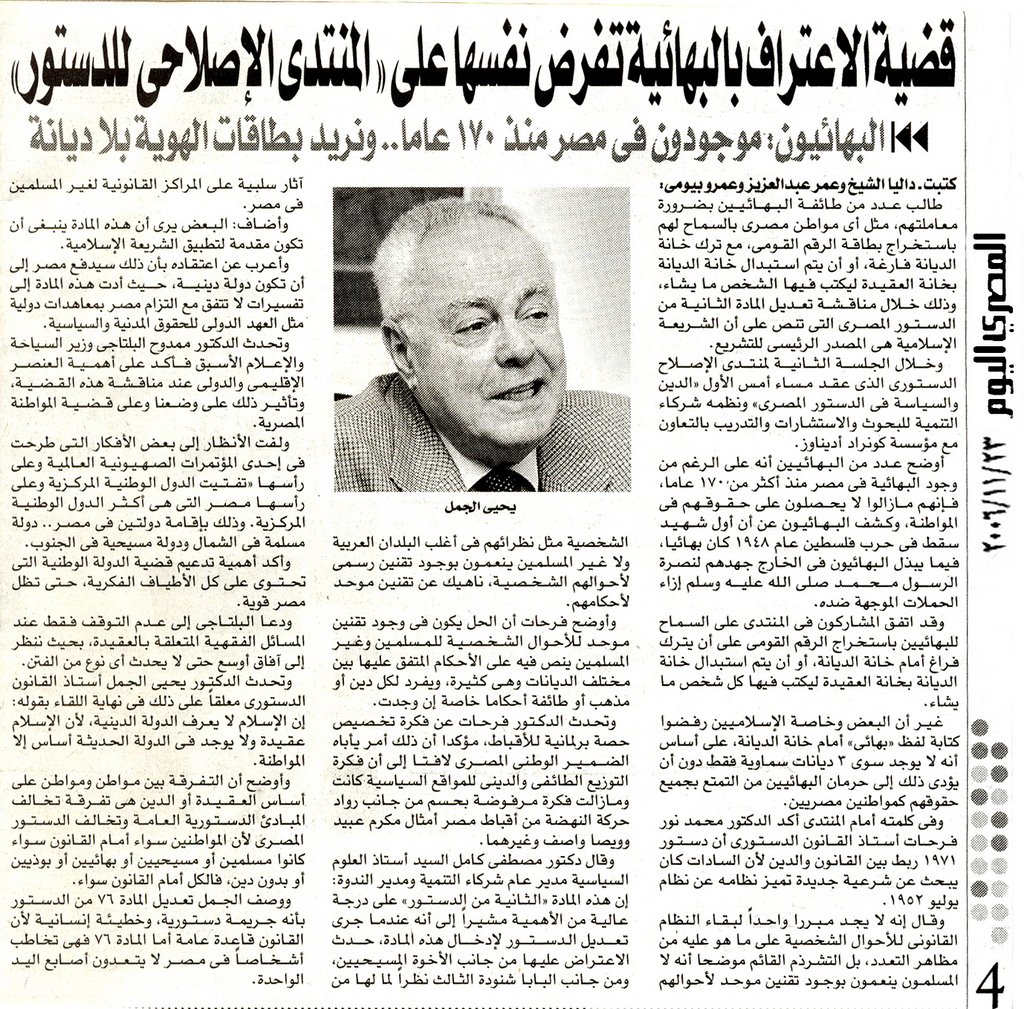
Egypt: Symposium on Constitutional Reforms


The Egyptian newspaper "al-Masry al-Youm" reported today on the role of the Baha'is in an important national symposium held in Cairo at the Marriott hotel in Zamalek. In its headline, it stated "the Legal Case [concerning] the Recognition of the Baha'i [Faith] Has Affirmed [placed] Itself in Front of the Constitutional Reforms Symposium." It is subtitled "Baha'is: Present in Egypt for 170 Years...We Demand ID Cards Without Religion."

In its extended coverage, the newspaper described in great detail the statements made by the Baha'is during this session. They presented a complete historical background of the Baha'i Faith in Egypt as well as the details of their current struggle, the consequences of their inability to obtain ID Cards, and the violation of their civil and human rights in Egypt.

A number of Egyptian Baha'is were officially invited to participate in this national symposium on constitutional reforms, and in particular to participate in discussions related to the necessary reforms to critical issues such as in Article-2 of the Egyptian constitution which states: "Islam is the Religion of the State. Arabic is its official language, and the principal source of legislation is Islamic Jurisprudence (Sharia)."

This second session of the symposium (the first was held on 7 November 2006), which is sponsored by an Egyptian organization named Partners in Development (For Research, Consulting and Training) in collaboration with the German foundation Konrad-Adenauer-Stiftung, was held on Tuesday, 21 November 2006. It is estimated that their work on the constitution will continue for the next six months. The session was entitled "Religion and Politics in the Egyptian Constitution."

Near the conclusion of the session Dr. Yehiah al-Gamal (pictured in the article), who is a Professor of Constitutional Law, stated that "Islam does not know [recognize] a nation based on religion because Islam is a belief, and that the modern nation's foundation is only based on citizenship." he went on to clarify that "differentiation between a citizen and another based on belief is discrimination, which is in violation of the Egyptian constitution because all citizens are equal before the law; whether citizens are Muslims, Christians, Baha'is, Buddhists or irreligious, they are still all equal before the law."

The Baha'is were also invited to the next session entitled "The Nation's Economic and Social Role in the Constitution." In addition to the Baha'is, several prominent leaders, specialists and scholars representing the Egyptian society were invited to contribute to the symposium.

This important symposium is well timed with the current push by President Mubarak to implement progressive constitutional reforms in Egypt as was presented in his recent speech on 19 November at the opening of the Egyptian parliamentarian session this past Sunday.