Showing posts with label al-Azhar. Show all posts

Thursday, January 31, 2008

While Al-Azhar Supports Egypt's Court Ruling on Baha'is, Ministry of Interior Contemplates Appeal!

In a statement published in today's (31 January 2008) edition of Cairo's Rose al-Yousef newspaper, Al-Azhar, represented by its Islamic Research Council, expressed its support of the 29 January court ruling that allowed the two Baha'i litigants to be issued birth certificates and ID cards with no religious classification entered in the required section of these documents.

The statement indicated that the members of the council affirmed that the Administrative Court ruling allowing these Baha'is to leave the religion section vacant or to enter the word "other" does not violate the prior decision of the Islamic Research Council in which it did not recognize the Baha'i Faith.

The article further explains, "Member of the Council, Dr. Muhammad El-Shahaat El-Gendy, clarified that the ruling is in agreement with the decision of the Islamic Research Council because the ruling did not recognize the Baha'i Faith as a congregation, a societal, political or religious entity."

On the other hand, the article also reports that Dr. Hamed Sad'diq, a professor in the National Centre for Research [?], has filed an argument with Cairo's Administrative Court requesting the annulment of the court's verdict based on his opinion that "the Baha'i Faith is not recognized in Egypt as one of the three divine religions." He then went on with the usual falsehood and arguments being propagated by Egypt's extremists regarding their views of the Baha'i Faith. It is neither clear who this person is nor whom, exactly, he speaks for!

Another article in today's edition of Al-Masry Al-Youm reported on the verdict and that it has been welcomed and hailed by Human Rights Watch, the Egyptian Initiative for Personal Rights and the Baha'i International Community. It also reported that "a responsible security source from Egypt's Ministry of Interior revealed that the Ministry's section on legal affairs is studying the ruling [just] issued by the Court of Administrative Justice in preparation for [the Ministry's] appeal before the Supreme Administrative Court."

Saturday, December 23, 2006

Egypt: Need to Apply the True Teachings of Islam

The Teachings of Islam: What is Right for Muslims Must Also be Right for Baha'is

In an "OPEN LETTER TO HIS HOLINESS POPE BENEDICT XVI" [Arabic version linked here] sent on 12 October 2006 in response to the Pope's statements in a lecture he has given at the University of Regensburg in Germany on 12 September 2006, thirty eight Islamic religious leaders, thinkers and scholars have presented their response to the Pope's injudicious comments about the Prophet Muhammad (PBUH), and his references to Islam and to religious violence which had aroused a great uproar, violence and many demonstrations by outraged Muslims throughout the world.

The statements were in regards to the Pope's use of a debate between the Emperor Manuel II Paleologus and a “learned Persian” as the starting point for a discourse on the relationship between reason and faith. Among the thirty eight co-signatories of this open letter were, H.E. Shaykh Professor Dr. Ali Jumu‘ah Grand Mufti of the Republic of Egypt and Professor Dr. Abla Mohammed Kahlawi Dean of Islamic and Arabic Studies, Al-Azhar University (Women’s College), Egypt.

This letter pointed out to the Pope the true nature of Islam and very eloquently corrected misrepresentations of it and its Prophet. As will be quoted below, the letter emphasized the merciful, tolerant and compassionate essence of Islam.

Under the title, There is no Compulsion in Religion, the letter states the following: "...There is no compulsion in religion was not a command to Muslims to remain steadfast in the face of the desire of their oppressors to force them to renounce their faith, but was a reminder to Muslims themselves, once they had attained power, that they could not force another’s heart to believe. There is no compulsion in religion addresses those in a position of strength, not weakness...." It continues by stating, "...Moreover, Muslims are also guided by such verses as Say: The truth is from your Lord; so whosoever will, let him believe, and whosoever will, let him disbelieve. (al-Kahf 18:29); and Say: O disbelievers! I worship not that which ye worship; Nor worship ye that which I worship. And I shall not worship that which ye worship. Nor will ye worship that which I worship. Unto you your religion, and unto me my religion (al-Kafirun: 109:1-6)."

Under the title, What is "Holy War"? it states: "We would like to point out that “holy war” is a term that does not exist in Islamic languages. Jihad, it must be emphasized, means struggle, and specifically struggle in the way of God. This struggle may take many forms, including the use of force. Though a jihad may be sacred in the sense of being directed towards a sacred ideal, it is not necessarily a “war”...."

It continues: "...Moreover, the emperor’s statements about violent conversion show that he did not know what those instructions are and have always been. The authoritative and traditional Islamic rules of war can be summarized in the following principles:

1. Non-combatants are not permitted or legitimate targets. This was emphasized explicitly time and again by the Prophet, his Companions, and by the learned tradition since then.
2. Religious belief alone does not make anyone the object of attack. The original Muslim community was fighting against pagans who had also expelled them from their homes, persecuted, tortured, and murdered them. Thereafter, the Islamic conquests were political in nature.
3. Muslims can and should live peacefully with their neighbors. And if they incline to peace, do thou incline to it; and put thy trust in God (al-Anfal 8:61). However, this does not exclude legitimate self-defense and maintenance of sovereignty.

Muslims are just as bound to obey these rules as they are to refrain from theft and adultery.... God says in the Holy Qur’an:
Let not hatred of any people seduce you into being unjust. Be just, that is nearer to piety (al-Ma’idah 5:8)."

Under Forced Conversion it states: "...The command There is no compulsion in religion means now what it meant then. The mere fact of a person being non-Muslim has never been a legitimate casus belli in Islamic law or belief.... We emphatically agree that forcing others to believe—if such a thing be truly possible at all—is not pleasing to God and that God is not pleased by blood. Indeed, we believe, and Muslims have always believed, that Whoso slays a soul not to retaliate for a soul slain, nor for corruption done in the land, it shall be as if he had slain mankind altogether (al-Ma’idah 5:32)."

Under Something New it states: "...and, Say (Muhammad): I am no new thing among the messengers (of God), nor know I what will be done with me or with you. I do but follow that what is Revealed to me, and I am but a plain warner (al-Ahqaf, 46:9). Thus faith in the One God is not the property of any one religious community. According to Islamic belief, all the true prophets preached the same truth to different peoples at different times. The laws may be different, but the truth is unchanging."

And finally under Christianity an Islam it quotes the Bible: "...particularly ‘the two greatest commandments’ in Mark 12:29-31 (and, in varying form, in Matthew 22:37-40), that, the Lord our God is One Lord; / And thou shalt love the Lord thy God with all thy heart, and with all thy soul, and with all thy understanding, and with all thy strength: this is the first commandment. / And the second commandment is like, namely this, Thou shalt love thy neighbour as thyself. There is none other commandment greater than these."

Last week, shortly after this enlightened and eloquent letter to the Pope, Egypt's Supreme Administrative Court gave its final judgement against the Baha'is' basic rights, which denounced them as infidels and apostates of Islam, echoing the adamantly held attitude of al-Azhar towards the Baha'i Faith; there was no uproar or demonstration by Baha'is in Egypt or anywhere else, instead they continued their peaceful and rational appeals for their citizenship rights.

Furthermore, the Egyptian Baha'is are being told by the officials that in order to obtain ID Cards and recognition in Egypt they must either lie on official documents by denying their religion or convert to Islam!

These two events occurred within a few short months of each other. The Baha'is in Egypt, as a result of the recent Supreme Court verdict, are currently being treated as a non-entity in direct violation of the stated sacred teachings of Islam and the Holy Qur'an that has been clearly voiced by these respected Islamic leaders and scholars, including those from Egypt.

Would it not be deemed obedient to the Qur'an and the Prophet Muhammad (PBUH), righteous, sincere and honest for these honorable Muslim leaders to put into action their pronouncements and elucidations, and similarly, advice the Supreme Court of Egypt as well as the Egyptian Government to apply these essential and basic teachings of Islam to their Baha'i religious minority which has been cruelly persecuted and deprived of its basic civil and human rights?

Tuesday, November 07, 2006

Egypt: al-Azhar's Tantawi Promotes Acceptance & Dialogue

This is the latest of news from Islamic leaders in Egypt regarding their apparent tendency towards proclaiming tolerance and religious acceptance of others.

In al-Ahram newspaper article published on 7 November 2006, al-Azhar's Sheikh Muhammad Sai'yd Tantawi was reported to promote his message that "Islam welcomes dialogue with others regardless of their religious affiliation, their civilization or culture." And "that Islamic Shari'ah accepts diversity and differences between humans and urges collaboration with others for the sake of their benefit."

He pointed to the eight principles on which Islamic dialogue is based, namely: "truthfulness, objectivity, and that the goal of those consulting should be to arrive at justice and reason between the parties involved." He stressed the need to "avoid dominating others and that dialogue should be without selfish pride or a sense of superiority," to "avoid wounding others' feelings, and to respect their opinions."

This was said [on 5 November 2006] during the opening session of the tenth "Season of Culture" Congress hosted by the Supreme Assembly for Islamic Affairs, held at the Nour mosque in Abbassi'yah [Cairo]. It was also attended by Dr. Mahmoud Hamdi Zaqzouk, Minister of Religious Endowment and the president of that Assembly.

During the conference, Sheikh al-Azhar Tantawi gave a lecture on "the Islamic understanding of dialogue and that it is considered as one of the principles of Islamic Shari'ah which urges Muslims to collaborate, and [to learn how] to give and take with all humans."

He added that "conflict between people regarding their religious beliefs is an ancient matter and is in human nature." He warned that "even with the worst of conflicts leading to blinded bigotry and prejudiced dialogue, it is important that we give enough room to others when engaged in a dialogue, and to clarify interpretations and phrases used whether from the legislative or the linguistic aspects in order to arrive at justice...because there is so much misunderstanding and incorrect interpretation among people."

These words appear righteous and noble. They promote justice, collaboration, open dialogue, purity of motive, respect for others' beliefs and convictions, tolerance and acceptance. Now it is time to transform these words into action by practicing these pure teachings of Islam when dealing with all people of other beliefs and backgrounds, including the Egyptian Baha'is who have been terribly oppressed by Egypt's fundamentalist religious establishment.

Wednesday, October 04, 2006

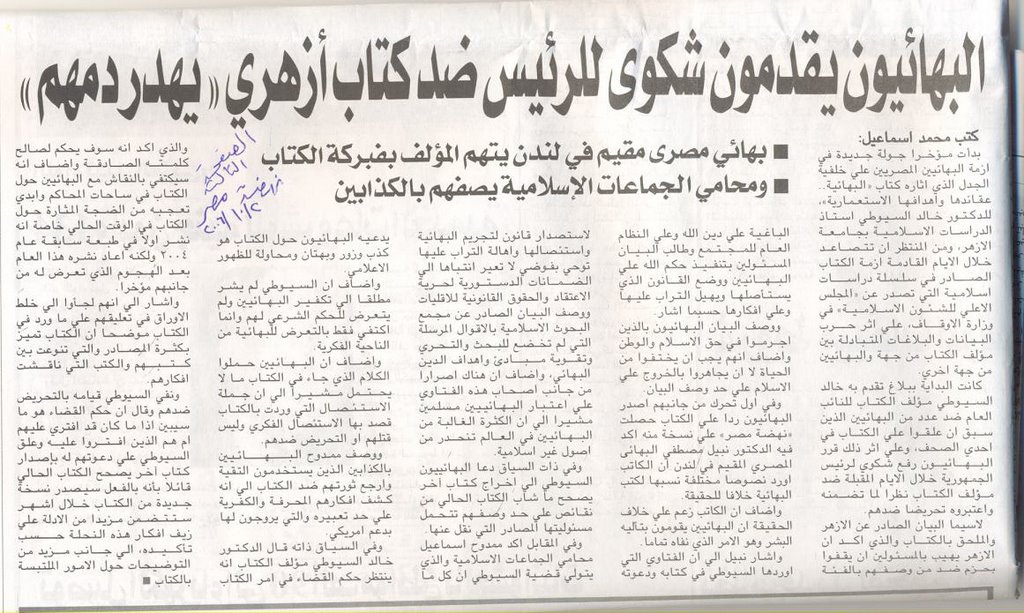
Egypt: Baha'is File A Complaint With President Mubarak

In response to the recent offensive by Dr. Khaled Abdel-Halim el-Sayouty, professor of Islamic studies at al-Azhar University and the author of a book calling for killing the Baha'is, a formal complaint was just filed with President Mubarak by the Egyptian Baha'is accusing the book's author of fabrication and forgery. The report of this action was published in "Nahdat Misr" (Rise & Renaissance of Egypt) on 2 October 2006, linked here.

Dr. Khaled Abdel-Halim el-Sayouty, under the authority and direction of the Ministry of Religious Endowment and the Supreme Council of Islamic Affairs in Egypt, authored a book entitled, "Baha'ism - its Beliefs and Colonial Goals." It included statements clearly calling for the killing of Baha'is, and was sold for a bargain price of one Egyptian Pound. It was dated June 2006 and consisted of 104 pages. The author of the book has recently hired an attorney and filed a complaint with Egypt's Attorney General alleging that he was defamed and that his reputation with the country's National Security Agency and the Presidency of the Republic has been damaged as he was presumed to promote hatred and terrorism.

In this book, its author wrote:

"[For] this Baha'i 'sect' and its likes of other deadly plagues of thought, the government should recruit all the powers it can muster, in order to stand against it and destroy it. That is because protecting the Islamic faith should rank no less [in its importance] than protecting the bodily ailments (physical sicknesses) that the government so promptly and readily rushes to remedy. Rather, protecting the faith is more important because in faith that is [still] healthy, lies purity of life, and the worship of God. If a nation loses its Faith, it loses its very identity and is overcome by its enemies. Egypt must remember that now and always it has protected Islam and the land of the Muslims since the time it [Egypt] entered the faith of Islam, and it had in the past recaptured Jerusalem and liberated Palestine in the name of Islam, and let us remember that Egypt fought in Ramadan of 1393H – October 1973 under the call of Islam "Allah'u'Akbar" and with this Call and under its banner, it prevailed, and it has to [now] cleanse and purify its land from this 'filth' and throw out this malady so that its affairs come to [the] right order, and so that it remains in the name of Islam, a leader and a rising nation."

He then added:

"al-Azhar urges those in authority in the Arab Republic of Egypt to stand firm against this wrongful congregation which is against the Faith of God and the public order of this society. The judgement of God must be executed against it, the law it deserves must be enforced and must be interred with the dust [dirt] heaped over it together with its teachings. This is protection for all citizens from its apostasy, and its beliefs that are deviant from God's straight path. Those who have committed crimes against the truth [rights] of Islam and their nation, must disappear from life so they will not dare estrange themselves from Islam."

The newspaper reported that according to an acquired copy of the formal complaint to the President of Egypt, Dr. Nabil Mustapha, an Egyptian Baha'i residing in London, stated that al-Azhar's book contains false quotations that violate reality and are inconsistent with the actual Baha'i teachings and writings.

Nabil added that the "Fatawis" pronounced by el-Sayouty in his book (mentioned in the above quotations), promote a state of chaos and anarchy and violate their constitutional guarantees of freedom of belief in the Baha'i Faith as an independent and free-standing religion. This also leads to violation of the legal rights of minorities. He described the statements made by al-Azhar's Islamic Research Council as baseless and devoid of honesty in research and unbiased investigation of the true essence of the principles and goals of the Baha'i Faith. Dr. Nabil Mustapha added that there is insistence on the part of the authors of these "Fatawis" to consider the Baha'is as Muslims [implying apostasy]. He indicated that the majority of Baha'is in the world comes from non-Muslim origins.

In this complaint, the Baha'is invited el-Sayouty to produce another book that would correct the falsities which were promoted in his current book, and to use appropriate and responsible sources.

The newspaper went on to report the response of Mamdouh Ismail, the attorney for the Islamic organizations sponsoring el-Sayouty's case. He is attempting to deny the published statements in the mentioned book and is calling the Baha'is liars!

How could the Baha'is lie about reality that is already in print, and about such ominous statements and "fatwas" calling for the elimination of Baha'is, particularly when such material has been already published and distributed by these individuals, organizations and learned institutions? Is there any logic to this?

In a way, this response is quite typical of such "learned" groups: instead of correcting their actions, investigating the merits of the case and following the path towards truth and justice, they simply resort to calling innocent and honest people "liars!"

Thursday, September 28, 2006

Egypt: Al-Azhar On The Defensive


In response to the International Religious Freedom Report released by the US Department of State, al-Azhar's top clergy are attempting to justify their position in the persecution of Egyptian Baha'is which was clearly addressed in the report as a violation of human rights.

This defense was published on 28 September 2006 in "Nahdat Misr" (Rise & Renaissance of Egypt) newspaper, entitled "American arrows [implanted] in the heart of al-Azhar...."

Sheikh Mahmoud Ashour
, a member of al-Azhar's Islamic Research Council, criticized the US report by stating that: "al-Azhar's position on Baha'is is very firm, and since it does not recognize the Baha'i Faith as a divine religion, therefore Baha'is cannot be persecuted." Implying that as far as al-Azhar is concerned, Baha'is have no rights since they do not belong to one of "the three recognized religions."

He also stated that "the report serves the soldiers [the loyals] of the United States in the region, adding, "we would not accept the interference of anyone in our internal affairs, even if it is the United States."

He stated: "Baha'i is not a religion in order for us to persecute it."

Now in response to these statements:

1) It is not up to al-Azhar or its clergy to determine whether or not the Baha'i Faith is a Divine Religion. The Baha'i Faith's divinity and legitimacy have long been established and recognized worldwide. al-Azhar is in no position, does not have the knowledge, nor has the authority to make such determination.

2) If we follow the same logic used by al-Azhar to justify its position towards the Baha'i Faith, then the millions of Muslims living in Western Countries would have no rights whatsoever, and their persecution would be justified (free for all) since Islam is not recognized by Christianity as a divine religion. But we know that this is not how they are being treated in countries where Christianity is the majority. They have their full civil rights, they are recognized as Muslims and they are free to worship and to propagate their religion.

Wednesday, September 27, 2006

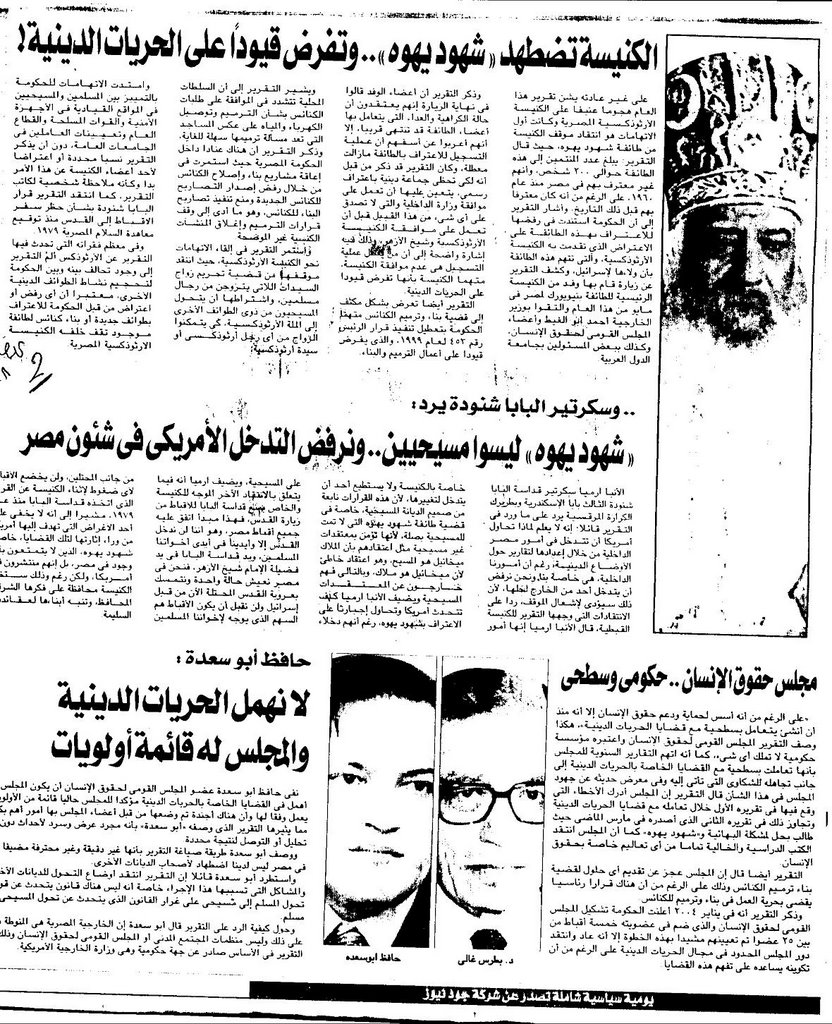
Egypt: Another Revealing Interview With Sheikh Al-Azhar Tantawi


Another interview was conducted with Sheikh al-Azhar, Dr. Muhammad Sayyid Tantawi, published in "al-Watany el-Youm" (The Homeland Today) newspaper on 19 September 2006. The interview was triggered by the recent conflict regarding the Pope's statement. However, the interview went farther from this subject and narrowed on the plight of the Baha'is in Egypt.

The interviewer asked the Sheikh: what was his opinion regarding the proposal of Egypt's National Council for Human Rights to eliminate the religion section from ID Cards?

Tantawi responded by stating that "they have no right to do so...religion section must remain, as it does not cause any discrimination...we have nothing to do with human rights...that section is necessary, necessary, necessary."

The next question was: "what is the use of it as you have asserted its necessity?"

Answer: "its usefulness is for the goal of its presence [on ID cards] so we can clarify the description of the human [individual] on official documents. There is no harm that could be done to anyone in showing his religion, so why do we eliminate it? The religion section must not be changed regardless of those who request that, as the human [individual] has the right to write in his religion in the specified section [on ID cards]."

Next question: "even if he is a Baha'i?"

Answer: "yes, he writes in it "Baha'i," there is no objection to that as long as this is his belief and had taken it for himself as a belief. Therefore writing Baha'i in the religion section liberates any other religion from him and prevents some from being linked to any of the other divine religions that are innocent [free] of them."

Next question: "does this mean recognizing it [Baha'i] as a religion?"

Answer: "Baha'i is not a religion, but writing it as a belief in the religion section is a real possibility as there is no harm in it, but it is a necessary distinction as they are outside of the divine religions."

Next question: "Your eminence are seeing Baha'i as "outside Islam," but after that you also speak of freedom of belief. Don't you find in this a contradiction?"

Answer: "freedom of belief is the right for all, and not for only one. What is meant by freedom of belief is that every human has his own belief, and is only accountable to God."

Earlier on in the interview when Tantawi was asked questions regarding the reaction to the Pope's statement, he said: "...the UN Security Council must expeditiously produce a legislation that forbids accusations directed at religions...."

The original newspaper publications have been added to this post in order to ensure its authenticity and accuracy. The online publication of the same article can be accessed HERE.

This interview and its publication have formally documented the current official stand of al-Azhar el-Sharif, represented by its eminent head Sheikh Tantawi, on the right of Egyptian Baha'is to enter their religion as "Baha'i" in the specified section of the newly government-issued ID Cards.

Tuesday, September 26, 2006

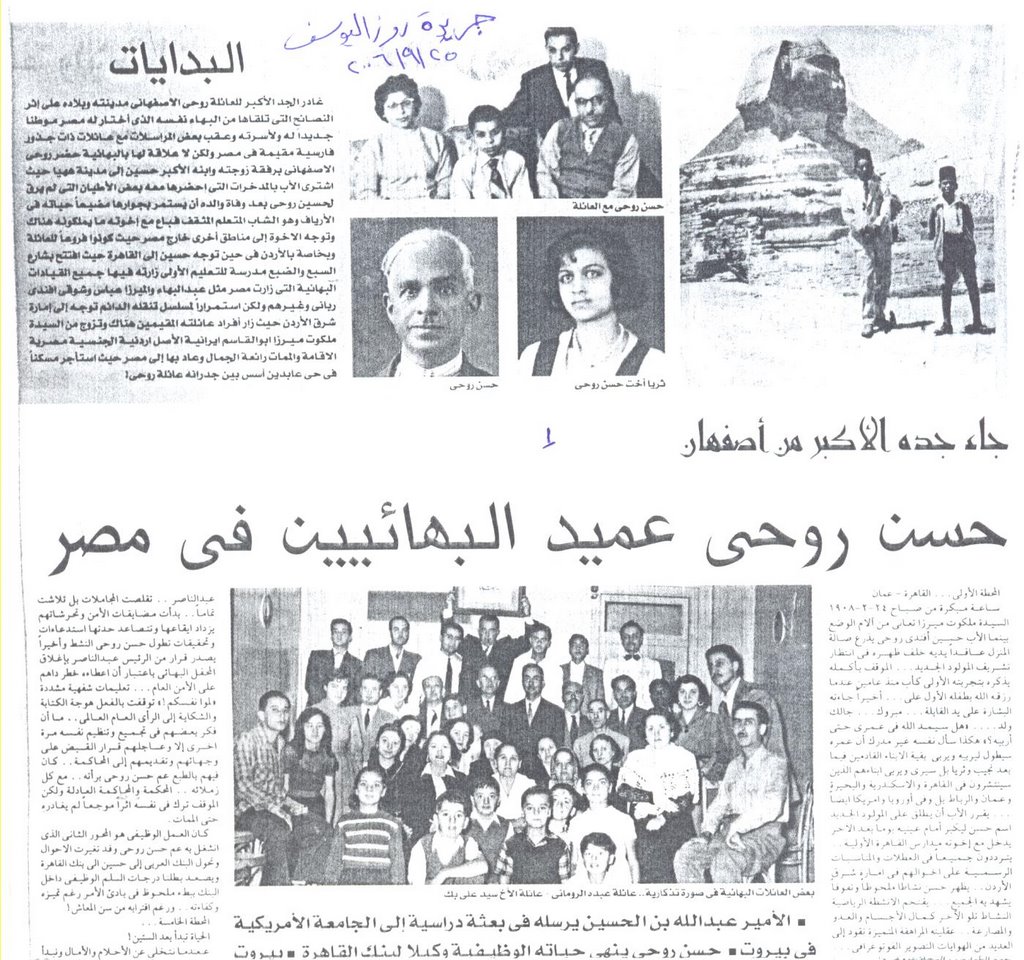
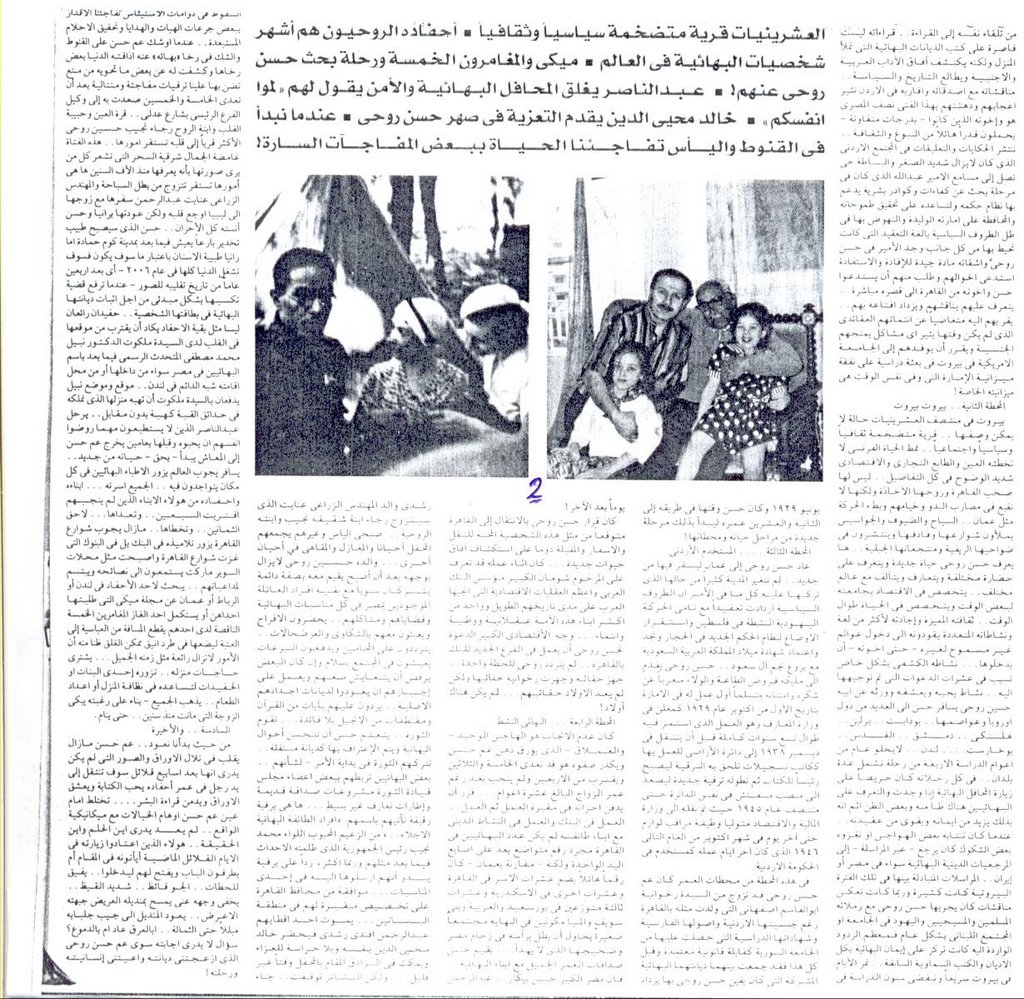
Egypt: Rose El-Yousef Returns With Its Own History

The second article in the promised series on Egyptian Baha'is was published on 25 September 2006 in Rose el-Yousef newspaper. As before, the writer relies heavily on sensationalism and contemptible journalism.

This time he recounts the history of a Baha'i Family which was headed by the late Mr. Hussein Ruhi. It is not clear how the author had obtained his information since he does not use any references to support his story. The only reference he makes regarding this, is a vague description of how he had obtained his information by deceiving Mr. Ruhi's son, who was described by the author as: "an elderly Mr. Hassan Ruhi...who cannot differentiate between dreams and reality...and who did not realize that his documents and photographs would land in the hands of a man the age of his grandchildren who loves writing and adores documents in order to satisfy his readers."

It is truly tragic to witness such journalism that is devoid of ethics and integrity!

The purpose of this post is to expose the writer's intentions and to make these articles available to those who would want to respond to the inaccuracies indicated in the publication. The comment section of this blog is entirely open for such responses and clarifications. In addition to posting comments on this blog, members of the families mentioned in the article might also want to write to the editor of Rose el-Yousef with their thoughts, responses and corrections.

The other article published in Rose el-Yousef on the same day, is a report on a study regarding the Baha'i Faith conducted by Mr. Sameh Sayyid who was commissioned by al-Azhar's Islamic Research Council. The "researcher" admits that the Baha'i International Community had written a letter to al-Azhar with copies to Egypt's President Mubarak and Prime Minister Nazif, offering to collaborate with al-Azhar in this study, but apparently the offer was ignored, and the study was conducted without any input from the Baha'i Institutions nor the input of any reputable scholarly and unbiased agency.

Of course the report exudes falsehood and the usual nonsense and misrepresentations--again nothing new! It also clearly illustrates the very poor scholarship and intellectual dishonesty exhibited by this "learned institution" and its so-called scholars and men of the law. All these accusations have been repeatedly addressed by authoritative as well as scholarly responses as can be seen (in English) HERE and (in Arabic) HERE. Other responses to al-Azhar (in Arabic) can be accessed HERE. Also, a letter which was written to Egypt's Minister of Justice prior to the completion of this "study" can be seen HERE.

This apparent "legal scholar" goes further to propose a solution to the ID Card dilemma with which the Baha'is have been faced. He offers that either the section on religion is left vacant or that it indicates "without religion." His justification is that the Baha'is as well as others who don't belong to the "three recognized religions" in Egypt "could be identified and treated accordingly." Here is another reminder of the grim past when people were selectively identified according to their religion so that they could be persecuted and rounded up whenever the need arises, as described in this previous post.

Monday, September 25, 2006

Egypt: Attacker Of Baha'is Attempts A Futile Offensive

The man that authored a book calling for killing the Baha'is in Egypt, which was published and distributed to bookstores and newspaper stands across the country, is now attacking the Baha'is again, but in an outrageous, irrational and twisted legal maneuver.

Dr. Khaled Abdel-Halim el-Sayouty, under the authority and direction of the Ministry of Religious Endowment and the Supreme Council of Islamic Affairs in Egypt, authored a book entitled, "Baha'ism - its Beliefs and Colonial Goals", and includes statements clearly calling for the killing of Baha'is, and was sold for a bargain price of one Egyptian Pound. It was dated June 2006 and consisted of 104 pages.

On 24 July 2006, an interview with some Baha'is was published in "Sowt el-Omma" (Voice of the Nation) newspaper regarding the fact that they were terrorized by the publication of that book, which had sanctioned and called for the spilling of Baha'i blood in the name of Islam. The Baha'is who were interviewed had defended themselves, as was noted in this previous post.

As reported in the same newspaper on 25 September 2006, Khaled el-Sayouty, the author of the book, has recently hired an attorney and filed a complaint with Egypt's Attorney General alleging that he was defamed and that his reputation with the country's National Security Agency and the Presidency of the Republic has been damaged as he was presumed to promote hatred and terrorism.

He goes further to deny the exact words that he had already published in his book! Unfortunately for him the book has been released back in June and sold at news-stands and bookstores across the country.

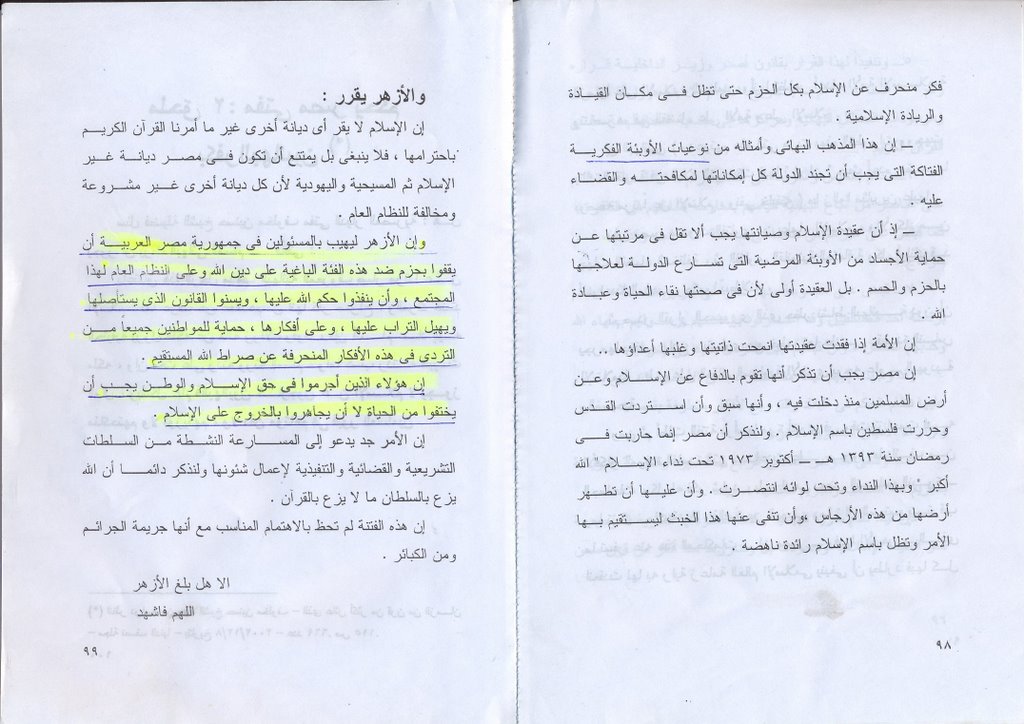
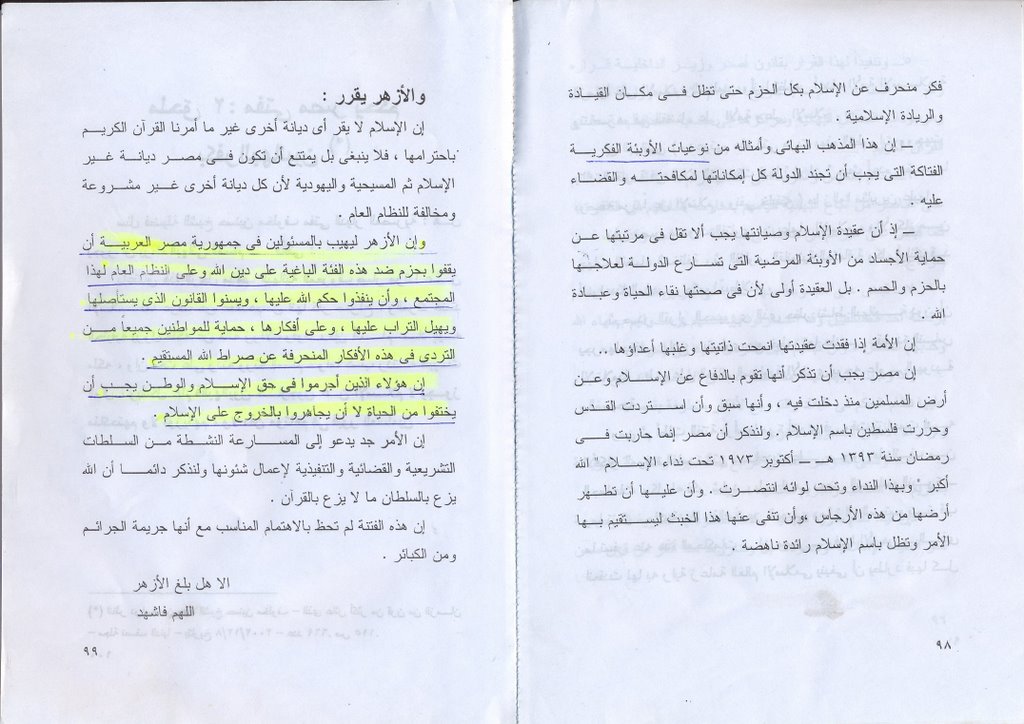
On page 99 of his book, the author states following (translated):

"al-Azhar urges those in authority in the Arab Republic of Egypt to stand firm against this wrongful congregation which is against the Faith of God and the public order of this society. The judgement of God must be executed against it, the law it deserves must be enforced and must be interred with the dust [dirt] heaped over it together with its teachings. This is protection for all citizens from its apostasy, and its beliefs that are deviant from God's straight path. Those who have committed crimes against the truth [rights] of Islam and their nation, must disappear from life so they will not dare estrange themselves from Islam."

Thanks to Ghanim (one of the commentators) who translated page 98 as shown below, which is what the author of the book had stated about the Baha'i Faith in the page preceding the one quoted above:

"[For] this Baha'i 'sect' and its likes of other deadly plagues of thought, the government should recruit all the powers it can muster, in order to stand against it and destroy it. That is because protecting the Islamic faith should rank no less [in its importance] than protecting the bodily ailments (physical sicknesses) that the government so promptly and readily rushes to remedy. Rather, protecting the faith is more important because in faith that is [still] healthy, lies purity of life, and the worship of God. If a nation loses its Faith, it loses its very identity and is overcome by its enemies. Egypt must remember that now and always it has protected Islam and the land of the Muslims since the time it [Egypt] entered the faith of Islam, and it had in the past recaptured Jerusalem and liberated Palestine in the name of Islam, and let us remember that Egypt fought in Ramadan of 1393H – October 1973 under the call of Islam "Allah'u'Akbar" and with this Call and under its banner, it prevailed, and it has to [now] cleanse and purify its land from this 'filth' and throw out this malady so that its affairs come to [the] right order, and so that it remains in the name of Islam, a leader and a rising nation."

He also states in his complaint that, as a university professor with responsibilities towards his faculty and students, he has been studying the Baha'i Faith along with other religions so that he can expose them.

One cannot but dare to wonder that if he has been truly, independently and objectively studying the Baha'i Faith, he would have adopted the Baha'i Faith by now.... History tells us that several others under very similar, and even worse, circumstances have done so!