Showing posts with label Birth Certificates. Show all posts

Friday, September 18, 2009

PRI on Religious Freedom in Egypt

The US-based Public Radio International (PRI) ran a story recently in its "The World" program on religious freedom in Egypt. The World is a co-production of WGBH/Boston, PRI, and the BBC World Service. As usual for this program, the story is well researched and directed, giving us a glimpse into the most recent developments regarding this sensitive subject.

In order to hear the entire story, please click here.... or Download MP3

A transcript of the program is also available at this link and is posted below:

Religious freedom in Egypt

By The World - September 7, 2009

In Egypt, followers of the Bahai religion have often complain of persecution and even official discrimination. But they have recently made gains in the largely Muslim country. The World’s Aya Batrawy reports from Cairo.

Read the Transcript
This text below is a phonetic transcript of a radio story broadcast by PRI’s THE WORLD. It has been created on deadline by a contractor for PRI. The transcript is included here to facilitate internet searches for audio content. Please report any transcribing errors to theworld@pri.org. This transcript may not be in its final form, and it may be updated. Please be aware that the authoritative record of material distributed by PRI’s THE WORLD is the program audio.

MARCO WERMAN: There is no First Amendment guarantee of freedom of religion in Egypt. That’s okay if you’re Muslim, Christian, or Jewish. If not it’s been impossible to get a government ID card. But last month an Egyptian court ruled in favor of a follower of the Bahai religion. He and his children can fill out their papers and leave that question on religious identification blank. It’s a step in the right direction for Bahais but Aya Batrawy reports from Cairo that Egyptians Bahais have a long way to go before they’re accepted as equals.

AYA BATRAWY: While it’s never been illegal to be a Bahai in Egypt, being one has never been easy. Amm Ahmed, his wife, and their six children had to flee their rural town of Suhag in southern Egypt due to harassment. In March, fellow residents burned his house down along with those of three other Bahai families. Even now, he is meeting me in a private residence on the outskirts of Cairo away from the public eye and security officials.

AMM AHMED: [SPEAKING ARABIC]

BATRAWY: And it is only in private that Amm Ahmed can practice his faith. Dressed in a traditional Egyptian gallabiya and turban he reads verses from the Bahai holy book as the Muslim call to evening prayer rings out in the background.

AHMED: [SPEAKING ARABIC]

BATRAWY: Although born Bahai he used to work as a reciter of the Quran. He saw nothing wrong with reading the Quran since the Bahai faith embraces it as well as the scriptures of other religions. But soon after he announced he was Bahai both he and his wife were imprisoned for nine months on charges of which he is still unaware. The recent torching of his house because he is Bahai further convinced him the government must do more.

AHMED: [SPEAKING ARABIC]

TRANSLATOR: Egypt can do better than this. It must open a dialogue with Bahais and sit with us and see what we believe in. This way people can relax and we can relax.

BATRAWY: The Bahai faith was founded in the mid-19th century by a Persian named Baha’Ullah. Members believe that God’s will has been revealed by messengers of all the world’s major religions and that world peace will come when humanity recognizes it is one race which worships one God. But many Muslims view the religion as a heretical deviation of Islam and Bahais have long faced persecution particularly in Iran. Here in Egypt Bahais enjoyed some level of recognition until 1960 when the government outlawed their public activities and forced them to misidentify themselves on government documents as either a Muslim, Christian, or Jew. Following years of legal struggle a court ruled earlier this year that Bahais can leave the section under religion as blank on government identification cards and birth certificates. Hossam Bahgat of the Egyptian Initiative for Human Rights.

HOSSAM BAHGAT: There are two ways of looking at this positive court outcome. For Bahais it’s simply a correction of a mistake. But for Egyptians in general it is a significant step in that this is the first time in Egypt’s legal history that there is an administrative system to deal with Egyptians who do not adhere to one of the three state-recognized religions of Islam, Christianity, and Judaism.

RAOUF HINDY: [SPEAKING ARABIC]

BATRAWY: Seated at a café in downtown Cairo Dr. Raouf Hindy enjoys a steaming Turkish coffee as he talks about the court case. He’s a modest hero among fellow Bahais for taking the government to court and winning. His children have just become the first Egyptians to receive the new IDs.

HINDY: [SPEAKING ARABIC]

BATRAWY: He says before this ruling Bahais either had to lie on official papers which could lead to being jailed or they had to function as best they could without documentation. Now he says he’s happy that no one will force him to lie.

But there are delays and complications. Oral Surgeon Dr. Basma Moussa is one of hundreds of Bahais still waiting for the new ID. She asked that the interview be conducted in her car because she’s weary of being interviewed in public. Although she’s been married for over 20 years she doesn’t have a marriage license because the Egyptian government does not recognize Bahai marriages. This means that if she and her husband check into a hotel they have to get separate rooms because unwed Egyptian couples are not legally allowed to rent hotel rooms together. It also means that she cannot file taxes properly, open a bank account, buy a new car, or receive government benefits.

BASMA MOUSSA: [SPEAKING ARABIC]

TRANSLATOR: We’re tired. We’re exhausted. And they keep making things more complicated. Just give me my papers. Since the ruling was made and the order was issued there are complications you can’t even imagine to get the new ID. Now even those who have the new birth certificate cannot marry with this ID because they say they don’t accept the Bahai marriage.

BATRAWY: Bahais still face an uphill battle for acceptance in Egypt. Just last month there protests and arrests after the government announced plans to re-house Bahais whose homes were burnt down. But the new IDs have given them hope that change is coming. For The World this Aya Batrawy in Cairo.

Copyright ©2009 PRI’s THE WORLD. All rights reserved. No quotes from the materials contained herein may be used in any media without attribution to PRI’s THE WORLD. This transcript may not be reproduced, in whole or in part, without prior written permission. For further information, please email The World’s Permissions Coordinator at theworld@pri.org.

Saturday, March 21, 2009

What Can Be Expected After Egypt's Favourable Court Ruling?

Even though Egypt's Supreme Administrative Court has, on 16 March 2009, ruled in favor of the Baha'is allowing them to obtain identity documents with dashes [--] entered in place of religion, there remain many obstacles to the normalization of their status in Egypt. This can be easily perceived when reading the recent editorials and reports in several Egyptian newspaper articles.

Initially, following the recent court ruling, several of these articles limited their reporting to the facts about the verdict itself and its implications (1, 2, 3, 4, 5, 6, 7, 8). More recently, though, newspaper editorials have been busying themselves with eliciting public opinions regarding the Baha'i case from various factions (9, 10).

These opinions range from, those who adamantly oppose the Baha'is and who are bent on continuing their "war" against the Baha'is--calling them apostates who deserve the severest of penalties, to those who are supportive of the citizenship rights of the Baha'is (10, 11, 12, 13), to the extent of voicing their disappointment that the ruling did not go far enough to permit the Baha'is to enter their true religion on these identity documents.

The intent of some of the supporters appears to be not to acknowledge the legitimacy of the Baha'i Faith as an approved religion in Egypt, but rather they look at the matter as a human rights issue: that is the right of people to independent belief and to be identified correctly according to their own belief.

There remain, also, many others who do not understand what the fuss is all about and do not even acknowledge the existence of such a thing as "Baha'i," stating: "besides Islam and Christianity in Egypt, we only had Jews, and fortunately we have managed to get rid of them."

Furthermore, there are those who resort to using the well-known Egyptian sarcasm in order to make their point by calling the Baha'i Faith "Al-deen Abu-Sharta [the dashes religion]," referring to the ruling that allowed dashes to be entered in place of religion on identity documents.

Emad & Nancy Raouf Hindi in the courtroom on 16 March

This controversy, which cannot just vanish overnight simply because of a favorable court verdict, will likely continue for some time to come. Thus, the difficult task before the Baha'is of Egypt will likely go beyond the mere pursuit of their identity documents and the consequent acquisition of some of their citizenship rights.

It will require an extraordinary effort on their behalf to influence the public opinion as to the nature and the legitimacy of their belief. They will also need to help the Egyptian society learn the truth about their Faith and the desire of the Egyptian Baha'is, as obedient citizens and well-wishers of their homeland, to join hands with their fellow Egyptians in promoting their collective welfare.

It is a natural human reaction, particularly after such a long suffering and after so many legal battles, for all those affected by the ruling to be ecstatic with such a victory in their ongoing struggle for their rights. It is also obvious that many other minorities in Egypt will ultimately benefit from such a ruling that, at last, opened the door for them towards their civil rights without having to identify themselves as belonging to one of the three approved religions in Egypt. It is time, however, for the harder task to begin: that is for the Baha'is to intensify the projection of their well-acknowledged brilliant image on their beloved society and correct public perception of their true nature and intent.

A tough obstacle in their path, however, remains to be presidential decree (263) that, in 1960, outlawed the Baha'i Faith in Egypt. Without the reversal of this decree, the Baha'is of Egypt will continue to be the targets of all sorts of false accusations, attacks and ill-intentioned challenges by the extremist elements of the Egyptian society. Ultimately, in order for them to be treated equally in the true sense, it is essential for their status in Egypt be fully legitimized by removing all barriers to their standing as equal citizens of their beloved Egypt.


Monday, March 16, 2009

Baha'i International Community Reacts to Egypt's Favourable Court Ruling

Baha'i World News Service has just published the reaction of the Baha'i International Community to the 16 March 2009 ruling by Egypt's Supreme Administrative Court. Quoting Mr. Hossam Bahgat, the director of the Egyptian Initiative for Personal Rights (EIPR) which has been handling the litigation, it writes:
"This is the first time that the Supreme Administrative Court has found that any Egyptian has the right to keep their religious convictions private, even if the state does not recognize their belief system...."

Posted below is the entire published response on behalf the Baha'i International Community. The photograph below (a group of Baha'is at the court's entrance) has been added by the author of this blog.

Egyptian court removes barriers to ID documents for Baha'is
16 March 2009

GENEVA — A court in Egypt today removed any grounds for preventing Baha'is from receiving proper official identity documents, clearing the way for an end to years of deprivation for Egyptian Baha'is - and opening the door to a new level of respect for religious privacy in Egypt.

The Supreme Administrative Court dismissed an appeal by two Muslim lawyers that sought to prevent implementation of a lower court ruling last year that said Baha'is can leave blank the religious classification field on official documents, including all-important identity cards and birth certificates.

"We are pleased that the court has finally put this matter to rest, removing any possible excuse that would prevent the government from issuing official documents to Egyptian Baha'is," said Bani Dugal, the principal representative of the Baha'i International Community to the United Nations.

"Our expectation now is that the government will move swiftly to bring this ruling into practice and, at long last, grant Baha'is the essential right that all citizens have of possessing proper documents."

Hossam Bahgat, director of the Egyptian Initiative for Personal Rights (EIPR), said the ruling actually goes far beyond the issue of rights for Egyptian Baha'is.

"This is the first time that the Supreme Administrative Court has found that any Egyptian has the right to keep their religious convictions private, even if the state does not recognize their belief system," said Mr. Bahgat, whose organization handled legal representation for Baha'is in court.

"The final ruling is a major victory for all Egyptians fighting for a state where all citizens enjoy equal rights regardless of their religion or belief," he said.

Mr. Bahgat said that because the Supreme Administrative Court is the highest court on such matters, there can be no further appeal to this case - and that, therefore, there should be no delay in the government's implementation of the new policy.

"The government policy that justified mistreatment of Egyptian Baha'is has now been firmly and finally struck down," he said.

For nearly five years, since the government began introducing a computerized identity card system that locked out all religious classifications except Islam, Christianity, and Judaism, Baha'is have been unable to get documents essential to day-to-day life. Among other things, they have been blocked from obtaining education, financial services, and even health care in government hospitals.

In April 2006, a lower administrative court upheld the right of Baha'is to be explicitly identified on official documents. But in December that year, the Supreme Administrative Court reversed that decision.

In a compromise, Baha'is proposed using a dash or the word "other" on documents, instead of being forced to list themselves as Muslim, Christian, or Jewish, and, on 29 January 2008, a lower court again ruled in their favor. But then two Muslim lawyers, who oppose anything that might be seen as even tacit recognition of the Baha'i Faith, filed an appeal.

In response, government officials took a "go slow" attitude on implementing the lower court ruling, saying they wanted to wait until all legal issues were cleared up.

The ruling today came in the case of 14-year-old twins Imad and Nancy Rauf Hindi who have been deprived of birth certificates and were unable to legally attend school in Egypt.

In recent weeks, several other cases involving Baha'is have been likewise resolved in their favor. But the Rauf Hindi twins' case was the final case to be settled.

A Remarkable Victory for the Baha'is of Egypt

While their brothers and sisters in Iran continue to endure harsh oppression, the Baha'is of Egypt have just received a remarkable gift from their judicial establishment. The appeal--brought by Islamist lawyers in their attempt to reverse the 29 January 2008 ruling that permitted the Baha'is of Egypt to obtain ID cards and birth certificates with dashes [--] inserted in place of religious identification--was denied by Egypt's Supreme Administrative Court in its session today. The court also asserted that the 29 January ruling must be now enforced and ordered the appellant, Attorney Abdel Mageed Al-Aanani, to pay all costs of the appeal.

With this ruling, all legal challenges and appeals, brought by those extremists who oppose the Baha'is in Egypt, have been defeated in court. The Ministry of Interior, the principal party to the lawsuits, has never challenged or appealed the ruling that favored the Baha'is.

With this final verdict, there are no legal or administrative obstacles left that could prevent the Baha'is of Egypt from obtaining ID cards or birth certificates in their homeland.

Even though this significant step is considered to be a very welcome development in their struggle for their civil rights, the Baha'is of Egypt continue to suffer from consequences of the 1960 Presidential Decree-263, of the late President Gamal Abdel-Nasser, that outlawed the Baha'i Faith in Egypt.

More details to follow....

Update:

The great significance of this historic ruling is clearly emphasized in the press release by the Egyptian Initiative for Personal Rights (EIPR). The Arabic version of the press release can be seen here.

Freedom of Religion and Belief Program
16 March 2009

Five-Year Legal Battle Ends in Favor of Baha’i Egyptians:

Supreme Administrative Court Upholds Right to Identification Documents without Discrimination

Today’s final decision by the Supreme Administrative Court upholding the right of Baha'i Egyptians to obtain mandatory identification documents without stipulating any religious affiliation is a welcome end to a long legal battle against official religious discrimination, the Egyptian Initiative for Personal Rights (EIPR) said today.

The ruling, which is not subject to appeal, permanently revoked the government policy over the past eight years of forcing Baha'i citizens to convert to one of the three state-recognized religions - Islam, Christianity or Judaism - as a prerequisite for obtaining official identification papers. Such papers are necessary for accessing most basic rights in Egypt and they must mention a citizen’s religious affiliation. EIPR lawyers, acting on behalf of Baha’i individuals, challenged the policy on the grounds that it violated the rights to freedom of belief, equality and privacy, and contravened the percepts of Shar’ia (Islamic law).
Hossam Bahgat

"The significance of today's decision goes far beyond the direct remedy it provides for hundreds of Baha’i Egyptians who have been the immediate victims of this arbitrary and discriminatory government policy,” said Hossam Bahgat, Executive Director of the Egyptian Initiative for Personal Rights. “This final ruling is a major victory for all Egyptians fighting for a state where all citizens must enjoy equal rights regardless of their religion or belief.”

Today's decision (in appeal no 10831/54) upheld a similar ruling issued by the lower Court of Administrative Justice in January 2008, which had found that the Interior Ministry’s treatment of Baha’is wishing to obtain mandatory official documents was illegal. It also ordered the Ministry’s Civil Status Department to grant them documents that did not mention any religion instead of forcing them to misidentify their religious affiliation as Muslim or Christian. While the Interior Ministry did not appeal the lower court decision, several private lawyers challenged the decision in a number of judicial appeals and the Ministry has used these appeals as justification for not implementing the decision for more than one year now.

"Now that all legal challenges against restoring the rights of Baha’is have been dismissed, the government has no more excuses for dragging its feet in ending this abusive policy without delay,” said Bahgat.

Background

With the introduction of computer-generated identification documents in Egypt around the year 2000, the Interior Ministry’s Civil Status Department decided, without legal basis, to stop issuing or renewing official documents for Baha’i Egyptians unless they agreed to change their religious affiliation in public records to one of three officially recognized religions. In 2004 the Interior Ministry went a step further and started confiscating birth certificates and identity cards from Baha'i individuals if these documents showed their adherence to the Baha’i faith.

In the same year some Baha'i individuals whose papers had been confiscated without legal justification challenged the new policy before the administrative court, and in April 2006 the Court of Administrative Justice decided in their favor and ordered the government to recognize their adherence to the Baha’i faith in all official documents. The Interior Ministry however appealed the decision, which was later reversed by the Supreme Administrative Court in December 2006.

In January 2007, Baha'i Egyptians once again sought recourse from the administrative court, this time asking for the right to obtain identification documents without revealing their religious conviction. The Court of Administrative Justice found in their favor in January 2008. Shortly afterwards, the Interior Ministry announced that it would not appeal the decision issued in favor of the Baha'i applicants, but that it would not implement it until courts have decided on all legal challenges filed against it by a number of private lawyers.

The inability to obtain or renew identification documents for more than eight years has caused severe difficulties for Egypt’s Baha’i citizens whose number is thought to be around 2,000 individuals. Basic daily activities – such as registering for school, opening a bank account, engaging in a property transaction, collecting a pension check, immunization of children – all require a national ID or a birth certificate.

All rights reserved © Egyptian Initiative for Personal Rights
e-mail:eipr@eipr.org

Monday, February 16, 2009

Cairo: Another Postponement & More Delays to Come!

The news from Egypt are not any better! In its session today, Egypt's Supreme Administrative Court postponed the verdict on the Baha'i ID case before it until 2 March 2009. The presiding judge stepped down and excused himself from the case, opening the door for another judge to take over the case and the decision on the appeal.

This counts for the sixth postponement of the decision on the appeal brought by extremist lawyers who were never party to the case . Following the initial hearing of the appeal on 27 September 2008 by this court and the scheduled verdict date of 20 October 2008, this is the sixth postponement (3 November 2008, 15 December 2008, 19 January 2009, 2 February 2009 & 16 February 2009). The Supreme Administrative Court's own State Judiciary Council had considered the appeal and had rejected it. The court was expected to abide by the decision of the Council.

The lower court's decision of 29 January 2008 was in favor of the Baha'is, allowing them to obtain ID cards and birth certificates with dashes [--] instead of their stated religion.

Considering the history of this case, and with the--now--introduction of a new judge, one cannot expect much progress. It would not be surprising to see more delays and indecision. The Ministry of Interior has not budged on its stand of not issuing identity documents for the Baha'is until a final court decision is reached. It is important to note, however, that the Ministry of Interior, who is the primary defendant in this case, has never appealed the 29 January decision favoring the Baha'is.

Saturday, January 31, 2009

Baha'is of Egypt Anticipate Final Verdict in Two Days

Egypt's Supreme Administrative Court is scheduled, on 2 February 2009, to announce its verdict regarding the appeal brought by Islamist lawyers in their attempt to reverse the 29 January 2008 ruling that allowed the Baha'is of Egypt to obtain ID cards and birth certificates. This appeal is thought to be the last apparent hurdle to granting the Baha'is their due identity rights. In order to review the recent history of this case, please look at the last post linked here....

A global prayer chain has been organized by world youth, linked to at this site.

Saturday, January 17, 2009

Cairo's Administrative Court Rejects a Challenge To Baha'i Rights

As was described in a previous post, the Baha'is of Egypt have been awaiting two court dates scheduled to issue final verdicts regarding the challenges and appeals lodged against the previous court rulings that were in their favor. The 17 January 2009 date, quoted below, concerns the challenge by an Islamist lawyer intended to halt the court ruling allowing the Baha'is to obtain birth certificates and ID cards with dashes [--] inserted instead of their religious identity.
...scheduled for 17 January 2009, on which Cairo's Seventh Circuit Administrative Court will rule on a challenge (a stalling tactic--not an appeal) to the same ruling of 29 January 2008 of the First Circuit Administrative Court, in which another Islamist lawyer challenged the competence of the judge. Consequently, the judge had referred the case out of his court to the Seventh Circuit Court for an unbiased determination.

In its session today, Cairo's Seventh Circuit Administrative Court rejected the challenge filed by the said lawyer, Hamed Saddiq, who was acting on behalf of Egypt's Islamic Research Council which is under the auspices of al-Azhar University. His challenge had the effect of stalling the implementation of the favorable 29 January 2008 court ruling.

Today's verdict implies that the 29 January 2008 court ruling in favor of the Baha'is can be enforced by the Ministry of Interior and that it can proceed, without delay, to issue the Baha'is of Egypt birth certificates with dashes [--] inserted in the religion section of these documents. Today's verdict concerns only the case of 14-year-old twin children, Emad and Nancy Raouf Hindi whose father has been requesting the issue of their birth certificates.

The Other case concerning the 18-year-old university student Hussein Hosni Bakhit Abdel-Massih, who is in quest for his ID card (he was dismissed from the university consequent to his inability to obtain a military postponement certificate, required for the continuation of his education), was heard on 15 January 2009 and postponed until 24 February 2009 for a final verdict on the challenge, filed by the same lawyer (Hamed Saddiq). The 29 January court verdict had also ruled in his favor to obtain an ID card with dashes [--] in place of his religion.

The next date to watch is 19 January 2009, on which Egypt's Supreme Administrative Court will issue its final verdict on an appeal by another Islamist lawyer, named Abd El-Mageed El-Aanany. He was not a party to the lawsuit, but appeared to act on behalf of extremists. The appeal could not stop the implementation of the ruling unless the court had decided to do so. In this case, the court has not stopped the implementation of the lower court's ruling, and the Ministry of Interior has not appealed either.

It is anticipated the the Supreme Administrative Court will reject the appeal since its own State Judiciary Council has already recommended this course of action.

Based on these developments, it is becoming clearer that Egypt's judiciary is on a righteous path that is headed towards a resolution to the dilemma of the Baha'is of Egypt, who are in quest of their basic civil rights.

Monday, December 15, 2008

Egypt's Supreme Court Postpones Verdict Again!

Egypt's Supreme Administrative Court convened today to rule on the appeal described in this previous post and quoted below:
The first one will be on 15 December 2008 at Egypt's Supreme Administrative Court when a decision is expected regarding the appeal of a non-party (by an Islamist lawyer) to the 29 January 2008 ruling that allowed the Baha'is to obtain identification documents and birth certificates by inserting dashes "--" in place of religion in these documents. It is expected that the court will endorse the recommendation of its own State Judiciary Council to reject the appeal since the appellant, as stated by the council of judges, has no right to interfere with this lawsuit, and since the defendant (the Ministry of Interior) had not appealed the ruling and had accepted it on its face.

The court decided to postpone its verdict again until 19 January 2009.

Wednesday, December 10, 2008

Upcoming Court Dates to Watch in Egypt

The Baha'is of Egypt are eagerly awaiting two court dates that might greatly influence their struggle to obtain identity documents.

The first one will be on 15 December 2008 at Egypt's Supreme Administrative Court when a decision is expected regarding the appeal of a non-party (by an Islamist lawyer) to the 29 January 2008 ruling that allowed the Baha'is to obtain identification documents and birth certificates by inserting dashes "--" in place of religion in these documents. It is expected that the court will endorse the recommendation of its own State Judiciary Council to reject the appeal since the appellant, as stated by the council of judges, has no right to interfere with this lawsuit, and since the defendant (the Ministry of Interior) had not appealed the ruling and had accepted it on its face.

The second date is scheduled for 17 January 2009, on which Cairo's Seventh Circuit Administrative Court will rule on a challenge (a stalling tactic--not an appeal) to the same ruling of 29 January 2008 of the First Circuit Administrative Court, in which another Islamist lawyer challenged the competence of the judge. Consequently, the judge had referred the case out of his court to the Seventh Circuit Court for an unbiased determination.

Meanwhile, as of today, the Baha'is of Egypt remain "without identity."

Saturday, November 22, 2008

Egypt: Yet Another Newborn Denied Birth Certificate

A baby, named Shehab Shady Moussa, was born in Cairo on the 9th of November of this year to Baha'i parents. When his father went to the civil affairs agency, charged with registering newborns and producing their birth certificates, he was told that they received recent instructions from the Ministry of Interior forbidding them from issuing birth certificates to Baha'is. This is despite multiple court rulings ordering the Ministry to issue certificates to children born to Baha'is with dashes "--" inserted in place of their religious identity.

This news item was published in today's edition of Cairo's Al-Badeel newspaper (attached, with a photograph of the Minister of Interior, Habib Al-Adly). The baby's father told the newspaper that this means that his newborn child cannot be counted in Egypt's census, he cannot be vaccinated against serious infectious diseases and that the baby's mother cannot obtain maternal leave from her employment.

This newborn can be now added to a long list of Egyptian children, born to Baha'i parents, who live in the shadows, and whose existence has been denied by their own government. They are deprived of all their human and civil rights, including the rights to health care and education. By doing so, Egypt continues to be in gross violation of all international covenants that guarantee the rights of man, to which Egypt is a co-signatory.

The entire world must express its outrage at this inhumane treatment of children in a nation considered to be a so-called mainstream, moderate and modern, as well as one that is regarded to represent a unique ancient civilization--admired by all. Is this what Egypt wants to be remembered by? One would doubt this very much, and one would expect otherwise.

Saturday, October 25, 2008

An Update: Personal, Egypt & Iran

This past week has been full of events on many fronts, both personal and public. On a personal level, I would like to share the arrival of our first grandchild in San Francisco, a peaceful and happy baby girl who looks up to a future full of peace and harmony. More specifically to a future when people are not segregated based on their color, race, religion, ethnicity, class, political orientation, nationalism, or culture. A future when all people share the same opportunity regardless of where they are or who they are, and where people feel comfortable in their homelands without intimidation or alienation caused by ugly and divisive political and social rhetoric .

Regarding the recent news from Egypt, most significant is the decision of Egypt's Supreme Administrative Court on 20 October to postpone its final verdict on the question of issuing ID cards to the Baha'is until its next session of 3 November 2008.

As was posted before, "the State Council of the Supreme Administrative Court has produced a judicial memorandum requesting the Supreme Administrative Court to issue a final judicial judgment that affirms the [29 January 2008] ruling of Cairo's Administrative Court, which allowed placing dashes '--' for the Baha'is of Egypt in the religion section, since neither the Ministry of Interior nor the Attorney-General appealed the decision of the Administrative Court."

It is hoped and expected that the Supreme Court will abide by the decision of its own State Judicial Council. This will surely ease some of the serious difficulties encountered by the Baha'is of Egypt on a daily basis, simply because of their inability to possess identification documents and birth certificates.

Additionally, Egypt's National Council for Human Rights, a government-appointed official organization, has just proposed to the government the passing of a law that forbids discrimination based on religion, a law that would ensure equal treatment for all Egyptian citizens regardless of their belief.

As to Iran, a revealing piece of information has just made the world aware of a document vindicating the Baha’i youth prisoners in Shiraz. The youth, named: Raha Sabet, Haleh Rouhi and Sasan Taqva, have by now completed 10 months of their four-year sentence and continue to be incarcerated in the prison facility of the Ministry of Intelligence (known as Pelak 100), which is reserved only for interrogations and temporary arrests.

The two-page document, belonging to the office of the Supreme Leader [Ayatollah Ali Khamenei], discovered in relation to the humanitarian activities of the 54 Baha’is in Shiraz arrested on 19 May 2006 on the charge of “participating in activities against state security,” showed that these individuals are indeed innocent. Of interest, the document's date is 16 June 2008, but it remained a secret until now, and the Iranian authorities did nothing to correct its wrongdoing and release these innocent youth. In order to read the entire translated (very revealing) document and view the original one, please refer to this site, named Iran Press Watch.

Saturday, October 04, 2008

Breaking News for the Baha'is of Egypt

The case of the Baha'is of Egypt has just undergone an important new development that appears to finally permit the tentative resolution of their struggle in their quest for their civil rights. As can be recalled, on 29 January 2008, Cairo's Administrative Court had ruled that Baha'is can obtain identification documents with dashes "--" inserted in place of religious identification in the required section of these documents.

This ruling was not appealed by Egypt's Ministry of Interior or any other responsible agency or authority. It was appealed, however, by an Islamist lawyer, named Abd El-Mageed El-Aanany. He was not a party to the lawsuit, but appeared to act on behalf of extremists. Last July, the Egyptian media announced that the judicial State Council, which is a panel of judges at the highest level of the State charged with acting on such judicial matters and appeals before the Supreme Administrative Court, had rejected the appeal by El-Aanany and upheld the administrative court's ruling to allow the Baha'is obtain identification documents. In its decision, the Council had affirmed that the only authority that has interest in this case is the Ministry of Interior, not this lawyer or any others for that matter.

The appeal was heard by the Supreme Court, on 27 September 2008, which decided to postpone it until 20 October 2008 for a decision. Meanwhile, in yesterdays edition of Rose El-Youssef newspaper, the mouthpiece of the Egyptian government, an article (attached) announced that "the State Council of the Supreme Administrative Court had produced a judicial memorandum requesting the Supreme Administrative Court to issue a final judicial judgment that affirms the [29 January] ruling of Cairo's Administrative Court, which allowed placing dashes '--' for the Baha'is of Egypt in the religion section, since neither the Ministry of Interior nor the Attorney-General appealed the decision of the Administrative Court."

The article goes on to state: "The Judicial Council affirmed in its report that no citizen or any other intruder has the right to interfere with or appeal the lawsuit involving the Baha'is that was before the Administrative Court." It based its opinion on the fact that those who appealed were not a party to the lawsuit and that only the Ministry of Interior and the Attorney-General had the right to appeal.

This development should be regarded as a very important step towards the normalization of the status of the Baha'is of Egypt. It puts an end to all unjustified and frivolous challenges and appeals brought by extremists who would want to put a stop to any judgment favoring the Baha'is. With the expected enforcement of this ruling, the Baha'is will soon be able to obtain ID cards and birth certificates, and hopefully many other documents, that would allow them a normal and decent life in their homeland. Additionally, in doing so, Egypt's judiciary is in a position to prove its true independence in its quest for justice.

Thursday, July 24, 2008

Egypt's Ministry of Education is Put to Test

The recent statement of Egypt's Ministry of Education regarding the admission of Baha'i children to schools was put to test. An Arabic language blog named "Egyptian Baha'i" wrote about this recent development and expressed the rising degree of frustration caused by the inability of Baha'i parents to enroll their children in schools in Egypt.

As was posted recently here, the Ministry of Education had clearly expressed its position regarding this matter, that is, admission to schools will be based on citizenship alone, and that there will be no discrimination in the admission process based on religion. The Ministry went further by stating that it will accept children of Baha'is with (--) "dashes" in their documents.

The parents at the center of this controversy were unable to register their daughters to begin their formal education in a private elementary school because of their religious affiliation and the consequent administrative hurdles. They were referred to the Ministry of Education for an appeal. The Ministry, which had just publicized its position against discrimination, responded today with rejection of admission to the child. The reason given is that the child in question does not hold the newly issued computerized birth certificate, but rather presented them with the old "paper" birth certificate. None of the Baha'is were able to obtain the new computerized certificates (or ID cards) as had been mandated in the 29 January 2008 court verdict that allowed them to insert (--) dashes instead of their religious identification.

The handwritten response of the Ministry to the parent (in Arabic) is attached with this post. Its translation reads:
Governorate of Cairo
New Cairo Education Administration

Elementary Education


In response to the request presented by the [student's] guardian, Wassim Kamal El-Deen Nosseir regarding the admission of his daughter, Hana Wassim, using a paper birth certificate. The paper birth certificate cannot be accepted and will not be used for that purpose. A computer birth certificate must be presented instead. The signature of the Director-General is taken [as a confirmation] to reject the student's paper birth certificate.

[signed:]
Mona Abd El-Aziz Abd El-Hafez
Director of Elementary Education
24/7/2008
[official stamp]

Based on this new development, the Ministry of Education has already abandoned its declaration of not discriminating based on religion. The Ministry has clearly stated that the only condition is "Egyptian citizenship." It did not make any mention of what kind of proof of identity is required, i.e. paper, computerized or any other form. The parents of this child submitted a proof of citizenship: an Egyptian birth certificate. Now the Ministry returns with rejection of this proof and requires that the certificate must be computerized. The Ministry knows very well that none of the Baha'is were able to obtain any of the newly-issued computerized documents, even though the court had ordered the Ministry of Interior to issue them such documents. The Ministry of Interior did not appeal the court's verdict, but has been slow to implement the ruling. Actually, so far, it did not issue any documents to any of the Baha'is of Egypt (including the individual litigants).

This current crisis requires immediate attention by Egypt's senior leadership. Depriving helpless children of their right to education can be seen as, yet another, serious violation of standard international human rights. This matter is now in the public eye...the facts are clear, and it cannot be ignored. There is no other choice but to issue the Baha'is of Egypt their identity documents. In the interim, the schools and other agencies must accept whatever documents these citizens currently hold.

Tuesday, July 01, 2008

Baha'is of Egypt Continue Their "Roller Coaster Ride"

The state of uncertainty and confusion continues for the Baha'is of Egypt, just like a "roller coaster ride," when on a given day they might become elated at the news of progress and vindication, and on another they are brought down very rapidly by set-backs and regress.

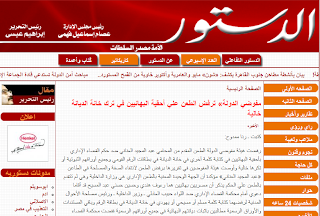
A case in point is this most recent important piece of news that was announced yesterday in Cairo's Al-Dostoor newspaper (attached), which affirmed that Egypt's Judicial State Council has just upheld the 29 January 2008 court verdict, permitting the Baha'is to obtain identification documents with dashes "--" inserted in the religion section of these documents. The 29 January verdict was previously challenged by an Islamist lawyer who, in an attempt to stall the ruling on procedural excuses, attacked the judge and questioned his competence. This stalling tactic was discussed before in this post.

In addition to that, the 29 January ruling had also faced another legal challenge by another lawyer. This second challenge was indeed an appeal of the ruling itself, intended to penetrate its core and reverse it altogether. This appeal was filed shortly after the 29 January verdict by another Islamist lawyer, named Abd El-Mageed El-Aanany. As a result of that appeal, the case was referred to the judicial State Council, which is a panel of judges at the highest level of the State, charged with acting on such judicial matters and appeals.

This council rejected the appeal by El-Aanany and upheld the administrative court's ruling to allow the Baha'is obtain identification documents. In its decision, the Council affirmed that the only authority that has interest in this case is the Ministry of Interior, not this lawyer or any others for that matter.

Since the defendants in these cases, i.e. the Ministry of Interior, its Minister, General Habib El-Adly, as well as the head of the civil [personal] affairs authority had not appealed the verdict during the alloted time period, that in itself led to the enforcement of the verdict. Thus the independent appeal by this lawyer was rejected by the State Council.

This is a very significant ruling that affirms that the administrative court verdict must stand and cannot be challenged, implying that the Baha'is of Egypt can now obtain ID cards and birth certificates as ruled by the court.

On the other hand, a day after this announcement, another newspaper, Al-Masry Al-Youm (attached) published an article that reported on cases when Baha'i students were refused admission to schools simply because of their religion.

When the parents of these students went to the schools to enroll their children, they were told by the schools' administrators that they were instructed to accept students only if their religion was stated as "Muslim" or "Christian," and that they will not accept any students with dashes "--" entered in the religion section of their birth certificates.

When the parents went to the Ministry of Education to complain, they were given the usual "run around" by placing the blame on other agencies, such as the Ministry of Interior. Of interest, one of these schools is a French private school and the other is a British private school--both report directly to the Egyptian Ministry of Education.

According to these new developments, it is clear that the "right hand does not know what the left hand is doing." These developments betray a state of chaos, with some individuals, who think that they are in "authority," are making their own arbitrary decisions without evidence of any sort of accountability. Those responsible for the citizens of Egypt must step-up and stop this state of madness and anarchy. They are under the absolute obligation to enforce the laws.

Saturday, June 07, 2008

Egypt: More Court Delays...No IDs...No Birth Certificates Yet!

Today, a Cairo court (Administrative Court, First Degree, District-7) heard a challenge to the court ruling of 29 January 2008 allowing the Baha'is of Egypt to obtain ID cards and birth certificate with dashes "--" or "other" entered for religious classification in these documents.

This court challenge is not an appeal per se, but rather a procedural challenge intended to stall the implementation of the court's ruling. This challenge was filed shortly after the ruling by a lawyer named Hamed Saddiq, acting on behalf of Egypt's Islamic Research Council which is under the auspices of al-Azhar University. He did not appeal the ruling itself but he criticized the judge on procedural matters. In his criticism, he harshly and rudely insulted the judge and questioned his competency, which led the judge to throw the case out of his court, referring it to another judge in order to eliminate bias.

Today, in court, the government lawyers representing the civil records department sided with the Baha'is and made it very clear that they want to proceed with the ruling and apply it as it was. They stated that they will present a memorandum to the court documenting their position and stating that they are supporting the ruling and wish to apply it. They were not, however, ready to present their memorandum today and requested a postponement in order to allow them time to prepare. Thus, the court decided to postpone the hearing until 25 October 2008. [update: date changed by judge to 1 November 2008]

Meanwhile, the Baha'is of Egypt remain without ID cards, birth certificates or other official documents. The consequences of such state of existence are quite obvious and have been clearly described in several previous posts and media publications.

It must be understood, however, that it is entirely up to Egypt's government (Ministry of Interior & the Civil Records authorities) to proceed with implementing the initial court ruling regardless of any challenges or appeals. They can...today...issue ID cards and birth certificates to all the Baha'is of Egypt.

Since the government has no objections, whatsoever, to the ruling itself, and since the government (Ministry of Interior) has been the principal party to this lawsuit, one fails to understand the reasons for such delays in implementation. These delays can only contribute to the continuing suffering of the Baha'is of Egypt.

Furthermore, it is also in the government's interest to apply this ruling to all the Baha'is of Egypt and not only to those involved in the lawsuits. Otherwise, complex and extended litigations and unrest can result from such tactics.

Thursday, May 01, 2008

Reuters Critical of "Official Foot-Dragging" in Egypt

An article authored by Cynthia Johnston, just published in Reuters, underscores the continuing struggle of the Baha'is of Egypt in their attempts to obtain their government-issued official documents.

It reports that, according to the human rights organization--Egyptian Initiative for Personal Rights (EIPR), "official foot-dragging means Egypt's Baha'i religious minority is still struggling to get identity papers, despite a landmark court ruling...."

The 29 January 2008 ruling allowed the Baha'is to obtain ID cards and birth certificates without having to lie about their true religious affiliation. The ruling fell short, though, of permitting the Baha'is to indicate their own religion on the required sections of these documents...instead, it allowed them to enter dashes "--" in the indicated fields. The Ministry of Interior accepted that solution without any challenge to the decision rendered by the court.

The Baha'is of Egypt, however, have not been able to obtain their official documents since the ruling. They remain without ID cards and birth certificates. No clear reason or explanation, regarding the delay, had ever been given to them.

Another ruling in favor of Christian converts in Egypt remains to be implemented. It allowed those who have returned to Christianity to indicate their true faith correctly on their ID documents.

EIPR, represented by Mr. Hossam Bahgat, expressed its great concern with such delays and has been actively pursuing all means to help propel the authorities to expedite the implementation of these new policies.

Tuesday, April 22, 2008

It is Time to Issue ID Cards to the Baha'is of Egypt

International Herald Tribune (IHT)'s Daily News Egypt has just published another article regarding the status of ID cards in Egypt. The Baha'is of Egypt remain without ID cards and birth certificates, even though the administrative court had allowed them the issue of these official documents and the Ministry of Interior had decided not to appeal the ruling.

Hossam Bahgat, director of the Egyptian Initiative for Personal Rights (EIPR), who has been acting on behalf of the Baha'is in their quest for their civil rights, is asking for the immediate implementation of the court's ruling.

A couple of frivolous legal challenges, filed by extremist Islamist lawyers who are not party to the case, should not interfere with the swift implementation of the ruling, particularly when the Ministry of Interior showed no interest in objecting to this solution and had already announced its intention to use dashes "--" in place of "Baha'i" in the religion field on ID cards and birth certificates.

Considering the extreme hardship experienced by the Baha'is of Egypt, the Ministry of Interior would serve these Egyptian citizens best by removing all obstacles and instructing its employees and agents to issue these essential documents promptly.

Egypt needs to show its citizens and the rest of the civilized world that it can indeed protect its minorities. After all, isn't this how a modern society judged?

Monday, April 14, 2008

Baha'is of Egypt Still Waiting for ID Cards

Since the 29 January 2008 court ruling and its subsequent acceptance by the Ministry of Interior, no Baha'i in Egypt has been able to receive an ID card or a birth certificate.

The Ministry, through the media, has declared its decision not to appeal the ruling and its intention of allowing dashes "--" in place of "Baha'i" in the religion field of these official documents.

Baha'is in Egypt continue to face a variety of hardships on a regular basis because of being deprived of holding these important official documents that are required for their daily living.

It is expected and hoped that the Ministry of Interior will want to avoid all current distractions and proceed with the implementation of its decision expeditiously. After all, it is entirely up to the Ministry to proceed without delay in applying this--mutually acceptable--solution to all Baha'is in Egypt, and not only to those three individuals who were involved in the lawsuit. Clearly, the Ministry has the power and authority to do so. Delays can only add to frustrations and would not reflect well on the image Egypt is trying to portray to the rest of the world.

Wednesday, April 02, 2008

Egypt's Interior Ministry Decides on "Dashes" for Baha'i IDs

In its 2 April 2008 edition, Al-Masry Al-Youm newspaper reported that the Ministry of Interior has just decided that the only option that will be given to the Baha'is of Egypt is to insert dashes "--" instead of leaving the religion field blank or writing "other" on ID cards.

The Ministry clarified that "leaving the religion field blank might open the door to inappropriate manipulation of official documents."

This decision was expected since the Ministry has been considering its options on what choice it would make following Cairo's Court of Administrative Justice ruling on 29 January 2008 to allow the Baha'is obtain ID cards and birth certificates.

The court permitted three options for registering their religious affiliation. These options were: 1) "other," 2) dashes "--" or 3) to leave the field blank. As to which choice would eventually be used, the court had left the final decision for the Ministry of Interior to make.

This announcement is an indication that progress is being made by the Ministry in its efforts to proceed expeditiously with granting the Baha'is of Egypt their identity documents and birth certificates.

In a related case involving Egyptians who have returned to Christianity after having been declared Muslims at some point in their lives, the Ministry has decided to enter "formerly declared Muslim" on their ID cards that will be issued stating that they are currently "Christian."

Monday, February 04, 2008

Egypt: Extensive Media Reaction to the Verdict on Baha'i Rights

Several news outlets reported on the recent verdict that placed the Egyptian Baha'is in a position to obtain ID cards, birth certificates and other official documents.

Some reports were in Egyptian newspapers while others were in international newspapers and websites as shown in previous posts and in this one as well.

Several international articles were published in Arabic as linked to at the end of this post. Among the recent publications was an article written by Mr. Gamal Nkrumah in Al-Ahram Weekly, which is the English version of Egypt's daily semi-official newspaper. On three previous occasions, Mr. Nkrumah had courageously written on the Baha'i case as was posted here, here and here. His coverage has been objective, balanced, well-informed and accurate.

Below is the complete transcript of his current article:

A question of faith

Gamal Nkrumah sounds out rights activists' reactions to a new court ruling this week that no longer denies Bahaais essential identity documents

_____________________

Bahaai community in Egypt, local and international human rights organisations warmly welcomed an Administrative Court ruling this Tuesday (29 January), which reversed the official state policy of denying essential identity documents to Egyptians who do not wish to be identified in official documents as adherents of the three Monotheistic religions recognised by the state.

Bahaai Egyptians, leading a legal battle over the past few years to be certified as Bahaais on official documents, won a first step court ruling to that effect in April 2006. The 2006 court ruling, however, was overturned later by the Supreme Administrative Court.

This week's new sentence seems to meet the Bahaais' demand half way, since while rejecting the demand that the Bahaai faith is a religion, it allowed those who do not wish to be identified as followers of Islam, Christianity or Judaism to have official documents in which the religion category would either be filled by a "hyphen" or the word "without".

"This is not just a victory for the Bahaai community of Egypt, but it is also a victory for all those Egyptians who do not adhere to the three monotheistic religions," Hossam Bahgat, director of the Egyptian Initiative for Personal Rights (EIPR) told Al-Ahram Weekly. "For the first time in contemporary Egyptian history, an individual who professes Hinduism or Buddhism, or even those wishing to call themselves non-believers, could enjoy full citizenship rights. That in itself is a great advance of human rights and will tremendously enhance the country's human rights record," Bahgat explains.

Basma Moussa, a leader and spokeswoman of the Bahaai community of Egypt, concurs. She was ecstatic. "This ruling is what we have been struggling to achieve for years. At last our prayers have been answered. We are extremely grateful that justice has been served and that finally we can lead normal lives as Egyptian citizens," Moussa says.

Labib Iskandar, a leading Egyptian Bahaai, and a professor of engineering at Cairo University laments that, "we used to move about without personal identification cards. That is a criminal offence in Egypt. We could be stopped by police at any moment, anywhere and asked for our ID."

"Inability to produce an ID card entails a five-year prison sentence," Moussa, a dentist and an assistant lecturer at Cairo University says. "The civil status law makes it obligatory for every Egyptian citizen to carry on his or her personal ID card".

"These documents are essential to obtain education and employment, register births, immunise children, and conduct basic transactions such as opening a bank account, obtaining a driver's licence, or collecting a pension," Bahgat extrapolates.

"A previous ruling by the Supreme Administrative Court in December 2006 had upheld the state policy of refusing to recognise the religious affiliation of Bahaais in official documents, arguing that such recognition would violate public order and Sharia [Islamic law] requirements," Bahgat explains.

The December 2006 ruling prompted Bahaai Egyptians to file two other lawsuits -- the subject of Tuesday's ruling -- requesting documents that do not list any religious affiliation. "The new cases, filed by EIPR lawyers, argued that forcing Bahaais to identify falsely as Muslim or Christian violated their rights to freedom of conviction, privacy, equality and full citizenship rights," Bahgat notes.

Bahaais began to experience grave difficulties beginning in 1995, when the authorities insisted that all Egyptians had to acquire or replace personal documents with computerised ones from the central Civil Registry Office in the Ministry of Interior.

It is hoped that this week's ruling would finally allow Bahaai Egyptians to obtain birth certificates and computerised identity cards leaving the religious category void.

Bahgat, Iskandar and Moussa hope that the state would implement the ruling as soon as possible. "We urge the government to implement the decision without delay, and not to appeal this clear verdict of the court," Bahgat says.


Other articles can be viewed at the following sites:

Radio Netherlands Worldwide (Arabic): حرية العقيدة في مصر: أحكام متباينة

BBC (Arabic): هل يحق للدولة الاعتراف بديانات دون أخرى؟

US Copts (Arabic): تغطية الفضائيات المصرية للحكم بترك خانة الديانة فارغة للبهائيين

Egyptian Initiative for Personal Rights "EIPR" (Arabic):
مصر: القضاء يبطل حرمان البهائيين من الوثائق الرسمية
على الحكومة أن تمتثل لتطبيق الحكم دون إبطاء