Saturday, December 16, 2006

Egypt: Extensive Article on the Baha'i Faith in Al-Fagr


This article in Egypt's Al-Fagr newspaper was published on 11 December 2006, and is entitled "First photographed journalistic report on the Baha'i temple in New Delhi."

As a footnote, the writer announced "Next issue: the complete text of the Baha'is' al-Kitab al-Aqdas [The Most Holy Book]."

A summary in English will follow soon. This article can also be reviewed at the newspaper's website linke here.

Friday, December 15, 2006

Egypt: Test for Religious Freedom

Test for Egypt religious freedom in Bahai verdict
Jailan Zayan
AFP
December 15, 2006

CAIRO -- Ragi Labib, a young Egyptian university graduate, cannot find a job, buy a car, or open a bank account. By next year, he may not even be able to prove his identity. Why? Because he is a Bahai.

When the government announced four years ago that only Islam, Christianity, and Judaism were recognized as religions on official papers, the ID card on which he had scribbled the name of his faith became invalid.

"We don't mind omitting religion from ID cards altogether, or being allowed to insert 'other' in the religion field. But we don't want to lie about our religion on official documents," the 25-year-old said.

Now he fears that, despite being born in Egypt to Egyptian parents, his own children will not be recognized as Egyptian citizens.

Egypt's small Bahai community - fewer than 2,000, according to official figures - is eagerly awaiting a December 16 court ruling on the right of Bahais to obtain legal documents that state their religion.

In Egypt, carrying identity papers at all times is required by law and essential for access to employment, education, medical, and financial services.

The Bahai case gained local attention and sparked more than 400 press articles after an April ruling upheld Bahais' right to state their religion on their ID papers, but it is being appealed by the interior ministry.

Before April, most Egyptians had not heard of the Bahais, who are often registered by clerks as Muslims or Christians.

"I had to study the Christian religion at school, because Labib is traditionally a Christian surname in Egypt," said Ragi.

The case has exposed a loophole in Egypt's constitution, which assures that all citizens are equal before the law but also states that laws are to be derived from Sharia - Islamic law - which recognizes only three religions.

Hossam Bahgat, director of the Egyptian Initiative for Personal Rights, argues that the case transcends the small Bahai community in Egypt, and says that it will have a wider impact on religious freedom.

"The case will define the boundaries of the state's involvement in people's personal affairs," he said.

"We're not sure what will happen to us if the court rules against us," said Anwar Shawki, 29, who like Ragi is a fifth-generation Bahai. "But we won't leave Egypt, it's our country," said the entrepreneur who could not get his private furniture business running for three years because he lacked a valid ID. He had to register the business in a friend's name.

"I even had to buy his mobile phone for him because he didn't have the right paperwork," said Alaa Al Battah, 33, who is registered as a Muslim, as he and Anwar showed their almost identical mobile phone numbers.

Bahais have been in Egypt for as long as the religion has existed - 163 years.

The faith, which was founded in nineteenth-century Persia, promotes the idea of progressive religious revelation, resulting in the acceptance of most of the world's religions.

Sheikh Ali Gomaa, Egypt's grand mufti, the government-appointed interpreter of Islamic law, has refused to recognize the faith, and said that all Bahais should be registered as Muslims on the country's new electronic ID cards, which will have replaced the old paper ones by next year.

"There are only three religions in Egypt, and there is no place for anyone to come after that. Bahais, just as Muslims, believe in all three religions and therefore should be listed as Muslims, not Bahais," he told Egyptian satellite television.

Under the late president Gamal Abdel Nasser, Bahais were suspected of collaborating with Israel because the faith's highest governing institution is based in Haifa. In 1960, Bahai assemblies and institutions were dissolved.

"Israel was created in 1948 and our faith has been around for a lot longer," said Ragi's father Labib Hanna, professor of engineering at Cairo University.

The former grand imam of Al Azhar, Sunni Islam's main seat of learning, Gad Al Haq Ali Gad Al Haq, described the Bahai faith as an "intellectual plague" that works "for the benefit of Zionism."

Between 1910 and 2005, five fatwas - or religious edicts - were issued declaring Bahais apostates. In 1946, a woman was forced to divorce her husband after he converted to the Bahai faith.

Of the faith's 12 principles including the unity of mankind, the elimination of all forms of prejudice, gender equality, and independent investigation of truth, it is obedience to government that is most highlighted in Egypt.

Egyptian Bahais will not join political parties, take part in demonstrations, or hold elections for their spiritual assemblies.

"We don't want to cause problems - we just want to exercise our rights as Egyptian citizens," Hanna said.

Thursday, December 14, 2006

Home Support for Egyptian Baha'is

Today, in Manal & Alaa's Egyptian blog, a post was also prominently featured calling for support of the Egyptian Baha'is in their landmark case which is to be ruled on by the Supreme Administrative Court this coming Saturday, 16 December. As one of the world's most popular blogs Manal & Alaa ranks in "Technorati" between 1,000 and 3,000 out of millions of blogs.

The post is entitled "A stand in solidarity with the Egyptian Baha'is for the purpose of their right to document their religion, or writing-in 'other' in the religion section of official documents."

Then it states:

Location: The State's Judicial Assembly--Giza street--next to Cairo Sheraton.

Organizer: The Egyptian Initiative for Personal Rights + Egyptian Bloggers and Individuals Against Religious Discrimination.


Description: The Egyptian Ministry of Interior requires the citizens to acquire and carry identification cards and legal documents such as birth certificates and others...it also requires that the religion section be filled-in, and refuses leaving it blank...but at the same time it prevents the Egyptian Baha'is from documenting their religion in official documents, or obtain birth certificates for their children who are born to Egyptian Baha'i parents, and does not leave them a choice but to lie [deceive] in choosing between Muslim or Christian...even though these are religions that they do not belong to, and they demand to enter the word "other" in the religion section.

Join us in the stand in solidarity on Saturday, 16 December in front of the State's Judicial Assembly from 10 to 11 in the morning for the right of all Egyptians to a just homeland for all its sons.


Several other independent Egyptian blogs continue their campaign in publicizing this event and in proclaiming their support for the Baha'is, such as the one by "3arabawy" and another one in a blog named "Arabist." A simple search will divulge several other Egyptian blogs with the same message of solidarity and support.

On Saturday, the panel of senior judges sitting at Egypt's Supreme Administrative Court will have to reach a just decision based on constitutional guarantees for all Egyptian citizens. Any judgement they make will have an enormous impact on the cause of civil liberties in Egypt for decades to come, impacting many other Egyptians.

The Baha'is are simply asking to be able to exercise their rights to citizenship, to be able to obtain employment, get educated, travel, register their children when they are born, open bank accounts, drive their vehicles with a valid license, have their marriages recognized and legalized, be able to obtain pensions due to them, be able to vote and contribute to society, have their dead buried with dignity and obtain their death certificates, be able to obtain passports, and simply become recognized as human beings...none of this can be accomplished without being permitted to obtain ID Cards as well as all other required official documents. The case is not about recognizing the Baha'i Faith, it is simply about citizenship!

Tuesday, December 12, 2006

Egypt: Mounting Public Support for the Baha'is

Prominent Egyptian bloggers are mounting their support of the Baha'is with great intensity, and are inviting their readers to pay close attention to the Baha'i case and to attend the upcoming Supreme Court session scheduled for this Saturday, 16 December 2006.

Here are three of the posts which were just published on these very popular and credible blogs. Please be sure to click on each of the images in order to connect to the blogs' sites.

These three incredibly well thought of bloggers have been among the early few bloggers in Egypt that ultimately contributed to the growth of that phenomenon in that land, amounting now to thousands of very active weblogs.

This is definitely a sign of things to come in Egypt as the new generation is finding an avenue to express its opinions freely and with eloquence. The emergence of blogging in Egypt has produced unimaginable effects on the society at large, exposing injustices and promoting a balanced and free society that will influence the direction of the country's future.

Egypt must be proud of its new generation that exudes with courage and great wisdom....

P.S.
Another blog, authored by Nesreen, entitled "From a Different Angle," published a post on 13 December reviewing and analysing all the independent Egyptian blogs. It also links to six of these blogs that have been discussing the Baha'i case in their posts.

It is definitely of great importance that these blogs are published in Arabic (with rare comments in English), which enhances their widespread readability in the Arabic-speaking countries. As far as one can tell, the authors of these blogs are of Muslim background and belief.

How encouraging indeed to witness that many Muslims in Egypt and the rest of the Middle East reflect the true spirit of Islam which embraces acceptance, tolerance and peaceful coexistence, particularly when one considers the social and religious environment prevalent in that land. Another very popular blog which has been following the case very carefully and has been publishing feeds from all the posts on this blog, is Manal & Alaa's highly ranked blog linked here.... Additionally ME Faith has incorporated this blog as well as other interfaith sites into its collective website devoted to open dialogue, tolerance and interfaith collaboration.
All these recent posts, in addition to publicly proclaiming their support for the Baha'is in their struggle for their rights, they are calling for a stand-in at the Supreme Court on Saturday, 16 December 2006 during the session scheduled for 10 O'clock on that morning.

Monday, December 11, 2006

Egypt: Is It Time to Return to Its Known Civility?

Another article appeared in "al-Masri al-Youm" Egyptian newspaper on 9 December 2006 reviewing the upcoming Supreme Court Case.

The article is entitled "The Supreme Administrative [Court] determines the fate of Baha'i-yyah [Baha'i Faith] this coming Saturday." It is subtitled "Report of the State's Commissioners and Islamic Scholars concurred that it is not a recognized religion [in Egypt]."

It opens with:

The Supreme Administrative Court of the State Assembly will determine in its session, that will convene this coming Saturday, the fate of Baha'i-yyah in Egypt...specifically in regards to its recognition by official and governmental agencies as a religion, and whether or not it can be written in official papers and documents such as identification cards, birth certificates and passports.

The Supreme Administrative Court (first circuit) will produce its judgement on the "matter" of the appeal submitted by the Ministry of Interior, the Civil Affairs Agency, and the Passport and Immigration Agency regarding the judgement of the Administrative Court issued this past 4th of April, in which it ruled to cancel the decision of the Minister of Interior forbidding the entrance of the word "Baha'i" in the religion section of official documents. The court also ruled to enforce the right of the [Baha'i] plaintiffs to obtain official documents with Baha'i written in the religion section.

The lawsuit was initially filed in the Administrative Court on 10 June 2004, and in which Hessam Ezzat Muhammad Moussa and his wife Ranya Enayat Abd'el-Rahman Rushdi have stated that, as subjects of the Arab Republic of Egypt who are in possession of Egyptian citizenship, when they requested the Passports and Immigration Agency to include the names of their daughters in their two passports, the president of the agency confiscated their identification cards without any legal cause. That religion was the reason given for the refusal of registering their daughters in the passports, this in violation of the State's laws and the Egyptian Constitution which guarantees freedom of belief. And that this--illegal--refusal causes their daughters to be deprived of freedom of movement [travel] accorded to them by law. They demanded at the end of their lawsuit the cancellation of the administrative agency's ruling that forbids documenting "Baha'i" in the religion section of these official documents which were requested to be issued.

The rest of the newspaper article described the State Commissioners' report (previously posted here) and included the names of the eight judges involved in writing the commissioners' report opinion. Three of whom pictured in the article are: president of the State's assembly Justice Say'id Nofa'l, member of the assembly Justice Essam el-Din Abd el-Aziz and the State's commissioner Justice Abd el-Qader Qandil.

This newspaper report neglected to discuss the real substance of this landmark case. The essential crux of this case which must be dealt with is the right of any legal citizen of Egypt to obtain official documents, including ID Cards, birth certificates, death certificates, marriage certificates, passports, etc.... This case is not about whether or not Egypt should recognize the Baha'i Faith as an independent religion--it has already done so in the 1920s--this case is about the rights to citizenship. The Baha'is were asked by the governmental agencies to lie about their religion in order to obtain any documents they wish to obtain, forcing them to violate the law and commit a felony in doing so just to obtain their constitutionally guaranteed rights. Furthermore, lying on official documents would violate their own personal convictions and moral dictates.

Now it is up to the Supreme Court to uphold the lower court's ruling to grant the Egyptian Baha'is their rights to citizenship as written in the Constitution.... Is it time for Egypt to return to its tolerant, just and civil society it had been known for?

Saturday, December 09, 2006

Baha'i Rights: Egyptian Media Anticipating 16 December Court Ruling

In its 7 December 2006 issue, the Egyptian newspaper "Nahdat Misr" published three articles on the highly anticipated Supreme Administrative Court session scheduled for 16 December 2006 to deliver a final judgement on awarding the Egyptian Baha'is their long awaited civil and human rights.

The first article is entitled "the Baha'is...or the Ministry of Interior?"

The full text of this 'brief' article is translated below.

Who will be victorious on 16 December:

On 16 December the fate of the Baha'is will be decided and the curtain will fall on the litigation that occupied the Egyptian and world public opinion when the Supreme Administrative Court will rule on the appeal put forth by the Ministry of Interior in its attempt to reverse the judgement of the Administrative Court which granted the Baha'is their rights to document their religion on official documents.

The Administrative Court has ruled in favor of a Baha'i family that is made up of a father and a mother who are Egyptian citizens, and belong to the Baha'i religion. They had submitted a request to add the names of their three daughters on their passports, and were surprised [shocked] by the refusal of the administrative agencies to return to them their passports and by the confiscation of their ID Cards [and their daughters' birth certificates], forcing them to file a lawsuit....


Soon after the court's judgement [in their favor], there was an eruption of a debate in religious and legal circuits among those who support the judgement and those who oppose it. While the [Islamic] religious leaders have proclaimed that "Baha'i" is not a religion [according to their opinion] and that Baha'i should not be entered on ID cards as a religion since they are considered as apostates [by Islamic fundamentalists], the human rights organizations praised the judgement as a victory for personal freedom, called for by the [Egyptian] constitution. These issues prompted the Ministry of Interior to appeal the ruling, requesting its reversal, and in its appeal it argued that the judgement gives the Baha'is the right to the recognition of their religion, considered by many as a shameful error. However, the brief for the defense prepared by the Egyptian Initiative for Personal Rights confronted that argument, and affirmed that "not documenting the Baha'i religion in official documents [writing Muslim, Christian or Jewish instead] is considered a forgery crime punishable by the law...."

The full text of both the defense for the Baha'is and the government's response were then published in their entirety as two separate long articles in the same newspaper issue linked here & here.

Friday, December 08, 2006

Egyptian Baha'is: The Daily Star Rports on the ID Card Crisis

The following article was published yesterday in The Daily Star - Egypt which is distributed with the International Herald Tribune (IHT), "the world's foremost global newspaper. The IHT is the only English-language international paper printed in Egypt and available the same day."

"The first issue of The Daily Star Egypt hit the newsstands on May 9, 2005. Since then, it has become a major source of credible news and analysis on Egypt, daily."

The article is published below "as is":

IN EGYPT, YOU'RE BETTER OFF JEWISH THAN BAHAI

By Abdel-Rahman Hussein
First Published: December 7, 2006

CAIRO: At the heart of every bureaucratic function of government in Egypt is the National Identity card. Whether access to education, employment, financial services, health care or assorted government dealings the bitaqa is an absolute necessity.

Egyptian law decrees that every citizen should carry the ID on their person at all times. Police are allowed to ask anyone at any time for it, and are permitted to detain those who don't present one when requested.

In the early nineties, the government digitized the whole National ID system, in an effort to counter the then looming terrorism threat and also because it was about time.

An identity card is issued with a person's religion clearly marked but the state recognizes three religions only: Islam, Christianity and Judaism, and it is only those that can be recorded on the card. With the old IDs this could be left blank.

This is no longer possible with the newer, electronic versions.

This has posed serious challenges to followers of religions other than the three main monotheistic faiths.

The Bahais, followers of a nineteenth century Persian nobleman named Baha u llah who they consider to be a messenger of God, are one such community facing increasing political and socio-economic entanglements in Egypt.

On principle, the Bahais have refused to affiliate themselves to any of the state-recognized religions on the IDs and therefore do not carry the new cards.

They don't have birth certificates either or any other official documents that require one to state their religious affiliation.

In April, the Egyptian Administrative Justice Court ruled in favor of two Bahai parents who requested birth certificates for their three daughters because their original ones were confiscated by the Interior Ministry for having them documented as Bahais.

Sharia (Islamic law) prohibits discrimination against non-Muslims, the court decreed.

In addition, it was imperative for the state to recognize the real beliefs of its citizens to administer the appropriate rights and laws unto them. This recognition does not mean that the state endorses Bahaism, the court stated.

The Interior Ministry appealed this ruling, and the First Circuit of the Supreme Administrative Court considered the appeal on Dec. 2. Arguments were heard on Saturday and the court will give a final judgment on Dec. 16th.

Former Deputy Head of Al Azhar and Member of the Islamic Research Council Seif Mahmoud Ashour, backed the government standpoint in an interview with The Daily Star Egypt.

“Bahaism is not a religion,” he said, “what we recognize are Islam, Christianity and Judaism. Bahaism is a worldly belief, and not a heavenly religion, it is a man-made creation. We recognize only the heavenly religions.”

Ashour added that from an Islamic standpoint “They are allowed to believe what they want, and to exercise their beliefs as they see fit, but the state will not recognize them.”

Ashour then launched into a critique of Bahaism saying “We hear they permit incest, that a man can marry his sister, pray with nineteen raq’aa (prostrations), fast nineteen days a year and pray towards Acre (in Israel, resting place of Baha u llah’s remains) and not Mecca.”

Dr. Labib Iskandar Hanna, a professor of Engineering at Cairo University and a follower of the Bahai faith, disputed much of this rumor-mongering as babble propagated by an ignorant media. In an interview with The Daily Star Egypt he challenged anyone to present one case of incest amongst the Bahai community. He also dismissed the idea of nineteen prostrations in their prayer.

He said: “If you want to know about Muslims, you don’t ask a Jewish Rabbi, you ask Muslims themselves. People should ask us if they want to know something.” He added that there are official Bahai sites on the Internet, in English and Arabic among other languages, where one can find out about the faith....
Read more....

Thursday, December 07, 2006

UN Report on Egyptian Baha'is Published in IRIN

The human rights weekly update published in IRIN (Integrated Regional Information Networks) by the UN Office for the Coordination of Humanitarian Affairs on 30 November 2006, focused on the human rights violations concerning Egyptian Baha'is. The report described the current legal battle endured by the Baha'is in order to obtain their full citizenship rights as equals to all other citizens of Egypt. The Baha'is in Egypt have always been legitimate citizens of Egypt based on their birthplace, their ancestry and their extensive heritage in that country.

The report expounded on the Supreme Court session held on 2 December to rule on the fate of civil and human rights of Baha'i Egyptian citizens.

It concluded by stating:

"The question before the Supreme Administrative Court is whether or not Egyptian Baha'i citizens have the right to obtain official identification documents that listed their religious affiliation, or left the 'religion' line blank or inserted the word 'other' instead of stating one of the three officially recognised religions in Egypt: Islam, Christianity and Judaism.

These three alternatives were available for Egypt's Baha'i citizens for decades until the Interior Ministry's Civil Status Department decided four years ago to force them to follow one of the three recognised religions only."


Subsequently since the publication of this report, the Supreme Administrative Court in its session of 2 December decided to postpone its ruling until it reconvenes on 16 December 2006 for a final judgement on the case. Human rights organizations in Egypt as well as worldwide are following this case with great intensity and are in full support of granting the Baha'is their full citizenship rights. An extensive brief on behalf of the Baha'is was also submitted to the supreme court on 2 December by the Egyptian Initiative for Personal Rights (EIPR).

Monday, December 04, 2006

Egypt: Public Support for the Baha'is

The email below was sent to me with its author's permission to publish it in its entirety. Also more posts appeared on Egyptian blogs and websites such as the ones linked HERE & HERE.

Another extensive article was written by the Egyptian journalist Mr. Nabil Sharaf el-Din and published in Elaf, a prominent daily electronic newspaper on 3 December 2006. It is accompanied with several comments from its readers, and can be seen HERE....


---------- Forwarded message ----------
From: XXXXXXXXXXXX
Date: Dec 4, 2006 5:12 PM
Subject: Egyptian Baha'is need attention

As reported by The Egyptian Initiative for Personal Rights:

Supreme Admin Court to Consider Interior Ministry's
Appeal against Baha'is on Saturday


[Quoted statement of the Egyptian Initiative for Personal Rights]

We hope that international recognition of this case might effect the court's decision, like it has been influenced many times before by the presence of fanatic Islamists. And I wish that all the activists that are currently present in Egypt to head to court next Saturday to make a clear statement to the Egyptian government and fanatic religious groups and organizations.

The case of the Baha'is and religious minority rights crucially effects the status of liberalism in all of Egypt which is a need for the whole world, I hope that we all support this issue.

Best,

XXXXXXXXXXX

www.liberalegyptians.blogspot.com

Egypt: Latest BWNS Article on Baha'i Court Case

Egyptian Baha'i case final arguments heard; judgment due in two weeks

CAIRO, 3 December 2006 (BWNS) -- Lawyers representing a Baha'i couple seeking to have their religious affiliation properly identified on state documents presented arguments yesterday at a full hearing before the Supreme Administrative Court here in a case that has become the focus of a national debate on religious freedom.

The hearing was short, and the court adjourned until 16 December, when it is expected to render a judgment in the case, which is being closely watched by international human rights groups.

The case stems from a lawsuit filed by a married couple, Husam Izzat Musa and Ranya Enayat Rushdy, who had their identification cards and passports confiscated after they applied to have their daughters added to their passports, which listed the Baha'i Faith as their religion.

In Egypt, all citizens must list their religious affiliation on state ID cards and other documents, and current policy requires that they choose from one of the three officially recognized religions -- Islam, Christianity or Judaism. As such, Baha'is are being forced to go without ID cards, which are the key to accessing most rights of citizenship, such as education, financial services, and even medical care.

In April, a lower administrative court ruled in favor of the couple, saying the state must issue them ID cards that properly identified their religion. The ruling said that even if the government did not recognize the Baha'i Faith, adherents should still have their religious status properly stated on official documents.

That ruling provoked an outcry among fundamentalist elements in Egyptian society, who objected to any official mention of a religion other than the three mentioned in the Qur'an, opening a vigorous debate over issues of religious freedom and tolerance here. Since April, more than 400 articles have appeared in the Egyptian and Arabic news media about the case or its fallout.

The government appealed the lower court's ruling in May, which brought the case before the Supreme Administrative Court.

uno-bp-06 12 03 -1-EGYPT2DEC-493-N

Sunday, December 03, 2006

Egypt: Ministry of Education Recognizing the Baha'i Faith!


Two articles appeared on 2 December 2006 in Nahdet Misr Egyptian newspaper regarding the Baha'i Faith.

The first one entitled "A [Muslim] Brotherhood Representative Accuses the Minister of Education of Recognizing the Baha'i Faith," and subtitled "Secondary Education Final Examinations Contain Questions for the Baha'is."

The article states that "a representative from the Muslim Brotherhood Party in the Peoples Assembly [Parliament] has accused the Ministry of Education of committing an egregious violation of the constitution and the law by announcing its recognition of the Baha'i Faith as an official religion in Egypt."

Dr. Yousri el-Gamal

It continues, "the representative in his expedited request, demanded that Prime Minister Dr. Ahmed Nazif and Minister of Education Dr. Yousri el-Gamal, present immediate explanations to the Egyptian Parliament as to why the Ministry of Education has recognized the Baha'i Faith in violation of the laws and the constitution...." He is supporting his claim by indicating that "there are documents and proofs confirming that the Ministry of Education has approved the inclusion of specific examination questions authored exclusively for examining Baha'i students under a [new] subject entitled 'Morals' instead of the usual examination subjects of Islamic or Christian religions, in violation of the constitution and the law."

Dr. Ahmed Nazif

In order to support his claim, he referred to the case of a student named Sarah Maher from el-Menya who had completed her examination and was issued the questions on the new subject of "Morals."

He also indicated that there was an envelop containing ten papers released by the Ministry of Education specifically for that purpose, and that the student's father has confirmed that the examination papers originated centrally and for national use from Cairo. El-Menya case was reported on in a previous post linked here....

The second article reports on the Supreme Administrative Court session which was held on that same day and reported on in this previous post. It also concluded by stating that the legal team for the Baha'is affirmed that a judgement will be in their favour since the case is not about the recognition of the Baha'i Faith, but rather concerns the civil rights of Egyptian citizens who must obtain identification documents owed to them.

Saturday, December 02, 2006

Egypt: Supreme Court Postpones Decision


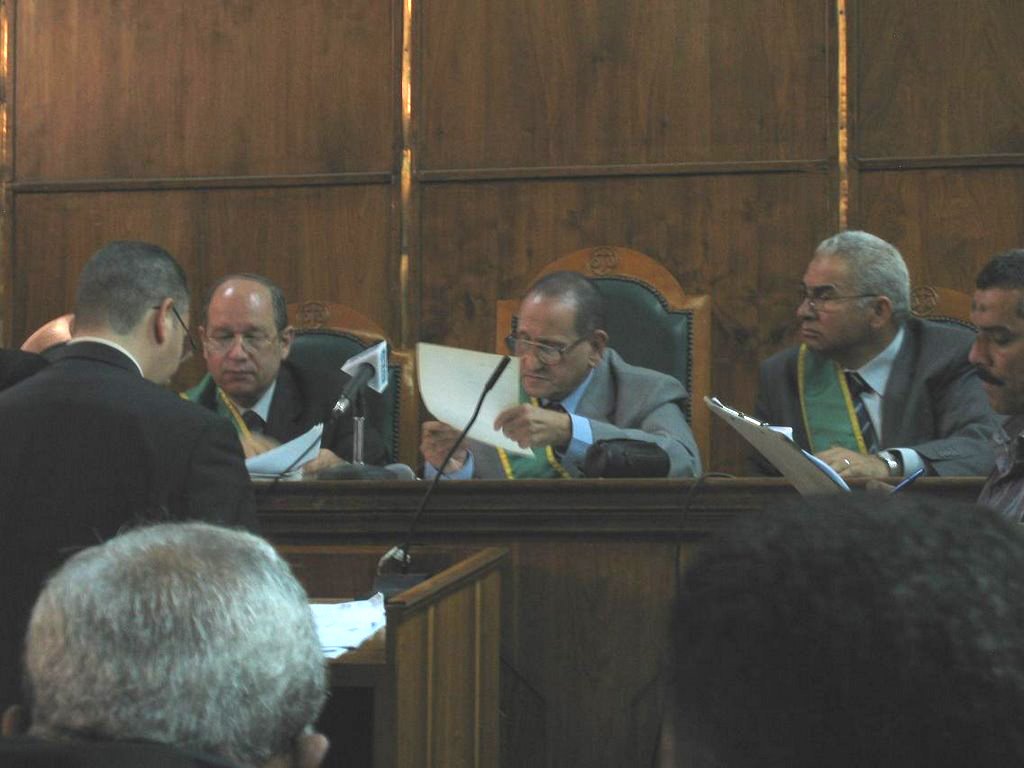
Egypt's Supreme Administrative Court held its session today in Cairo to decide on the Ministry of Interior's appeal of the lower court's ruling that granted the Egyptian Baha'is their rights. The judges were in full control of today's session--preventing any interruptions or chaos--and after receiving a Memorandum prepared by Mr. Labib Moawad, the lead attorney representing the Baha'is, the court decided to postpone its decision until 16 December 2006.

The panel of judges declined the government's lawyers request and urging to receive a final decision on their appeal today.

Some of the Baha'is present were interviewed by television stations covering the court's session.

More to come....

Friday, December 01, 2006

Egyptian Baha'is: BWNS Press Release on Supreme Court Case


In a press release entitled "Egypt court sets date for full hearing on Baha'i case," the Baha'i International Community has just published its report in the Baha'i World News Service (BWNS) website regarding the upcoming Supreme Administrative Court session scheduled for Saturday, 2 December 2006, in Cairo.

For the full article, please click here....

Egyptian Initiative for Personal Rights Prepares for Court


Hossam Bahgat, a 26 year old Egyptian human rights activist and director of the Egyptian Initiative for Personal Rights is urging supporters of human rights in Egypt to attend the Supreme Court's session scheduled for this Saturday, 2 December 2006, which is intended to rule on the Ministry of Interior's appeal of the lower administrative court's ruling which granted the Egyptian Baha'is their rights to be recognized on official documents and be able to obtain government-issued ID Cards.

He reports that during previous court's sessions, the courtroom was full of extremists who had intentionally created an environment of terror, anarchy and chaos during the court's sessions intimidating the judges, the attorneys and the journalists present. Consequently, the attorneys for the Baha'is were never free to argue their case before the panel of judges.

As in Bahgat's letter quoted in Arabic below he is strongly urging the attendance of the largest number possible of "Egyptians Against Religious Discrimination" and in particular those who are members of the judiciary committees.

Here is a press release by the Egyptian Initiative for Personal Rights (EIPR):


Right to Privacy Program

Press Advisory- 29 November 2006

Supreme Admin Court to Consider Interior Ministry's Appeal against Baha'is on Saturday

On Saturday, 2 December 2006, the First Circuit of the Supreme Administrative Court will consider the merits of the Interior Ministry's appeal against a lower court decision that found Egyptian Baha'is had the right to obtain birth certificates, identity cards and other official documents that recognized their faith.

The Supreme Court's Appeal Inspection Chamber started considering the seriousness and admissibility criteria of the appeal last May. On 15 May, the Chamber accepted the Interior Ministry's request to suspend the implementation of the lower court decision pending consideration of the appeal. The appeal was referred to the First Circuit on 20 November after receiving the mandatory advisory opinion of the State Commissioners Authority that recommended ruling in favor of the Interior Ministry.

In a 4 April 2006 ruling the Administrative Justice Court had found in favor of two Baha'i parents who wanted birth certificates for their three daughters after the Interior Ministry had confiscated them for discovering they recognized the daughters and their parents as followers of the Baha'i faith. The ruling was founded on the premise that Islamic Shari'a prohibited discrimination against non-Muslims; that recognizing the Baha'i faith in official records did not mean an official endorsement of its tenets; and that it was in the state's interest to recognize the true religious affiliation of citizens in order to identity the rights, duties and laws applicable to them.

It is worth noting that the current lawsuit does not deal with the legal recognition of the Baha'i community or the veracity of its faith. The question before the Supreme Administrative Court is whether or not Egyptian Baha'i citizens have the right to obtain official identification documents that listed their religious affiliation, left the 'religion' line blank or inserted the word 'others' instead of the three officially recognized religions of Islam, Christianity and Judaism. These three options were available for Egypt's Baha'i citizens for decades before the Interior Ministry's Civil Status Department decided in the last four years to force them to follow one of the three recognized religions only.

The Court hearing should start at 10 a.m. and be open to the public and the media in Maglis El-Dawla in Dokki.


The following is Mr. Bahgat's letter to Misriyoun [Egyptians] Against Religious Discrimination (MARED):


السادة أعضاء مصريون ضد التمييز الديني
لعلكم ربما تعلمون أن المحكمة الإدارية العليا ستنظر يوم السبت القادم 2 ديسمبر في موضوع حق البهائيين في الحصول على أوراق رسمية دون الاضطرار إلى ادعاء الدخول في الإسلام أو المسيحية. ولا أجد حاجة للتأكيد على أهمية الموضوع أو الدعوى أو الجلسة التي يتم فيها أقرار مبدأ نهائي غير قابل للطعن عليه قد يظل معنا لسنين طويلة قادمة. كما أن الأسئلة المطروحة على المحكمة والمبادئ التي تحاول وزارة الداخلية إقرارها من خلال هذا الطعن تتجاوز في تأثيرها جماعة البهائيين الصغيرة لتؤثر على الوضع القانوني لحرية العقيدة وتطبيق المادة الثانية من الدستور بشكل يمس جميع المصريين بشكل عام.

في الجلسات الماضية أمام دائرة فحص الطعون كانت المحكمة تحتشد بالمحامين والمواطنين المتشددين الذين كانوا يشيعون جواً من الإرهاب في المحكمة ضد المحامين والقضاة والصحفيين بمنتهى الغوغائية. كنا في العادة نقف فردين أو ثلاثة أمام حوالي خمسين من الطرف الآخر ونحارب باستماتة لنتمكن من مخاطبة المنصة. في جلسة السبت من المهم للغاية أن تحتشد قاعة المحكمة بأكبر عدد ممكن من المصريين المناهضين للتمييز على أساس العقيدة وأن يتقدموا إلى المنصة عند بدء مناقشة قضيتنا. لذلك فإننا نحتاج بشدة لحضور أكبر عدد من أعضاء مصريون ضد التمييز الديني، خاصة السادة أعضاء اللجنة القانونية. آسف لضيق الوقت ولكن الجلسة تحدد موعدها فجأة منذ بضعة أيام.
الجلسة موعدها العاشرة صباحاً بمجلس الدولة في الدقي بجوار شيراتون القاهرة. لمن يرغب في الحصول على أي معلومات أرجو الاتصال بي على
مع خالص الشكر
حسام بهجت


Egyptian Initiative for Personal Rights
Tel/fax: + (202) 795 0582- 796 2682
eipr@eipr.org
www.eipr.org

Press Release: The Arabic Network for Human Rights

Just released, a statement by the Arabic Network for Human Rights Information regarding the Egyptian Baha'is Case pending to be heard in Egypt's Supreme Administrative Court on 2 December 2006.

Here is the English version of the statement:


Egypt
========

The Supreme Administrative Court considers internal appeal against the Egyptians Baha'is coming Saturday.

The Supreme Administrative Court, the State Council on December 2, 2006, in consideration of the appeal submitted by the Interior Ministry against the ruling of the Administrative Court on April 4 last, which had been spent on Baha'is to obtain birth certificates, identification cards and other official documents that prove their conversion to the Baha'i. It should be noted that the case did not go to the existing recognition of the Baha'i or to the health beliefs, but only the case in the area of the right of citizens Egyptian Baha'is in obtaining official documents prove true beliefs or left the religion blank or put in front of free speech (again), which had existed for decades before the Civil Status Department decides on its own in the last four years, forcing citizens Baha'is to forgery in official papers and claim to engage in Islam or Christianity.

Tuesday, November 28, 2006

The Irony of Change!

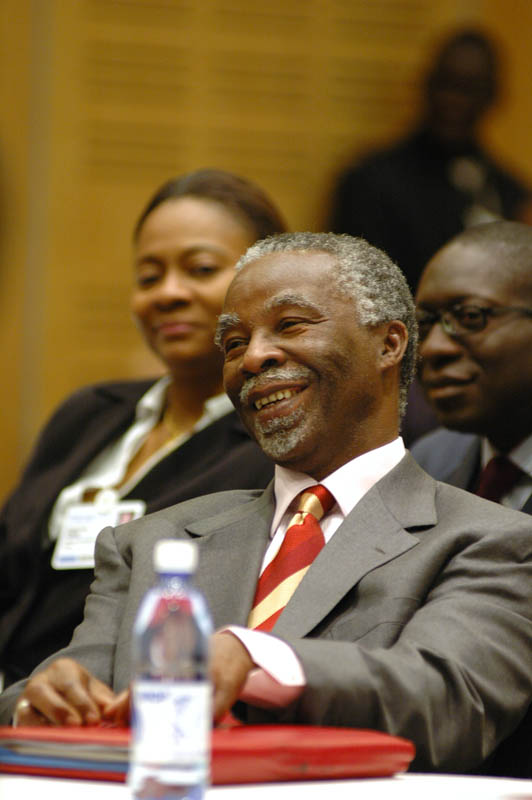
(Mbeki, Mandela & de Klerk)

While Egypt continues to struggle with its current issues in treating its minorities--a deviation from its past history of tolerance and acceptance--South Africa, a nation long known for its past discriminatory practices and apartheid, is moving in the exact opposite direction with its openly tolerant society and support for minorities. It is ironic indeed that each of these nations hold the continent of Africa as the two jaws of a giant dinosaur, one to the far north and the other to the far south.

The report posted below clearly illustrates the direction South Africa is taking:

"The National Spiritual Assembly of South-Africa hosted a banquet for the Birth of Bahá'u'lláh on the 11th of November in Johannesburg where some 170 guests and about 110 Bahá'ís attended. The occasion not only celebrated the Holy Day but also the 50th year of the anniversary of the election of the first National Spiritual Assembly of the Bahá'ís of South Africa. The Bahá'í Community was indeed privileged to receive a message of congratulations from the State President of this country, Mr. Thabo Mbeki"


MESSAGE BY PRESIDENT THABO MBEKI ON THE OCCASION OF THE 50TH ANNIVERSARY OF THE NATIONAL SPIRITUAL ASSEMBLY OF THE BAHÁ'ÍS OF SOUTH AFRICA

I am most honoured to have this opportunity to extend warm greetings to the National Spiritual Assembly of the Bahá'ís of South Africa on this important day, the 11th of November, in which you celebrate your 50th Anniversary.

That you are today turning fifty testifies clearly to your steadfastness and to the pivotal role you have played and doubtlessly will continue to play in advancing the cause of unity and amity in our beloved country, South Africa.

Since its formation half a century ago, on 11 November 1956, the National Spiritual Assembly of the Bahá'ís of South Africa untiringly has promoted the spiritual, moral and material development of Bahá'ís in this country as well as that of the South African society in general. In this regard, your notable participation in the National Religious Leaders Forum has also contributed immensely in ushering in an age of hope in our country.

The fact that your anniversary falls in the same year in which we commemorate our country's land-marking events, such as the tenth year of our democratic Constitution which recognises and promotes religious freedom, points further to the historical position you occupy in our country.

Accordingly, on behalf of the Government and people of South Africa we say congratulations and best wishes to the National Spiritual Assembly of the Bahá'ís of South Africa on your 50th Anniversary.

May you have more successful and fulfilling decades ahead!

THABO MBEKI


[Arabic translation of the letter can be accessed here....]

Monday, November 27, 2006

Egypt: Another Interview With a Baha'i Family


Today, another article appeared in Sawt el-Umma (Voice of the Nation) newspaper, reporting an interview with a Baha'i family living in Maadi, a suburb of Cairo. Raouf Iss'haq and his wife Manal Adel Mustapha were interviewed, and both have expressed their ordeal very eloquently and clearly. The article is entitled "We asked the Baha'is: How do you feel after being considered apostates in the government commissioner's report?" The subtitle states, "They answered: we were not Muslims [in the first place] to have been apostates, and our hope is in the final court's ruling and in the mercy of God."

The article refers to the government commissioner's report prepared for its appeal to the Supreme Administrative Court in its attempt to reverse the lower court's ruling which has granted the Egyptian Baha'is their rights. The previous post published regarding this report is linked here.

The Baha'i couple described in great detail their daily struggle just to survive in their own homeland without any identification documents or an official proof of their marriage, since their Baha'i marriage certificate is not recognized as such by the Egyptian authorities. Raouf said that he can neither walk freely in the streets with his wife nor can he check into a hotel room with her because, in the absence of an ID card for either one of them, no one will accept his Baha'i marriage certificate as an evidence of their status as a family.

He indicated that his ancestors became Baha'is several generations ago after having converted from Christianity. How then could he be considered an apostate from Islam? His wife is a descendant of a family that had a Muslim background that had converted several generations ago, and she was born into a Baha'i family. How could she be considered an apostate since she had never been a Muslim to begin with?

Mr. Iss'haq also recounted his experience when he went to the government's civil status office to request an ID card and was rudely thrown out of the office and told by its administrator "go and sue the government!"

The couple described in great detail the historical background of this crisis, and alluded to all the false accusations made against the Baha'is as well as the evidence refuting these allegations. They also referred to past court cases and the Egyptian courts' rulings that have emancipated the Baha'i Faith as an independent religion. Much emphasis was also placed on the history and teachings of the Baha'i Faith as a recognized independent world religion.

Manal talked about the laws and the sanctity of the Baha'i marriage as well as the Baha'i obligatory prayers and other sacred principles and noble teachings inherent to the Faith of God, just the same as in other world religions.

Overall, this was a very well written article that illustrated to its readers how a Baha'i couple living in Egypt is struggling daily just to survive and cope with these totally unnecessary barriers, simply because of having exercised their God-given right to freedom of religious belief, which also happens to be clearly stated in Egypt's Constitution.

Thursday, November 23, 2006

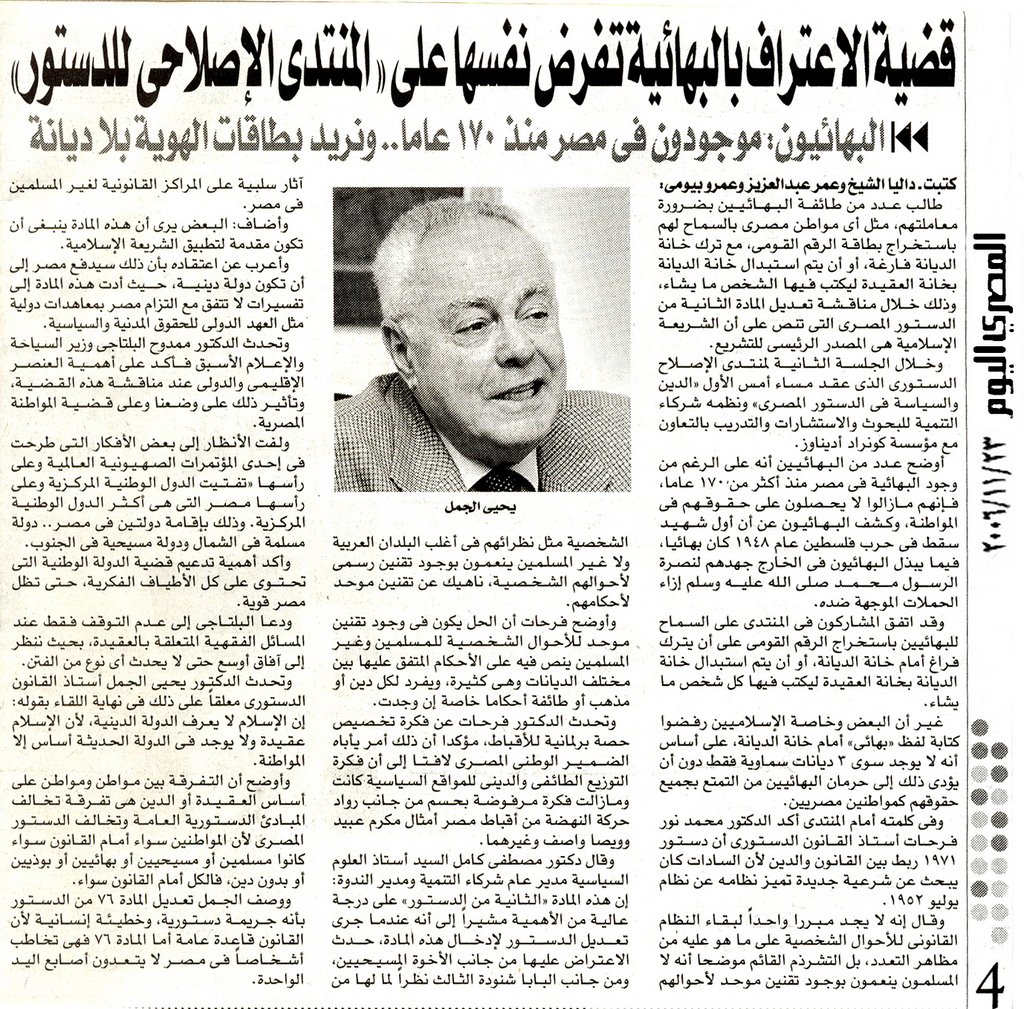
Egypt: Symposium on Constitutional Reforms


The Egyptian newspaper "al-Masry al-Youm" reported today on the role of the Baha'is in an important national symposium held in Cairo at the Marriott hotel in Zamalek. In its headline, it stated "the Legal Case [concerning] the Recognition of the Baha'i [Faith] Has Affirmed [placed] Itself in Front of the Constitutional Reforms Symposium." It is subtitled "Baha'is: Present in Egypt for 170 Years...We Demand ID Cards Without Religion."

In its extended coverage, the newspaper described in great detail the statements made by the Baha'is during this session. They presented a complete historical background of the Baha'i Faith in Egypt as well as the details of their current struggle, the consequences of their inability to obtain ID Cards, and the violation of their civil and human rights in Egypt.

A number of Egyptian Baha'is were officially invited to participate in this national symposium on constitutional reforms, and in particular to participate in discussions related to the necessary reforms to critical issues such as in Article-2 of the Egyptian constitution which states: "Islam is the Religion of the State. Arabic is its official language, and the principal source of legislation is Islamic Jurisprudence (Sharia)."

This second session of the symposium (the first was held on 7 November 2006), which is sponsored by an Egyptian organization named Partners in Development (For Research, Consulting and Training) in collaboration with the German foundation Konrad-Adenauer-Stiftung, was held on Tuesday, 21 November 2006. It is estimated that their work on the constitution will continue for the next six months. The session was entitled "Religion and Politics in the Egyptian Constitution."

Near the conclusion of the session Dr. Yehiah al-Gamal (pictured in the article), who is a Professor of Constitutional Law, stated that "Islam does not know [recognize] a nation based on religion because Islam is a belief, and that the modern nation's foundation is only based on citizenship." he went on to clarify that "differentiation between a citizen and another based on belief is discrimination, which is in violation of the Egyptian constitution because all citizens are equal before the law; whether citizens are Muslims, Christians, Baha'is, Buddhists or irreligious, they are still all equal before the law."

The Baha'is were also invited to the next session entitled "The Nation's Economic and Social Role in the Constitution." In addition to the Baha'is, several prominent leaders, specialists and scholars representing the Egyptian society were invited to contribute to the symposium.

This important symposium is well timed with the current push by President Mubarak to implement progressive constitutional reforms in Egypt as was presented in his recent speech on 19 November at the opening of the Egyptian parliamentarian session this past Sunday.

Tuesday, November 21, 2006

Egypt: Interesting Report in Media on Supreme Court Session


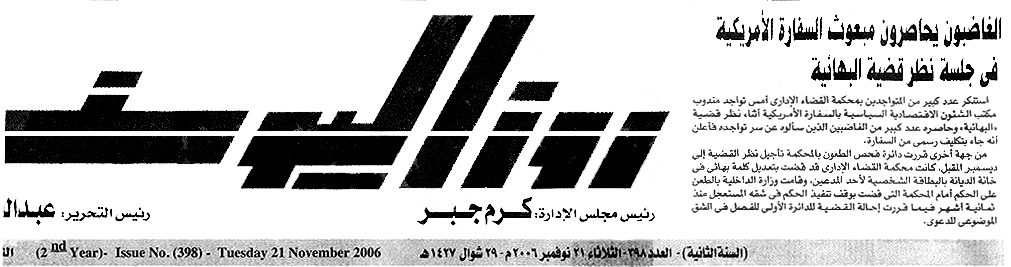
Today, Egypt's Rose el-Yousef newspaper published an interesting brief report on the Supreme Administrative Court's session which was held yesterday in Cairo to hear the government's appeal of the Baha'i case, and reported in this previous post.

The article is entitled, "Angry [mob] Surrounds American Embassy's Emissary in the [court] Session Examining the Baha'i Case."

The article reports the following:

"A large number of those present in the Supreme Administrative Court yesterday resented the presence of a delegate from the American Embassy's Office of Economic and Political Affairs during the court hearing of the Baha'i case. The large number of an angered [mob] surrounding him [the representative] asked for the secret [reason] behind his presence. He announced that he came [to the session] because he was officially commissioned by the Embassy to do so."

"On the other hand, the court's appeals circuit decided to postpone the case until next [this] December [2006]. An Administrative Court had decided to grant a Baha'i litigator [his right] to enter the word Baha'i in the religion section of the Identification Card. The Ministry of Interior has appealed the decision to the [Supreme] Court which suspended the implementation of the [lower court's] expedited ruling eight months ago, and decided to refer the case to the first plenary circuit to examine the merits of the case."

The United States Commission on International Religious Freedom had published a report for "Immediate Release" on 16 November 2006, entitled "Egypt: USCIRF Calls for New Policy on National Identity Cards." To read this report published in a previous post, please click here.

Monday, November 20, 2006

Egypt: Supreme Court Refers Baha'i Case To Plenary


In its session today, Egypt's Supreme Administrative Court ruled to postpone a decision again on the government's appeal of the lower court's ruling that granted the Egyptian Baha'is their rights to correctly enter their religion on official government documents and the newly instituted computerized ID Cards. The court referred the case to a Plenary for a hearing scheduled on 2 December 2006.

This ruling was not unexpected considering the complexity of the case and, perhaps, the current efforts by the Egyptian government to follow a course of promoting democracy, assuring equal civil rights, applying guarantees for freedom of belief, and its move towards progressive constitutional reforms as stated in President Mubarak's recent speech addressing the nation.

Egyptian Baha'is continue to be denied the required identification documents and are in a precarious position as the deadline for enforcing the new ID Card system approaches on 31 December 2006. They are unable to obtain or renew their driver's licenses, unable to open bank accounts, unable to register with the draft board, unable to be admitted to universities, unable to obtain birth or death certificates, unable to obtain passports, unable to travel, unable to obtain marriage certificates, etc....

In other words, because of this ongoing "chase," Baha'is who are citizens of Egypt continue to be denied all their civil rights which are guaranteed to them by the current Egyptian Constitution.

It is time for the Egyptian Government to step in and correct this injustice....

Sunday, November 19, 2006

Egyptian Newspapers Report On US Press Release

In response to the Press Release which was also posted on this blog three days ago, entitled "Egypt: USCIRF Calls for New Policy on National Identity Cards" and published "FOR IMMEDIATE RELEASE" on 16 November 2006 by the United States Commission on International Religious Freedom, the Egyptian press started to bring this document to the attention of the Egyptian public by publishing an Arabic translation and a report on the press release in the Egyptian media.

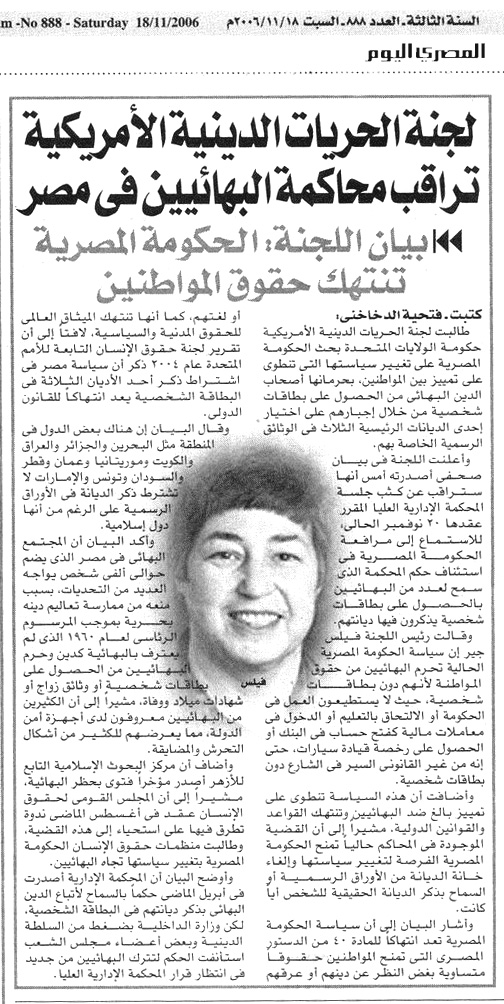
Al-Masry al-Youm [the Daily Egyptian] newspaper was the first to report on this in its article published on 18 November 2006 as attached with this post.

The article was entitled, "American Religious Freedom Commission Monitors [Watches] the [Legal] Trial of The Baha'is in Egypt," and subtitled, "Findings of the Commission: the Egyptian Government is Violating the Rights of the Citizens." The report, written by Ms. Fat'heyah el-Dakh'a'khny, was accurate in its translation, unbiased and stuck to reporting the facts from the press release without any unusual interpretations or unwarranted commentary. It represents a good example of honest, ethical and independent journalism.

Thursday, November 16, 2006

Religion On ID Cards In Egypt: To Be Or Not To Be?


Egypt: USCIRF Calls for New Policy on National Identity Cards

FOR IMMEDIATE RELEASE
November 16, 2006

Contact: Angela Stephens, Assistant Communications Director,
(202) 523-3240, ext. 114

WASHINGTON – The U.S. Commission on International Religious Freedom (USCIRF) is closely monitoring the outcome of a court case in Cairo that will consider whether an Egyptian Baha’i couple will be able to obtain national identity documents without having to deny or falsify their faith.

On November 20, the Supreme Administrative Court in Cairo will convene a hearing on the Egyptian government’s appeal of a lower court decision that would have allowed members of the Baha’i faith in Egypt to obtain a national identity card and to list their religious affiliation. The Commission urges the U.S. government to encourage the Egyptian government to reverse its discriminatory policy of requiring Egyptian citizens to list their religious affiliation, restricting the choice to one of the three state recognized religions – Judaism, Christianity, or Islam – on national identity documents.

“Current Egyptian policy essentially turns Baha’is into non-citizens because without an identity card they cannot gain access to government services like education and employment, or engage in basic financial transactions, such as opening a bank account or obtaining a driver’s license. It is even illegal to be in public without a card,” said Commission chair Felice D. Gaer. “This policy is highly discriminatory and is incompatible with international standards. The current court case provides the Egyptian government with an opportunity to change its policy and omit mention of religious affiliation from identity documents or to make optional any mention of religious affiliation,” said Gaer.

Egypt requires all citizens to obtain and carry a national identity card, including listing one’s religious affiliation, and only permits one of three choices. This policy: Read more....

Sunday, November 12, 2006

Egypt: Yet Another Giant Interviewed

In its recent edition of 9 November 2006, an independent daily newspaper from Kuwait called al-Seyassah [The Politics], published a full page article on its interview with Mr. Amin Battah, an eighty year-old prominent member of the Egyptian Baha'i Community.

The interview covers all aspects of the Baha'i Faith, including its history in Egypt and the rest of the world, its Founder and His successors, its principles, its teachings, its beliefs, its writings, its administrative structure, its goals, and its hopes for the future of the world and for humankind. It also elaborated on the trials, persecutions and legal challenges endured by the Egyptian Baha'is.

The article includes a photograph of Mr. Battah in his home holding al-Kitab al-Aqdas [the Most Holy Book], which is the Book of Laws revealed by Baha'u'llah, the founder of the Baha'i Faith. Another photograph shows the Shrine of the Bab [Gate], the Forerunner of Baha'u'llah, as well as the terraces and gardens surrounding the shrine on Mount Carmel in Haifa, Israel where the Baha'i World Centre is located.

The interview highlights the fact that the Baha'i Faith is a Divine religion, that it is practical in approach, and that its principles and goals are to serve society and solve its economic problems. It also pointed out that Baha'u'llah has revealed over 120 volumes of sacred writings during His ministry.

Bahji: Shrine of Baha'u'llah in Akka (Acre)

Mr. Battah clarified that the Baha'i Faith is the most recent in a succession of progressive nine Divine Revelations from the Almighty God [the last of Messengers being Moses, Jesus, Muhammad, Bab and Baha'u'llah]. He also indicated that Baha'u'llah is the Promised One as prophesied in all previous Divine Books, who will bring about unity of humanity and unity of the world. He stressed that Baha'is are required to obey their just-government, and that Baha'is promote the idea of founding a world authority charged with the preservation of security and peace for the whole world.

Friday, November 10, 2006

An Egyptian Baha'i: In Search Of Recognition (Cont. 4)

It is time to continue Mustapha's story and his struggle with the Egyptian government in his attempts to receive his entitlement as an employee of the Egyptians Railways for cost-of-living adjustments, based on his marriage and then the birth of his son, as was told in four previous posts. The story begins at the post linked here. The next episodes can be seen here, here, and here. This struggle began in 1947 shortly after his marriage and continued until his untimely death in 1968.

His lawsuit continued in the Egyptian courts until June 1952, when the panel of judges dismissed the case and ordered him to pay the costs incurred by the the government's attorneys, amounting to 300 piasters. He was refused the requested salary adjustments for the cost of living allowance guaranteed to all employees when they get married, as well as the additional allowance he was entitled to for the birth of his son.

However, the court failed to prevail in its attempt to implement its proclamations to execute him on the grounds of alleged apostasy, to formally annul his marriage and imprison his wife, or to deny his son's legitimacy and execute him as the son of an apostate.

As will be told in future posts, Mustapha never gave up on his rights, and he spent the rest of his earthly life challenging his government employer for the entitlements owed to him. Even following his death, his widow and three children, who were still students, had to fight for his death allowance and their pension when they were left with no income after his sudden death, at a relatively young age, as he was the only bread winner of the family.

The interesting fact remains that his marriage and the birth of his son were initially recognized in the official birth certificate of his son. The court was unable to invalidate it, and the document remains to this day as an evidence of one of the several cases proving Egypt's official recognition of the Baha'i Faith as a religion. A copy of this document and an English translation are shown in this post. (removed)

As can be seen in this document, the certificate was issued in Ismailia, a town in the Suez Canal region well known for its extreme opposition to the Baha'is since the birth of Muslim Brotherhood, founded by Hassan el-Banna in 1928, and resulting in what is known now as a worldwide Islamist extremism and fundamentalism movement, that was in constant opposition to the Baha'is in Egypt.

However, Ismailia was also known to have been blessed by frequent visits from Abdu'l-Baha, the son of Baha'u'llah the founder of the Baha'i Faith. He was the interpreter of Baha'u'llah's writings and the head of the Baha'i Faith after the passing of his father. As a result of Abdu'l-Baha's visits to that city, many people from various religious backgrounds--attracted by his message, his presence, his wisdom, his knowledge and his teachings--embraced the Baha'i Faith.

The Baha'i community in that city suffered at the hands of extremists for many years until 1960 when the Baha'i Centre was the first one to be raided and shut down by the police after President Nasser's decree outlawing the Baha'i Faith in Egypt. This was also when the first wave of arrests, interrogations and imprisonment of Baha'is in Egypt was carried out, and subsequently repeated over the ensuing years--the last of which was five years ago.

To be continued....

Tuesday, November 07, 2006

Egypt: al-Azhar's Tantawi Promotes Acceptance & Dialogue

This is the latest of news from Islamic leaders in Egypt regarding their apparent tendency towards proclaiming tolerance and religious acceptance of others.

In al-Ahram newspaper article published on 7 November 2006, al-Azhar's Sheikh Muhammad Sai'yd Tantawi was reported to promote his message that "Islam welcomes dialogue with others regardless of their religious affiliation, their civilization or culture." And "that Islamic Shari'ah accepts diversity and differences between humans and urges collaboration with others for the sake of their benefit."

He pointed to the eight principles on which Islamic dialogue is based, namely: "truthfulness, objectivity, and that the goal of those consulting should be to arrive at justice and reason between the parties involved." He stressed the need to "avoid dominating others and that dialogue should be without selfish pride or a sense of superiority," to "avoid wounding others' feelings, and to respect their opinions."

This was said [on 5 November 2006] during the opening session of the tenth "Season of Culture" Congress hosted by the Supreme Assembly for Islamic Affairs, held at the Nour mosque in Abbassi'yah [Cairo]. It was also attended by Dr. Mahmoud Hamdi Zaqzouk, Minister of Religious Endowment and the president of that Assembly.

During the conference, Sheikh al-Azhar Tantawi gave a lecture on "the Islamic understanding of dialogue and that it is considered as one of the principles of Islamic Shari'ah which urges Muslims to collaborate, and [to learn how] to give and take with all humans."

He added that "conflict between people regarding their religious beliefs is an ancient matter and is in human nature." He warned that "even with the worst of conflicts leading to blinded bigotry and prejudiced dialogue, it is important that we give enough room to others when engaged in a dialogue, and to clarify interpretations and phrases used whether from the legislative or the linguistic aspects in order to arrive at justice...because there is so much misunderstanding and incorrect interpretation among people."

These words appear righteous and noble. They promote justice, collaboration, open dialogue, purity of motive, respect for others' beliefs and convictions, tolerance and acceptance. Now it is time to transform these words into action by practicing these pure teachings of Islam when dealing with all people of other beliefs and backgrounds, including the Egyptian Baha'is who have been terribly oppressed by Egypt's fundamentalist religious establishment.