Showing posts with label Religious Tolerance. Show all posts

Wednesday, February 16, 2011

Article-2 of Egypt's Constitution is in Question!

Egypt's Supreme Council of Armed Forces, in its Communique No. 5 following its interim assumption of the country's leadership, suspended the constitution and dissolved both houses of the parliament. Reportedly, it did not, however, suspend Article-2 of the Egyptian constitution which states: "Islam is the Religion of the State. Arabic is its official language, and the principal source of legislation is Islamic Jurisprudence [Sharia]." This article was amended years ago by former President Sadat in his attempt to appease particular segments of the society. [See Egypt's Constitution, under: PART ONE - THE STATE]

The bulk of the revolutionaries, including the Egyptian youth, have been angered by finding out that this Article was not also suspended. They insist that Article-2 contradicts the whole intent and purpose of the revolution. They want to ensure that the revolution does not get hijacked by religious extremism, and want to make certain that the main goal of the revolution remains unchanged, that is: "to provide for a civilian and secular State devoid of any extreme religious ideology, a State that provides equality and fairness to every Egyptian citizen without alienating any minorities or religious groups within the society." They intend to make their case clearly known this Friday.

Sunday, January 23, 2011

Memorandum to Egypt's Prime Minister from HRO

The following press release is in regards to a memorandum submitted by a forum of independent human rights organizations in Egypt to the Prime Minister, Ahmed Nazif, requesting constitutional guarantees for equality in Egypt.

19 January 2011

Memo to the Prime Minister

Strengthening the pillars of the civil state and achieving equality requires the formation of a commission to include representatives from social sectors denied equality

Press Release

Yesterday the Forum for Independent Egyptian Human Rights Organizations submitted a memo to Prime Minister Ahmed Nazif asking that he form a commission under the cabinet to assume the mission of activating constitutional guarantees for citizenship, equality, and equal opportunity for all Egyptians, regardless of religion, belief, ethnicity, or place of birth.

In its memo, the Forum stressed the need for the commission to include independent figures among its members to represent those segments of society that face discrimination or marginalization, such as Copts, Shiites, Baha'is, Nubians, and Sinai Bedouins, as well as representatives of human rights organizations.

The memo, signed by 14 rights groups, aims to encourage official state efforts to address the sectarian crises that pose a real threat to the coexistence of Muslims and Copts within the framework of respect for equality, the repudiation of discrimination and exclusion, and respect for religious liberties. A clear departure must be made from the current sectarian climate, which is increasingly stoking hatred, bigotry, and religious extremism.

In the memo, the Forum noted that the commission’s mandate should include drafting legal proposals to entrench equality and prevent discrimination, advising on problems resulting from discrimination, and monitoring state institution’s observance of the equal right to build and restore houses of worship and occupy senior positions in state and public institutions, including the security establishment.

The commission should also assess and monitor the performance of investigating and security authorities as they deal with incidents of sectarian tension and violence and their compliance with a single standard of law in handling these cases. In addition, it will monitor and evaluate the performance of the media in confronting religious hatred, and assess and monitor the state as it undertakes a thorough review of academic curricula aimed at elevating the humanistic values common to all religions and faiths and strengthening the values of tolerance and mutual respect between adherents of different religions, faiths, and ideas.

The memo stated that there must an end to arbitrary security interference in the freedom of religious belief, stressing the state’s duty to ensure protection for all individuals to worship and deal transparently with cases of conversion. All forms of harassment and pressure brought to bear on people because of their religion or belief must end.

The memo added that the ability of the state to contain sectarianism and put an end to sectarian violence and tension depends to a large extent on restoring the pillars of the civil state that have been eroded over the past decades as a result of the increasing use and abuse of religion and religious institutions in politics and the public sphere. The Forum urged the state to stop deploying religion in the public and political sphere, which is better occupied in a democratic society by political parties and civil society institutions. The state must also stop using religious institutions to play political roles that go beyond their mandates. Similarly, religious institutions should produce modern religious discourses that reject religious exclusion, extremism, and hatred and promote enlightenment and moderation. The memo encouraged religious institutions to enlist one of their own qualified members to monitor publications they release or any speech for its incompatible with the values of citizenship or incites to religious hatred.

To read the entire memo, see:
http://www.cihrs.org/Images/ArticleFiles/Original/623.DOC
To read the entire press release, see:
http://www.cihrs.org/english/newssystem/details.aspx?id=2748

Signatures
1. Andalus Institute for Tolerance and Anti-Violence Studies
2. Arab Network for Human Rights Information
3. Association for Freedom of Thought and Expression
4. Cairo Institute for Human Rights Studies
5. Center for Trade Unions and Workers Services
6. Group for Human Rights Legal Aid
7. Hesham Mubarak Law Center
8. Land Center for Human Rights
9. New Woman Research Center
10. The Arab Penal Reform Organization
11. The Egyptian Association for Community Participation Enhancement
12. The Egyptian Center for Economic and Social Rights
13. The Egyptian Initiative for Personal Rights
14. The Human Rights Association for the Assistance for the Prisoners

Tuesday, January 04, 2011

Egyptians Against Religious Discrimination

Dr. Muhhamad Munir Mugahed, the Executive Director of a registered NGO in Egypt, called Egyptians [Misryioun] Against Religious Discrimination, has recently posted a rebuttal of an article published on 22 December 2010 in Egypt's semi-official newspaper "Al-Ahram" that was intended to belittle the Egyptian Baha'is in their quest for their rights.

The rebuttal was published on 31 December 2010 in an independent daily Arabic news site, promoting equality, justice and progressive human values, named "Modern Discussion."

Because of the vast differences between Arabic and English grammar and vocabulary, the English translation posted below does not do the article justice, but it will provide the reader with the gist of this well thought-out and articulate rebuttal. The original article in Arabic is also linked here....

Religion is for God and Country is for All [a translation]

Al-Ahram newspaper published a strange article by Mr. Ahmed Moussa in his weekly column named "On my own Responsibility" on 22 December 2010, titled "Baha'i is not a religion...!" [The article] stating that “freedom is only for the three heavenly religions, Judaism, Christianity, and Islam, and anything else cannot be regarded as a religion.”

With the exception of the point of view of the Ministry of Interior, I do not understand what he based his strange judgment on.

The word religion from a linguistic perspective means "belief" or "path" as in the [Quranic] verse [referring to unbelievers]: "Unto you your religion, and unto me my religion" (The Unbelievers: 6). Accordingly, disbelief is a religion, the worship of idols is a religion, and any vision related to God is a religion. Of course, people differ in what they consider as a true religion, and even differ within the same religion about what they see as true faith, but this is a personal issue, and it is up to every one of us to resolve this matter for himself and decide what religion is right for him, and what is the true faith for him. No one of us can impose his vision [belief or understanding] on others. And for us, Muslims, God the Almighty has revealed to us "Allah will judge amongst you on the Day of Resurrection concerning that wherein ye used to differ." (Hajj: 69).

Differences in religious beliefs—whether legitimate religions or doctrines—is found among human beings since time immemorial and will continue, but we should not turn this difference into disagreement, discord, and enmity. I am a Muslim, I believe strongly that the religion for Allah is Islam and that who seeks religion other than Islam will not be accepted. But at the same time I realize that there are others in this country and in the world who have contrary religious beliefs that they hold with the same conviction as I do with my own beliefs, and I acknowledge their right to uphold their convictions, and that should not constitute a hindrance in the enjoyment of their rights and personal freedoms, and their full equality with other citizens.

Mr. Ahmed Moussa criticizes Counselor Muqbel Shaker for meeting with a group of Egyptian Baha’is to discuss their grievances and their problems. He says, “these are issues that need the clergy and not civil legislators. This is the foundation of the religious State, because the clergy are the ones who will determine the legitimacy of beliefs of other religions and their rights.” I do not see here a difference between religions, "heavenly" or not. Because all religions do not recognize each other, and the followers of each religion see that the only way to Heaven is their religion or beliefs. Thus, a cleric should not be a judge and jury for other religions. On the other hand, the State has a well-defined role that does not include the admission of citizens into Paradise. Its duty is to protect the rights of all citizens on an equal footing when it comes to belief, manifestation of belief in worship whether secretly or openly, and proclamation—without restrictions or harassment—in accordance with the Universal Declaration of Human Rights.

Mr. Ahmed Moussa also criticizes the Baha'is for demanding their rights, including the declaration of their religion in official documents, and the recognition of Baha'i marriage contracts and divorce since the State has no system of civil personal status like in most countries of the world. He advises them "not to be the fork [the instrument] that foreign powers can manipulate to intervene in the matters of our country." This is blaming the victim for crying out about injustice.

If there is a genuine interest in the country's security, Mr. Ahmed Moussa and those who support him in discriminating against citizens because of their differing religions, should have cared to promote the principle of citizenship provided for in the heart of the Egyptian constitution, so that they block any gaps that predators could pass through in their attempts to attack this country, taking advantage of our mistakes which led to violating the rights of our citizens that differ in religion, race, national origin, or political affiliation. Simply to make Egypt for all Egyptians.

Tuesday, January 27, 2009

Faiths Around the World (Part 4 of 6)

A BBC program, worth watching till...the end! [Coverage of the Baha'i Faith begins at 6:11]

If interested in the complete series, Around the World in 80 Faiths: Part-1 (1/6) begins here.

Monday, November 17, 2008

Is the World Ready for Religious Unity?

The world continues to express its hunger for a solution to its widening disunity. An example of such movements--intended to break through the divisive nature of religious intolerance and widespread dislike of what others believe in--is a newly formed alliance between the technology industry and Hollywood elite. A project, named Charter for Compassion, was launched 3 days ago during a Technology, Entertainment and Design (TED) conference in California.

Along with the religious scholar Karen Armstrong, the group, named "Tedizens," includes several celebrities such as Google founders Larry Page and Sergey Brin as well as other Internet icons and widely-recognized entertainment industry names, such as Forest Whitaker and Cameron Diaz.

What is even very telling and worth noting is that Charter for Compassion--as stated below in the introduction to its movement--is inviting people of all nations, all faiths and all backgrounds to contribute to the writing of its charter:
Over the next four weeks, everyone is invited to help write the Charter for Compassion. Please choose the active phase below, read the description, be inspired by the sample text, and share your own words or suggestions for that section of the Charter. [link]

In order to find out more about the background of this project and to know what is meant by the "Golden Rule," please view the video below, which is introduced by Karen Armstrong.

Wednesday, October 17, 2007

An Egyptian Journalist's View on Tolerance

[Translator’s notes appear in square brackets [ ].]

An Egyptian Baha'i, Mrs. Wafá’ Hindi Halim, sent an email to Dr. Khalid Montasser (a medical doctor and writer for a number of newspapers, including Sawt Al-Umma; to express her sorrow that the fabric of Egyptian society should constitute only two religions, Islam and Christianity; she asks him how their society can reach the goal of accepting “the other” and briefly explains the plight of Egyptian Baha’is. Dr. Montasser has responded by writing this article, which was published by the independent weekly Egyptian newspaper Sawt El-Umma [Voice of the Nation] on 3 September, 2007. The headline reads:

A letter from a Baha’i citizen: we suffer a moral killing and a civilian death

Underneath the picture of ‘Abdu’l-Bahá, a lead-line by Dr. Montasser reads:

My acceptance of a Baha’i is [reflects] confidence in myself as a Muslim

The author introduces Mrs. Halim’s letter as follows: “We will not enter civilization or take part in any progress unless we memorize, comprehend and apply this word which was sculpted by Europeans; a word which we translated only in form and assassinated its meaning. The word is TOLERANCE; tolerance and acceptance of the other. We need to understand that the universe is not only for us; that my existence is not necessarily tied to another’s extinction; that the secret of my strength, as a Muslim, is confidence in myself and not fear and mistrust of the other. The concept of two pavilions, one for believers and one for infidels, is an old, out-worn understanding which has been overtaken by civilization; the concept of citizenship must reign and not be set aside. We have to deal with Baha’is through these understandings; no matter how much we disagree with them, they do have the right to life. Society has killed them, morally, when it deprived them of the identification card, birth certificate, death certificate, appointing a lawyer, etc. It is a crime of Nazi-style annihilation that future history—for assuredly progress will be victorious—will not forgive. They [the Baha’is] are not a terrorist organization, they are just ideologically different; this is their only crime. Let us read together the letter from the Baha’i citizen—or rather, non-citizen—Wafá’ Hindi Halim....” [her letter to Dr. Montasser , in which she quotes part of a statement by a civic group calling itself “Egyptians against discrimination”, is then printed in its entirety.]

Tuesday, October 09, 2007

President Mubarak Calls for Religious Discourse & Tolerance

In a speech posted today on Egypt State Information Service, President Hosni Mubarak "renewed his call for an innovative and elevated religious discourse that concentrates on the essence of the faith, spreads the values of moderation and tolerance and rejects extremism and bigotry."

The headline states: "Mubarak calls for renewal of religious discourse to disseminate the Islamic values of moderation & tolerance and to encircle extremism."

The report concludes with the following: "He said that Egypt is determined to build for its people, both Muslims and Copts, a better future that brings about progress and prosperity to them all. Egypt's people are united and will always remain so, he asserted."

"'We will remain committed to our slogan 'Religion is for God and the Nation is for all'. And we will also remain committed to calls for dialogue among people of different civilizations and faiths, he said noting that the world needs such a serious dialogue that is based on mutual respect and interests and common humanitarian principles for a future world that enjoys peace, amity, stability and justice."

To read the entire report, please click here....

Tuesday, October 02, 2007

Thursday, September 27, 2007

Ahmadinejad's Selective View of Religious Diversity & Acceptance

The New York Times wrote the following in today's edition:

"[President Ahmadinejad] took questions from a panel that included a Quaker, a Catholic, an Anglican, a Baptist and a representative of the interfaith World Council of Churches."

"The organizers said that they had pressed hard to find a Jewish leader to join the panel of questioners, but that those invited declined because they could not win support from Jewish organizations."

"...the Bahais, a minority religious group that has suffered persecution in Iran, said they supported these efforts at dialogue with the Iranian government. They had been invited to the prior meetings, but the Iranian side refused to come if Bahais were there, said Kit Bigelow, director of external affairs, National Spiritual Assembly of the Bahais of the United States."

Read the entire article here....

Based on the various interviews, meetings and panels involving the president of Iran, he had repeatedly used pleasant and inviting words proclaiming his belief in equality of humans, religious harmony and that the mission of all religions is the same as they all come from the same source. However, whenever the question of the Baha'is--being savagely persecuted in Iran--is brought up with him, he would evade the issue by stating that there are only four recognized religions in Iran "Christianity, Judaism, Islam and Zoroastrianism." He did not even acknowledge the existence of Baha'is in Iran, the largest religious minority in that country.

The question Mr. President is: since Iran is such a tolerant nation that respects all human beings, and since Baha'is are a significant segment of your human population, why then do you continue to isolate them, persecute them and deprive them of all their rights? Do you or do you not consider the Baha'is humans? Furthermore, why did you refuse to meet with the Baha'is when you had the opportunity to do so during this panel?

Considering your deep respect for the teachings of your own Faith, one cannot but to expect the best from you: that your deeds must conform to your words.

Here is a perfect example of the President's response to a question regarding the Baha'is of Iran:

Saturday, December 23, 2006

Egypt: Need to Apply the True Teachings of Islam

The Teachings of Islam: What is Right for Muslims Must Also be Right for Baha'is

In an "OPEN LETTER TO HIS HOLINESS POPE BENEDICT XVI" [Arabic version linked here] sent on 12 October 2006 in response to the Pope's statements in a lecture he has given at the University of Regensburg in Germany on 12 September 2006, thirty eight Islamic religious leaders, thinkers and scholars have presented their response to the Pope's injudicious comments about the Prophet Muhammad (PBUH), and his references to Islam and to religious violence which had aroused a great uproar, violence and many demonstrations by outraged Muslims throughout the world.

The statements were in regards to the Pope's use of a debate between the Emperor Manuel II Paleologus and a “learned Persian” as the starting point for a discourse on the relationship between reason and faith. Among the thirty eight co-signatories of this open letter were, H.E. Shaykh Professor Dr. Ali Jumu‘ah Grand Mufti of the Republic of Egypt and Professor Dr. Abla Mohammed Kahlawi Dean of Islamic and Arabic Studies, Al-Azhar University (Women’s College), Egypt.

This letter pointed out to the Pope the true nature of Islam and very eloquently corrected misrepresentations of it and its Prophet. As will be quoted below, the letter emphasized the merciful, tolerant and compassionate essence of Islam.

Under the title, There is no Compulsion in Religion, the letter states the following: "...There is no compulsion in religion was not a command to Muslims to remain steadfast in the face of the desire of their oppressors to force them to renounce their faith, but was a reminder to Muslims themselves, once they had attained power, that they could not force another’s heart to believe. There is no compulsion in religion addresses those in a position of strength, not weakness...." It continues by stating, "...Moreover, Muslims are also guided by such verses as Say: The truth is from your Lord; so whosoever will, let him believe, and whosoever will, let him disbelieve. (al-Kahf 18:29); and Say: O disbelievers! I worship not that which ye worship; Nor worship ye that which I worship. And I shall not worship that which ye worship. Nor will ye worship that which I worship. Unto you your religion, and unto me my religion (al-Kafirun: 109:1-6)."

Under the title, What is "Holy War"? it states: "We would like to point out that “holy war” is a term that does not exist in Islamic languages. Jihad, it must be emphasized, means struggle, and specifically struggle in the way of God. This struggle may take many forms, including the use of force. Though a jihad may be sacred in the sense of being directed towards a sacred ideal, it is not necessarily a “war”...."

It continues: "...Moreover, the emperor’s statements about violent conversion show that he did not know what those instructions are and have always been. The authoritative and traditional Islamic rules of war can be summarized in the following principles:

1. Non-combatants are not permitted or legitimate targets. This was emphasized explicitly time and again by the Prophet, his Companions, and by the learned tradition since then.
2. Religious belief alone does not make anyone the object of attack. The original Muslim community was fighting against pagans who had also expelled them from their homes, persecuted, tortured, and murdered them. Thereafter, the Islamic conquests were political in nature.
3. Muslims can and should live peacefully with their neighbors. And if they incline to peace, do thou incline to it; and put thy trust in God (al-Anfal 8:61). However, this does not exclude legitimate self-defense and maintenance of sovereignty.

Muslims are just as bound to obey these rules as they are to refrain from theft and adultery.... God says in the Holy Qur’an:
Let not hatred of any people seduce you into being unjust. Be just, that is nearer to piety (al-Ma’idah 5:8)."

Under Forced Conversion it states: "...The command There is no compulsion in religion means now what it meant then. The mere fact of a person being non-Muslim has never been a legitimate casus belli in Islamic law or belief.... We emphatically agree that forcing others to believe—if such a thing be truly possible at all—is not pleasing to God and that God is not pleased by blood. Indeed, we believe, and Muslims have always believed, that Whoso slays a soul not to retaliate for a soul slain, nor for corruption done in the land, it shall be as if he had slain mankind altogether (al-Ma’idah 5:32)."

Under Something New it states: "...and, Say (Muhammad): I am no new thing among the messengers (of God), nor know I what will be done with me or with you. I do but follow that what is Revealed to me, and I am but a plain warner (al-Ahqaf, 46:9). Thus faith in the One God is not the property of any one religious community. According to Islamic belief, all the true prophets preached the same truth to different peoples at different times. The laws may be different, but the truth is unchanging."

And finally under Christianity an Islam it quotes the Bible: "...particularly ‘the two greatest commandments’ in Mark 12:29-31 (and, in varying form, in Matthew 22:37-40), that, the Lord our God is One Lord; / And thou shalt love the Lord thy God with all thy heart, and with all thy soul, and with all thy understanding, and with all thy strength: this is the first commandment. / And the second commandment is like, namely this, Thou shalt love thy neighbour as thyself. There is none other commandment greater than these."

Last week, shortly after this enlightened and eloquent letter to the Pope, Egypt's Supreme Administrative Court gave its final judgement against the Baha'is' basic rights, which denounced them as infidels and apostates of Islam, echoing the adamantly held attitude of al-Azhar towards the Baha'i Faith; there was no uproar or demonstration by Baha'is in Egypt or anywhere else, instead they continued their peaceful and rational appeals for their citizenship rights.

Furthermore, the Egyptian Baha'is are being told by the officials that in order to obtain ID Cards and recognition in Egypt they must either lie on official documents by denying their religion or convert to Islam!

These two events occurred within a few short months of each other. The Baha'is in Egypt, as a result of the recent Supreme Court verdict, are currently being treated as a non-entity in direct violation of the stated sacred teachings of Islam and the Holy Qur'an that has been clearly voiced by these respected Islamic leaders and scholars, including those from Egypt.

Would it not be deemed obedient to the Qur'an and the Prophet Muhammad (PBUH), righteous, sincere and honest for these honorable Muslim leaders to put into action their pronouncements and elucidations, and similarly, advice the Supreme Court of Egypt as well as the Egyptian Government to apply these essential and basic teachings of Islam to their Baha'i religious minority which has been cruelly persecuted and deprived of its basic civil and human rights?

Monday, December 11, 2006

Egypt: Is It Time to Return to Its Known Civility?

Another article appeared in "al-Masri al-Youm" Egyptian newspaper on 9 December 2006 reviewing the upcoming Supreme Court Case.

The article is entitled "The Supreme Administrative [Court] determines the fate of Baha'i-yyah [Baha'i Faith] this coming Saturday." It is subtitled "Report of the State's Commissioners and Islamic Scholars concurred that it is not a recognized religion [in Egypt]."

It opens with:

The Supreme Administrative Court of the State Assembly will determine in its session, that will convene this coming Saturday, the fate of Baha'i-yyah in Egypt...specifically in regards to its recognition by official and governmental agencies as a religion, and whether or not it can be written in official papers and documents such as identification cards, birth certificates and passports.

The Supreme Administrative Court (first circuit) will produce its judgement on the "matter" of the appeal submitted by the Ministry of Interior, the Civil Affairs Agency, and the Passport and Immigration Agency regarding the judgement of the Administrative Court issued this past 4th of April, in which it ruled to cancel the decision of the Minister of Interior forbidding the entrance of the word "Baha'i" in the religion section of official documents. The court also ruled to enforce the right of the [Baha'i] plaintiffs to obtain official documents with Baha'i written in the religion section.

The lawsuit was initially filed in the Administrative Court on 10 June 2004, and in which Hessam Ezzat Muhammad Moussa and his wife Ranya Enayat Abd'el-Rahman Rushdi have stated that, as subjects of the Arab Republic of Egypt who are in possession of Egyptian citizenship, when they requested the Passports and Immigration Agency to include the names of their daughters in their two passports, the president of the agency confiscated their identification cards without any legal cause. That religion was the reason given for the refusal of registering their daughters in the passports, this in violation of the State's laws and the Egyptian Constitution which guarantees freedom of belief. And that this--illegal--refusal causes their daughters to be deprived of freedom of movement [travel] accorded to them by law. They demanded at the end of their lawsuit the cancellation of the administrative agency's ruling that forbids documenting "Baha'i" in the religion section of these official documents which were requested to be issued.

The rest of the newspaper article described the State Commissioners' report (previously posted here) and included the names of the eight judges involved in writing the commissioners' report opinion. Three of whom pictured in the article are: president of the State's assembly Justice Say'id Nofa'l, member of the assembly Justice Essam el-Din Abd el-Aziz and the State's commissioner Justice Abd el-Qader Qandil.

This newspaper report neglected to discuss the real substance of this landmark case. The essential crux of this case which must be dealt with is the right of any legal citizen of Egypt to obtain official documents, including ID Cards, birth certificates, death certificates, marriage certificates, passports, etc.... This case is not about whether or not Egypt should recognize the Baha'i Faith as an independent religion--it has already done so in the 1920s--this case is about the rights to citizenship. The Baha'is were asked by the governmental agencies to lie about their religion in order to obtain any documents they wish to obtain, forcing them to violate the law and commit a felony in doing so just to obtain their constitutionally guaranteed rights. Furthermore, lying on official documents would violate their own personal convictions and moral dictates.

Now it is up to the Supreme Court to uphold the lower court's ruling to grant the Egyptian Baha'is their rights to citizenship as written in the Constitution.... Is it time for Egypt to return to its tolerant, just and civil society it had been known for?

Friday, December 01, 2006

Egyptian Initiative for Personal Rights Prepares for Court


Hossam Bahgat, a 26 year old Egyptian human rights activist and director of the Egyptian Initiative for Personal Rights is urging supporters of human rights in Egypt to attend the Supreme Court's session scheduled for this Saturday, 2 December 2006, which is intended to rule on the Ministry of Interior's appeal of the lower administrative court's ruling which granted the Egyptian Baha'is their rights to be recognized on official documents and be able to obtain government-issued ID Cards.

He reports that during previous court's sessions, the courtroom was full of extremists who had intentionally created an environment of terror, anarchy and chaos during the court's sessions intimidating the judges, the attorneys and the journalists present. Consequently, the attorneys for the Baha'is were never free to argue their case before the panel of judges.

As in Bahgat's letter quoted in Arabic below he is strongly urging the attendance of the largest number possible of "Egyptians Against Religious Discrimination" and in particular those who are members of the judiciary committees.

Here is a press release by the Egyptian Initiative for Personal Rights (EIPR):


Right to Privacy Program

Press Advisory- 29 November 2006

Supreme Admin Court to Consider Interior Ministry's Appeal against Baha'is on Saturday

On Saturday, 2 December 2006, the First Circuit of the Supreme Administrative Court will consider the merits of the Interior Ministry's appeal against a lower court decision that found Egyptian Baha'is had the right to obtain birth certificates, identity cards and other official documents that recognized their faith.

The Supreme Court's Appeal Inspection Chamber started considering the seriousness and admissibility criteria of the appeal last May. On 15 May, the Chamber accepted the Interior Ministry's request to suspend the implementation of the lower court decision pending consideration of the appeal. The appeal was referred to the First Circuit on 20 November after receiving the mandatory advisory opinion of the State Commissioners Authority that recommended ruling in favor of the Interior Ministry.

In a 4 April 2006 ruling the Administrative Justice Court had found in favor of two Baha'i parents who wanted birth certificates for their three daughters after the Interior Ministry had confiscated them for discovering they recognized the daughters and their parents as followers of the Baha'i faith. The ruling was founded on the premise that Islamic Shari'a prohibited discrimination against non-Muslims; that recognizing the Baha'i faith in official records did not mean an official endorsement of its tenets; and that it was in the state's interest to recognize the true religious affiliation of citizens in order to identity the rights, duties and laws applicable to them.

It is worth noting that the current lawsuit does not deal with the legal recognition of the Baha'i community or the veracity of its faith. The question before the Supreme Administrative Court is whether or not Egyptian Baha'i citizens have the right to obtain official identification documents that listed their religious affiliation, left the 'religion' line blank or inserted the word 'others' instead of the three officially recognized religions of Islam, Christianity and Judaism. These three options were available for Egypt's Baha'i citizens for decades before the Interior Ministry's Civil Status Department decided in the last four years to force them to follow one of the three recognized religions only.

The Court hearing should start at 10 a.m. and be open to the public and the media in Maglis El-Dawla in Dokki.


The following is Mr. Bahgat's letter to Misriyoun [Egyptians] Against Religious Discrimination (MARED):


السادة أعضاء مصريون ضد التمييز الديني
لعلكم ربما تعلمون أن المحكمة الإدارية العليا ستنظر يوم السبت القادم 2 ديسمبر في موضوع حق البهائيين في الحصول على أوراق رسمية دون الاضطرار إلى ادعاء الدخول في الإسلام أو المسيحية. ولا أجد حاجة للتأكيد على أهمية الموضوع أو الدعوى أو الجلسة التي يتم فيها أقرار مبدأ نهائي غير قابل للطعن عليه قد يظل معنا لسنين طويلة قادمة. كما أن الأسئلة المطروحة على المحكمة والمبادئ التي تحاول وزارة الداخلية إقرارها من خلال هذا الطعن تتجاوز في تأثيرها جماعة البهائيين الصغيرة لتؤثر على الوضع القانوني لحرية العقيدة وتطبيق المادة الثانية من الدستور بشكل يمس جميع المصريين بشكل عام.

في الجلسات الماضية أمام دائرة فحص الطعون كانت المحكمة تحتشد بالمحامين والمواطنين المتشددين الذين كانوا يشيعون جواً من الإرهاب في المحكمة ضد المحامين والقضاة والصحفيين بمنتهى الغوغائية. كنا في العادة نقف فردين أو ثلاثة أمام حوالي خمسين من الطرف الآخر ونحارب باستماتة لنتمكن من مخاطبة المنصة. في جلسة السبت من المهم للغاية أن تحتشد قاعة المحكمة بأكبر عدد ممكن من المصريين المناهضين للتمييز على أساس العقيدة وأن يتقدموا إلى المنصة عند بدء مناقشة قضيتنا. لذلك فإننا نحتاج بشدة لحضور أكبر عدد من أعضاء مصريون ضد التمييز الديني، خاصة السادة أعضاء اللجنة القانونية. آسف لضيق الوقت ولكن الجلسة تحدد موعدها فجأة منذ بضعة أيام.
الجلسة موعدها العاشرة صباحاً بمجلس الدولة في الدقي بجوار شيراتون القاهرة. لمن يرغب في الحصول على أي معلومات أرجو الاتصال بي على
مع خالص الشكر
حسام بهجت


Egyptian Initiative for Personal Rights
Tel/fax: + (202) 795 0582- 796 2682
eipr@eipr.org
www.eipr.org

Tuesday, November 28, 2006

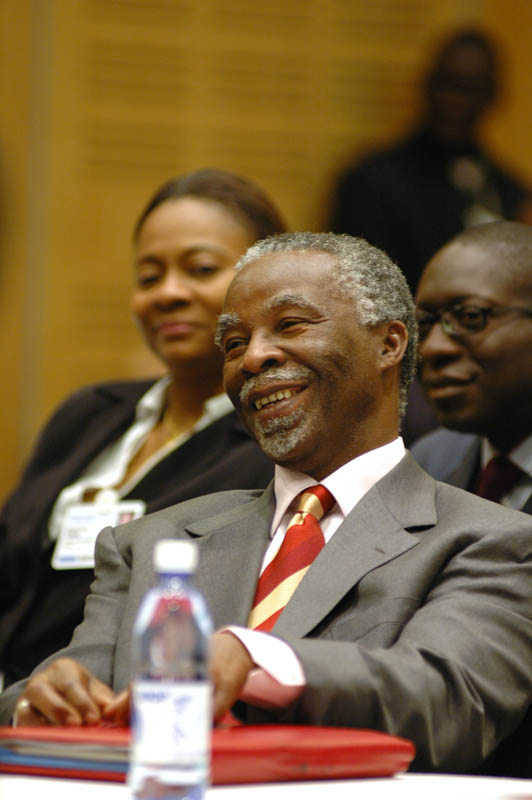
The Irony of Change!

(Mbeki, Mandela & de Klerk)

While Egypt continues to struggle with its current issues in treating its minorities--a deviation from its past history of tolerance and acceptance--South Africa, a nation long known for its past discriminatory practices and apartheid, is moving in the exact opposite direction with its openly tolerant society and support for minorities. It is ironic indeed that each of these nations hold the continent of Africa as the two jaws of a giant dinosaur, one to the far north and the other to the far south.

The report posted below clearly illustrates the direction South Africa is taking:

"The National Spiritual Assembly of South-Africa hosted a banquet for the Birth of Bahá'u'lláh on the 11th of November in Johannesburg where some 170 guests and about 110 Bahá'ís attended. The occasion not only celebrated the Holy Day but also the 50th year of the anniversary of the election of the first National Spiritual Assembly of the Bahá'ís of South Africa. The Bahá'í Community was indeed privileged to receive a message of congratulations from the State President of this country, Mr. Thabo Mbeki"


MESSAGE BY PRESIDENT THABO MBEKI ON THE OCCASION OF THE 50TH ANNIVERSARY OF THE NATIONAL SPIRITUAL ASSEMBLY OF THE BAHÁ'ÍS OF SOUTH AFRICA

I am most honoured to have this opportunity to extend warm greetings to the National Spiritual Assembly of the Bahá'ís of South Africa on this important day, the 11th of November, in which you celebrate your 50th Anniversary.

That you are today turning fifty testifies clearly to your steadfastness and to the pivotal role you have played and doubtlessly will continue to play in advancing the cause of unity and amity in our beloved country, South Africa.

Since its formation half a century ago, on 11 November 1956, the National Spiritual Assembly of the Bahá'ís of South Africa untiringly has promoted the spiritual, moral and material development of Bahá'ís in this country as well as that of the South African society in general. In this regard, your notable participation in the National Religious Leaders Forum has also contributed immensely in ushering in an age of hope in our country.

The fact that your anniversary falls in the same year in which we commemorate our country's land-marking events, such as the tenth year of our democratic Constitution which recognises and promotes religious freedom, points further to the historical position you occupy in our country.

Accordingly, on behalf of the Government and people of South Africa we say congratulations and best wishes to the National Spiritual Assembly of the Bahá'ís of South Africa on your 50th Anniversary.

May you have more successful and fulfilling decades ahead!

THABO MBEKI


[Arabic translation of the letter can be accessed here....]

Tuesday, November 07, 2006

Egypt: al-Azhar's Tantawi Promotes Acceptance & Dialogue

This is the latest of news from Islamic leaders in Egypt regarding their apparent tendency towards proclaiming tolerance and religious acceptance of others.

In al-Ahram newspaper article published on 7 November 2006, al-Azhar's Sheikh Muhammad Sai'yd Tantawi was reported to promote his message that "Islam welcomes dialogue with others regardless of their religious affiliation, their civilization or culture." And "that Islamic Shari'ah accepts diversity and differences between humans and urges collaboration with others for the sake of their benefit."

He pointed to the eight principles on which Islamic dialogue is based, namely: "truthfulness, objectivity, and that the goal of those consulting should be to arrive at justice and reason between the parties involved." He stressed the need to "avoid dominating others and that dialogue should be without selfish pride or a sense of superiority," to "avoid wounding others' feelings, and to respect their opinions."

This was said [on 5 November 2006] during the opening session of the tenth "Season of Culture" Congress hosted by the Supreme Assembly for Islamic Affairs, held at the Nour mosque in Abbassi'yah [Cairo]. It was also attended by Dr. Mahmoud Hamdi Zaqzouk, Minister of Religious Endowment and the president of that Assembly.

During the conference, Sheikh al-Azhar Tantawi gave a lecture on "the Islamic understanding of dialogue and that it is considered as one of the principles of Islamic Shari'ah which urges Muslims to collaborate, and [to learn how] to give and take with all humans."

He added that "conflict between people regarding their religious beliefs is an ancient matter and is in human nature." He warned that "even with the worst of conflicts leading to blinded bigotry and prejudiced dialogue, it is important that we give enough room to others when engaged in a dialogue, and to clarify interpretations and phrases used whether from the legislative or the linguistic aspects in order to arrive at justice...because there is so much misunderstanding and incorrect interpretation among people."

These words appear righteous and noble. They promote justice, collaboration, open dialogue, purity of motive, respect for others' beliefs and convictions, tolerance and acceptance. Now it is time to transform these words into action by practicing these pure teachings of Islam when dealing with all people of other beliefs and backgrounds, including the Egyptian Baha'is who have been terribly oppressed by Egypt's fundamentalist religious establishment.

Sunday, October 29, 2006

Egypt: A Response To Mahmoud On Baha'i Faith

While browsing some of the Egyptian blogs, a very interesting discussion was found in a blog owned by an Egyptian Muslim who had written a daring and honest post regarding the Baha'i Faith, which resulted in a mature discussion that has clearly illustrated the degree of openness and tolerance shown by the young Egyptian generation. The blog can be found at this link.

One of the individuals commenting on the post, named Mahmoud, has raised several questions--many of which repeat the usual false accusations and misrepresentations that have been circulated by uninformed media sources and enemies of the Baha'i Faith. After responding to one of Mahmoud's posts, it appeared to be of possible interest to the wider readership if this response were to be published here as well, so here is the response below:

Dear Mahmoud,

Thank you for beginning this interesting dialogue and hopefully these few paragraphs will assist you in gaining better understanding of the truth regarding the Baha’i Faith.

Please excuse me for not responding to you in Arabic as, currently, I do not have the facility to publish in Arabic.

The holy Qur'an states that "Muhammad is the messenger of God and the seal of the prophets." It did not state that he is the seal of the messengers. Baha'is acknowledge that His Holiness Muhammad is the seal of the prophets. His Holiness Muhammad had sealed and completed a prophetic cycle which began with Adam. His Holiness Baha'u'llah began a new cycle with a vast revelation from God. He never claimed to be God, but like all other messengers of God, He reflected God’s image to humanity as His Manifestation, just like a mirror reflecting an image—say of the sun—you will see the sun in the mirror…this does not mean that the mirror is the sun, it is only an instrument. This applies to any messenger of God.

Baha’is believe that this new Baha’i cycle will last about 500,0000 years and God will continue to bless humanity with many Messengers under this new cycle...every 1000 years or so. God will never abandon or leave humanity alone and without guidance—just think about that—would you think that when your parents sent you to the elementary school they would have stopped right there and left you without any further education? Humanity is also like this example, it cannot stop learning as it matures and grows over thousands of years. Do you think that God would say: “well I have done enough for my creatures, and I will not send them any further guidance, and will just leave them for themselves to alter My teachings, continue to interpret my words, divide themselves into sects and arm themselves towards annihilation, spilling each other’s blood, and to have savage wars and conflicts until they exterminate each other....”? I do not think so…and any person who really cleanses his heart and opens his eyes to see the truth without any prejudice or attachment, will see the same.

The proof of the authenticity of a religion is in its teachings and in its influence on its followers and on humanity as a whole. Today, the Baha'i Faith is geographically the second-most widespread religion in the world after Christianity. How any religion could spread so wide and so fast, and have so many followers from all races, colors and backgrounds, if it were not of God?

Regarding your other point on the accusation that Baha'u'llah was a Russian agent: this has been one of the many false allegations that have been spread by His enemies. One fails to see the point of this clearly silly allegation. What interest did Russia—turning into a communist nation at the time—have in religion? One of its first acts was to ban all religions in its land.... Baha’u’llah was exiled from Persia and became a prisoner of the Ottoman Empire, being expelled from one city to another until he ended up in the dreaded prison of Acre (Akka). What interest would Russia have in such a prisoner? Is there any logic to this?

May I suggest again that you check the links in Arabic listed in my site? You will find answers to all your questions at these links, but please look at them with an open and detached heart…then, you will see for yourself.

Your frankness in asking these questions is greatly appreciated, and I pray that you will be guided to the truth....

Wednesday, October 25, 2006

Egypt: Interview With Gamal El-Banna


This is the most recent media coverage in the Egyptian press on the status of the Baha'i Faith in that country. On 21 October 2006 al-Masry al-Youm newspaper published an interview with the Islamic scholar and prominent Egyptian liberal thinker Gamal el-Banna. The article was entitled "You ask and Gamal el-Banna answers on the truth of Baha'iyyah."

Gamal el-Banna is known in the Egyptian society as a progressive, moderate and liberal thinker who is also a scholar who has published several books and manuscripts on various aspects of reform of religion and Islam as it applies to the modern Egyptian society.

On several occasions, el-Banna has publicly defended the civil rights of Egyptian Baha'is, and their entitlement to recognition and equal treatment under the law.

His older brother Hassan el-Banna founded the Muslim Brotherhood movement in Egypt's Suez Canal city of Ismailia in 1928. The movement was subsequently outlawed, its followers were incarcerated over the years, and its founder was assassinated in 1949.

In contrast to the moderate and reformist Gamal el-Banna, his brother Hassan had contributed greatly to the persecution of the Baha'is in Ismailia, and his movement has been the main source of opposition to the Baha'i Faith in Egypt since the movement's inception in Ismailia.

The newspaper journalist asked Gamal el-Banna several penetrating and insightful questions, the responses of el-Banna were guarded, but appropriate. However, some of his answers were not quite accurate, particularly when he mentioned that Baha'is worship the number nineteen. It is apparent that this particular answer was not based on independent investigation of the Baha'i Faith, but rather repetition of misinformation that has been circulated by enemies of the Baha'i Faith, In fact, having heard and seen some of the interviews with Gamal el-Banna, one would have no doubt that in time, and through independent study of the Baha'i Faith, he would be able to determine for himself the truth and facts regarding the principles and noble teachings of the Faith, and it would become clear to him that there is no such a thing as worshiping a mere number.

He said, "...but the freedom of belief forces us to leave them [Baha'is] to the choice they made for themselves, this is their right, and I believe that it is in their right that they are documented as Baha'is in the ID Card and official documents."

He later stated that "even though the idea of recognizing the three religions of Judaism, Islam and Christianity [in Egypt] is a sound one, yet in China and India there are as many believers [in other religions] as there are in the mentioned three religions. God [in the Qur'an] has said...you have your religion and I have mine...so he ruled that even the unbelievers have their own religion, at least in the eyes of those who believe in these words, and that [the unbelievers] have just the same rights as the believers."

Another interesting fact about this honorable man is that, even though he disagreed with and opposed his brother's teachings and inclinations, he continues to hold respect and love for his late older brother. This became clear when he was asked by the reporter about the plans for a film depicting the life of his brother. Gamal indicated that the fact that he is the brother of Hassan is irrelevant since Hassan was and is considered a public figure rather than just a family member.

For further reading (in Arabic) about this particular news item, please refer to a recently published post at this site.

Friday, October 20, 2006

President Mubarak On Religious Tolerance

As a follow up on the previous post regarding the highly anticipated speech of Egypt's President Mr. Hosni Mubarak given on 19 October 2006, the following are excerpts from a report on the speech. For the full article on Reuters website, please click here.

To view a complete video recording of the speech, please click here.


Egypt's Mubarak blames Muslims for faith's bad image

By Alaa Shahine

CAIRO (Reuters) - Egypt's President Hosni Mubarak questioned on Thursday whether Muslims had done enough to change the West's "wrong perceptions" about Islam, which he said was under "ferocious attack".

He also said Islam needed a fresh religious discourse to promote tolerance and uproot extremist views.

"The Muslim world is facing a ferocious attack, describing Islam wrongly and offending Muslims' sacred (symbols and figures) and beliefs," Mubarak said in a speech marking Lailat al-Qadr, the night Muslims believe God started the revelation of the Koran to Prophet Mohammed more than 1400 years ago.

"Don't we Muslims share part of the responsibility for the wrong perceptions about Islam? Have we done our duty in correcting the image of Islam and Muslims?" he said.

"Isn't it the time for a new religious discourse, that teaches people the correct things in their religion ... and promotes the values of tolerance against those of extremism and radicalism?" he said.

It was the most detailed remark yet by the president on the need to reform Islam's jurisprudence to accommodate more moderate views, although critics say the state's control of religious institutions in Egypt has harmed their credibility.

Egypt has been battling radical Islamists since before Mubarak took office. His predecessor Anwar Sadat was assassinated by Islamist militants.


Also, this Associated Press (AP) article regarding the speech was reported in the New York Times, and excerpted here: Muslims have strayed from the essence of Islam and need to return to its principles of "forgiveness, righteousness and reform," he said.

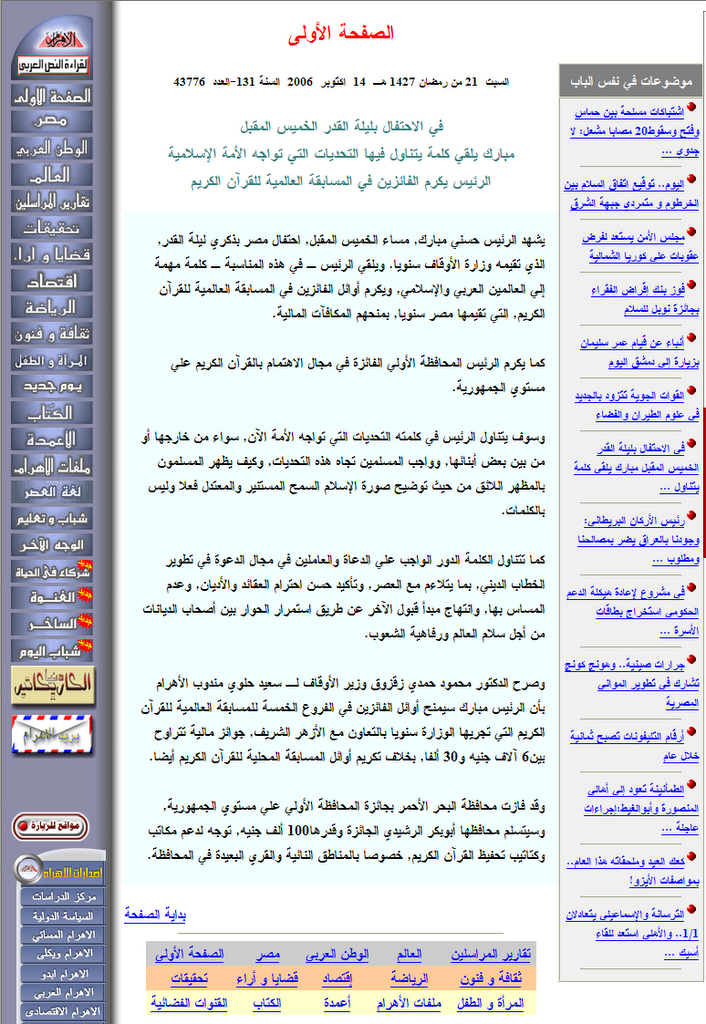
Saturday, October 14, 2006

Egypt: President Mubarak Speaks On Religious Tolerance

Al-Ahram newspaper published an article on 14 October 2006 announcing a scheduled speech by Egypt's President Mr. Hosni Mubarak next week on Thursday. In order to read the full article in Arabic, please click on the image to the right.

The evening celebration is hosted by the Ministry of Religious Endowment, and "the important speech will be addressed to the Arab world and the Islamic world."

The speech will focus on "the challenges currently facing the Egyptian Nation, whether from the outside world or from some of its sons [citizens], the duty of Muslims towards these challenges, and how Muslims should behave in a worthy appearance that displays and clarifies the image of Islam of enlightened forgiveness and uprightness shown in action and not only in words."

"The speech will also deal with the responsibility of those preaching and teaching religion towards behaving in accordance with the modern age, ensuring the benevolent respect of other beliefs and religions, and the avoidance of any interference with these beliefs. Emphasis will be placed on the application of the principle of accepting others through the channels of continuous dialogue between followers of all religions for the purpose of world peace and prosperity of humankind."

Tuesday, September 26, 2006

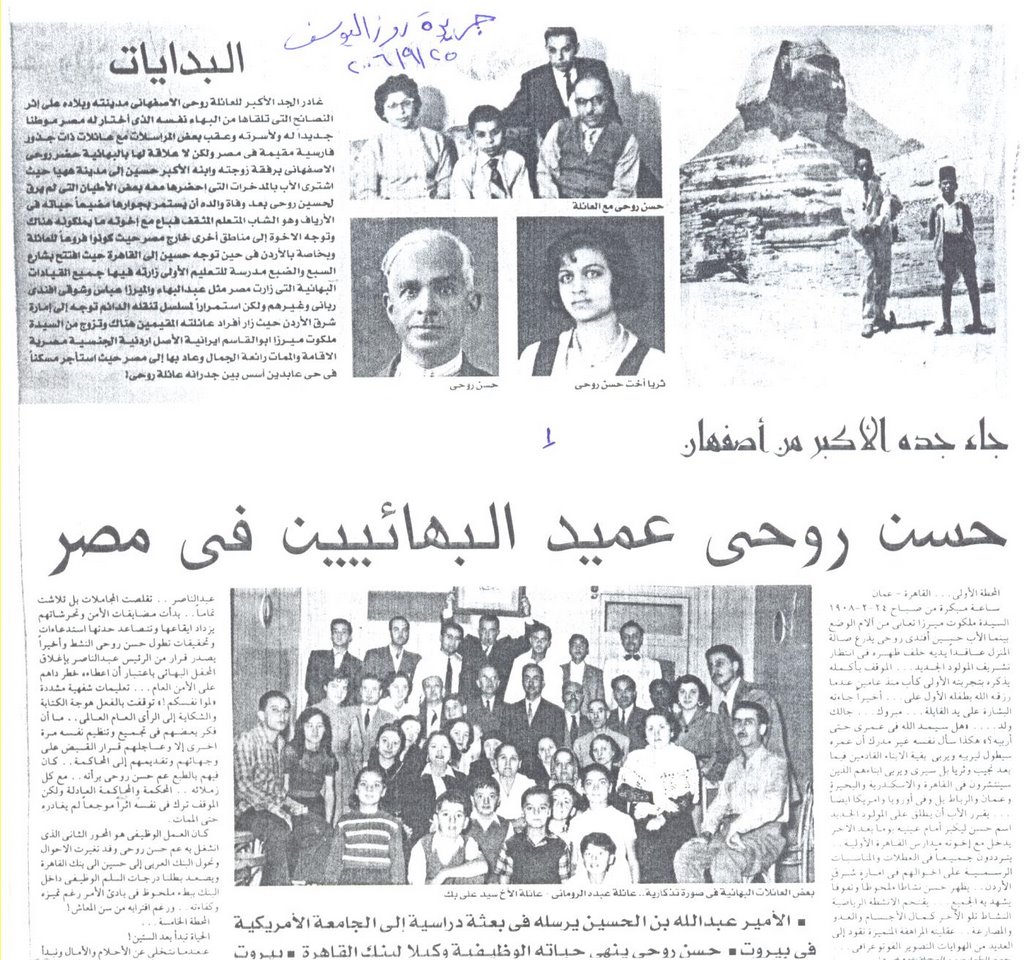
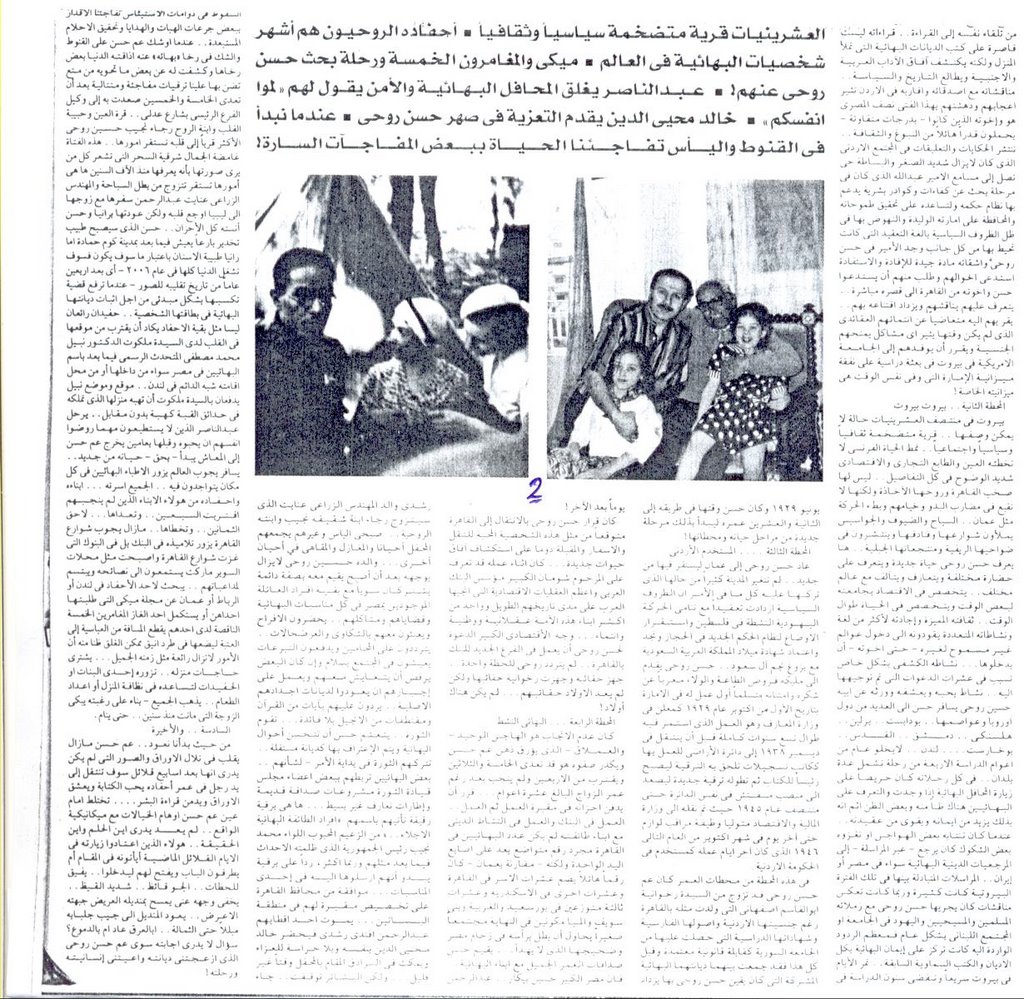
Egypt: Rose El-Yousef Returns With Its Own History

The second article in the promised series on Egyptian Baha'is was published on 25 September 2006 in Rose el-Yousef newspaper. As before, the writer relies heavily on sensationalism and contemptible journalism.

This time he recounts the history of a Baha'i Family which was headed by the late Mr. Hussein Ruhi. It is not clear how the author had obtained his information since he does not use any references to support his story. The only reference he makes regarding this, is a vague description of how he had obtained his information by deceiving Mr. Ruhi's son, who was described by the author as: "an elderly Mr. Hassan Ruhi...who cannot differentiate between dreams and reality...and who did not realize that his documents and photographs would land in the hands of a man the age of his grandchildren who loves writing and adores documents in order to satisfy his readers."

It is truly tragic to witness such journalism that is devoid of ethics and integrity!

The purpose of this post is to expose the writer's intentions and to make these articles available to those who would want to respond to the inaccuracies indicated in the publication. The comment section of this blog is entirely open for such responses and clarifications. In addition to posting comments on this blog, members of the families mentioned in the article might also want to write to the editor of Rose el-Yousef with their thoughts, responses and corrections.

The other article published in Rose el-Yousef on the same day, is a report on a study regarding the Baha'i Faith conducted by Mr. Sameh Sayyid who was commissioned by al-Azhar's Islamic Research Council. The "researcher" admits that the Baha'i International Community had written a letter to al-Azhar with copies to Egypt's President Mubarak and Prime Minister Nazif, offering to collaborate with al-Azhar in this study, but apparently the offer was ignored, and the study was conducted without any input from the Baha'i Institutions nor the input of any reputable scholarly and unbiased agency.

Of course the report exudes falsehood and the usual nonsense and misrepresentations--again nothing new! It also clearly illustrates the very poor scholarship and intellectual dishonesty exhibited by this "learned institution" and its so-called scholars and men of the law. All these accusations have been repeatedly addressed by authoritative as well as scholarly responses as can be seen (in English) HERE and (in Arabic) HERE. Other responses to al-Azhar (in Arabic) can be accessed HERE. Also, a letter which was written to Egypt's Minister of Justice prior to the completion of this "study" can be seen HERE.

This apparent "legal scholar" goes further to propose a solution to the ID Card dilemma with which the Baha'is have been faced. He offers that either the section on religion is left vacant or that it indicates "without religion." His justification is that the Baha'is as well as others who don't belong to the "three recognized religions" in Egypt "could be identified and treated accordingly." Here is another reminder of the grim past when people were selectively identified according to their religion so that they could be persecuted and rounded up whenever the need arises, as described in this previous post.