Friday, September 15, 2006

Egypt: US State Dept. International Religious Freedom Report Just Released

Today, 15 September 2006, the US Department of State released its International Religious Freedom Report for the year 2006. The report opens with description of the current status of the Baha'is of Egypt. The full report on Egypt can be accessed here. Report on Iran can be seen here. For reports on other countries please click here. The Executive Summary can be seen in English here, and in Arabic here.

The following quotes are the first two paragraphs of the report:

"The constitution provides for freedom of belief and the practice of religious rites, although the Government places restrictions on these rights in practice. Islam is the official state religion and Shari'a (Islamic law) is the primary source of legislation; religious practices that conflict with the Government's interpretation of Shari'a are prohibited. Members of non-Muslim religious minorities officially recognized by the Government generally worship without harassment and maintain links with coreligionists in other countries; however, members of religious groups that are not recognized by the Government, particularly the Baha'i Faith, experience personal and collective hardship."

"There was no significant change in the status of respect for religious freedom during the period covered by this report. The Government opposed advances in the respect for religious freedom affecting Baha'is; there continued to be abuses and numerous restrictions, and some improvements. It appealed an April 4 decision by the Administrative Court which supported the right of Baha'i citizens to receive ID cards and birth certificates with religion noted on the documents."

Later on, the report states:

"Tradition and some aspects of the law discriminated against religious minorities, including Christians and particularly Baha'is. The Government also continued to deny civil documents, including identity cards, birth certificates, and marriage licenses, to members of the Baha'i community, which numbered 500 to 2000 persons."

Under "Section I. Religious Demography" it states:

"The country has an area of 370,308 square miles, and its population, as of June 2006, was approximately 73.7 million, of whom almost 90 percent were estimated to be Sunni Muslims. Shi'a Muslims constituted less than 1 percent of the population. Estimates of the percentage of Christians in the population ranged from 8 percent to 15 percent, or between 6 to 11 million, the majority of whom belonged to the Coptic Orthodox Church."

"Other Christian communities included the Armenian Apostolic, Catholic (Armenian, Chaldean, Greek, Melkite, Roman, and Syrian Catholic), Maronite, and Orthodox (Greek and Syrian) churches. An evangelical Protestant church, established in the middle of the nineteenth century, included sixteen Protestant denominations. There also were followers of the Seventh-day Adventist Church, which was granted legal status in the 1960s. There were small numbers of Mormons and members of Jehovah's Witnesses, but the Government does not recognize either group. The non-Muslim, non-Coptic Orthodox communities ranged in size from several thousand to hundreds of thousands. The number of Baha'is was estimated at between 500 and 2 thousand persons. The Jewish community numbered fewer than 200 persons."

Under "Section II. Status of Religious Freedom--Legal/Policy Framework" it states:

"The constitution, under Article 46, provides for freedom of belief and the practice of religious rites; however, the Government places restrictions on these rights in practice. Islam is the official state religion, and Shari'a is the primary source of legislation; religious practices that conflict with the Government's interpretation of Shari'a are prohibited. Members of the non-Muslim religious minorities generally worship without legal harassment and may maintain links with coreligionists in other countries. Members of other religious groups that are not recognized by the Government, particularly the Baha'i Faith, continue to experience personal and collective hardship."

"The Government continued to encourage interfaith dialogue. The religious establishment of Al-Azhar and the Ministry of Awqaf (Religious Endowments and Islamic Affairs) engaged in interfaith discussions, both domestically and abroad. In 2004 the Government announced the formation of the quasi-governmental National Council for Human Rights (NCHR), on which five of the twenty-five appointed members, as well as the president, are Copts. The NCHR is charged with furthering protections, raising awareness, and ensuring the observance of human rights and fundamental freedoms, including religious freedom. It is also charged with monitoring enforcement and application of international agreements. The council gave only superficial attention to the issue of religious freedom in its first annual report. In its second report, released in March, the council called for a solution for official recognition of Baha'is; addressed the problem of Jehovah's Witnesses; and criticized religious textbooks in schools for failing to address human rights topics. The report also recommended that Parliament pass a law that would facilitate the construction of new places of worship for all religious groups. Finally, the report noted that the council had not received any response from the Ministry of Interior or several governorates to its nine inquiries related to numerous complaints of alleged violations of religious freedom that it had received."
Tree of Life (Charles Williams)

Under "Restrictions on Religious Freedom" it states:

"The Government continued to deny civil documents, including ID cards, birth certificates, and marriage licenses, to members of the Baha'i community. The Government appealed an April 4, 2006 decision by the Administrative Court which supported the right of Baha'i citizens to receive ID cards and birth certificates with religion noted on the documents. On June 19, the Administrative Court postponed the appeal hearing to September 16."

"Law 263 of 1960, still in force, bans Baha'i institutions and community activities, and a 1961 presidential decree stripped Baha'is of legal recognition. During the Nasser era, the Government confiscated all Baha'i community properties, including Baha'i centers, libraries, and cemeteries. The Government has asserted that national identity cards require all citizens to be categorized as Muslims, Christians, or Jews. The Ministry of Interior has reportedly, on rare occasions, issued documents that list a citizen's religion as "other" or simply do not include mention of religion. But it is not clear when these conditions apply. Baha'is and other religious groups that are not associated with any of the three "heavenly religions" have been compelled either to misrepresent themselves or go without valid identity documents."

"Those without valid identity cards encounter difficulty registering their children in school, opening bank accounts, and establishing businesses. Baha'is at age sixteen face additional problems under Law 143/1994, which makes it mandatory for all citizens to obtain a new identification card featuring a new national identification number. Police, often on public buses, conduct random inspections of identity papers, and those found without their identity card are regularly detained until the document is provided to the police. Some Baha'is without identity cards frequently stay home to avoid police scrutiny and possible arrest."

"In May 2004 the Government confiscated the identity cards of two Baha'is who were applying for passports. Officials told them that they were acting on instructions from the MOI to confiscate any identity cards belonging to Baha'is."

"In 1997 a human rights activist filed a lawsuit seeking the removal of the religious affiliation category from government identification cards. The plaintiff challenged the constitutionality of a 1994 decree by the MOI governing the issuance of new identification cards. A hearing scheduled for February 25, 2005, never took place. The court informed the attorney for the plaintiff that the case documents had been withdrawn and forwarded to the president of the State's Council, a highly unusual procedure. In December the court dismissed the appeal on a technicality, arguing that the complainant failed to file the appeal within sixty days after the decree had been published in the Government's Official Gazette in 1995."

Under "Abuses of Religious Freedom" it states:

"Al-Azhar's Islamic Research Center issued a legal opinion in December 2003 condemning Baha'is as apostates. In May 2006 the minister of justice requested guidance from the IRC in preparation for the Government's appeal against the landmark April 4 case in support of Baha'i rights. The IRC issued an Islamic legal interpretation stating that the Baha'i Faith was a "heresy." The 2006 interpretation referenced a 1985 opinion that had accused Baha'is of working in support of Zionism and imperialism, and labeled them as "apostates"."

Under "Improvements and Positive Developments in Respect for Religious Freedom" it states:

"In March 2006 the NCHR released its second annual report, in which it recommended a solution for official recognition of Baha'is, addressed the problem of Jehovah's Witnesses in the country, and criticized religious textbooks in schools for failing to address human rights topics. The report also encouraged the Government to pass a law for all religious groups addressing the construction of new places of worship."

Under "Section IV. U.S. Government Policy" it states:

"Religious freedom is an important part of the bilateral dialogue. The right of religious freedom has been raised with senior government officials by all levels of the U.S. government, including by visiting members of congress, the secretary of state, assistant secretary for Near Eastern Affairs, the ambassador, and other Embassy officials. The embassy maintains formal contacts with the Office of Human Rights at the Ministry of Foreign Affairs. The embassy also discusses religious freedom issues regularly in contacts with other government officials, including governors and members of parliament. The ambassador has made public statements supporting interfaith understanding and efforts toward harmony and equality among citizens of all religious groups. Specifically, the embassy has raised its concerns about official discrimination against Baha'is with the Government. The Government insists that religious identification on national identity cards is necessary to determine which laws apply in civil cases."

Tomorrow, 16 September 2006, Egypt's Supreme Administrative Court will convene to decide on the Government's appeal of the lower Administrative Court's ruling which granted the Egyptian Baha'is their right to be recognized on official government documents as Baha'is.

Wednesday, September 13, 2006

Civil Rights Struggles: An Example

This evening in Birmingham, Alabama, an award winning author was honored by a certain organization.

She (the author) was seated in the far left front row, a petite white haired eighty-year-old woman. Her claim to fame was a lone book published in 1960. The book touched on a very sensitive subject in the American South of the time. She was born and had grown up in a little known town in southwest Alabama of 7,000 people, named Monroeville. Her father was an attorney in that town immortalized by the fictional character of Atticus Finch and acted by Gregory Peck in the film "To Kill a Mockingbird".

Her name is Nelle Harper Lee, a recluse still living in Monroeville, Alabama who had never written a book before or after that one. The book, written by a white southern woman, did so much to the civil rights movement in the American south to the extent that 46 years later an organization in Alabama dedicated to equality and racial justice found it essential to honor that woman for what she had contributed to their cause.

Harper Lee never appears in public, never gives interviews or signs books, but she appeared for that special occasion simply because she was able to relate deeply to the organization's contributions to equality and justice. She went to the stage, received her award, and humbly thanked everyone, then sat down.

What is quite significant in this, is the organization that honored her. It is called "The Birmingham Pledge", located in Birmingham, Alabama, and made up of people of different races and backgrounds, and committed to the abolition of prejudice as well as the promotion racial harmony. It had received national attention, and even worldwide recognition for its work. It is noteworthy that this organization came out of the American south, an area that had been plagued with racial injustice and discrimination.

The pledge, which has been signed by over 109,000 people thus far states the following:

  • I believe that every person has worth as an individual.
  • I believe that every person is entitled to dignity and respect, regardless of race or color.
  • I believe that every thought and every act of racial prejudice is harmful; if it is my thought or act, then it is harmful to me as well as to others.
  • Therefore, from this day forward I will strive daily to eliminate racial prejudice from my thoughts and actions.
  • I will discourage racial prejudice by others at every opportunity.
  • I will treat all people with dignity and respect; and I will strive daily to honor this pledge, knowing that the world will be a better place because of my effort.
The learning points from this account are:

1) Out of darkness and out of an area that had been well known for intolerance and racial prejudice emerges the most righteous and vocal promoters of justice and equality.

2) Without the courage of those speaking out for equality, no progress could be accomplished, even though it only began with very few voices who were an alienated minority that spoke against injustice perpetuated by their own race and kin.

3) What happened in Alabama and Mississippi could be also repeated in the rest of the world where injustice is committed every day.

4) When comparing the racial struggle of the American south to that of the civil rights of the Baha'is in Egypt, one can only conclude that history is bound to repeat itself, and that the voices of reason, justice and tolerance will prevail and these brave and suffering souls will be able to acquire equality with every other Egyptian citizen.

The case of the Baha'is will be heard in the Egyptian Supreme Court on 16 September 2006, when the court will decide on the Government's appeal of the lower administrative court's ruling which granted the Baha'is in Egypt the right to obtain their ID Cards and to enter their religion, as required, on all official documents. For more details on this subject from a previous post, please click here.

Monday, September 11, 2006

Egypt Today: More On The Baha'i Faith

The rest of the printed paper version of the publication on the Baha'i Faith which appeared in the September issue of Egypt Today is presented here for the purpose of completeness. As shown in the previous post, the full article is also available online at this link.

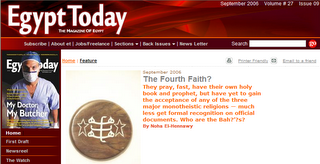
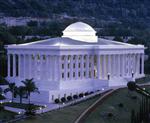
Interestingly, this article was titled "The Fourth Faith" as Egypt currently recognizes three religions only (Islam, Christianity and Judaism). It shows the picture of the Seat of the Universal House of Justice, the governing body and head of this worldwide religion. The House of Justice is an elected body of nine Baha'is. The elections are held every five years at the Baha'i World Centre in Haifa where all Baha'i National Spiritual Assemblies from around the world convene in a prayerful environment to elect the Supreme Body of the Baha'i Faith and without any electioneering or campaigning. The Universal House of Justice is the only infallible Institution in the Baha'i Administration for this age.

The third page shows three different photographs of Abdu'l-Baha, the son of Baha'u'llah who founded the Baha'i Faith. In His Will and Testament, Baha'u'llah appointed him as His successor and the Centre of His Covenant. Abdu'l-Baha served as the head of the Baha'i Faith and was the interpreter of the Baha'i Revelation. Before his passing, in his Will and Testament, he had appointed Shoghi Effendi Rabbani, his grandson as his successor, to serve as the Guardian and Head of the Baha'i Faith, who in turn was also the sole interpreter of the Baha'i Writings. After the passing of Shoghi Effendi in 1957, and after an interim period of six years during which the Faith was headed by the Hands of the Cause of God (an Institution of learned believers who held a high station and were appointed by the Central Figures of the Baha'i Faith), the first Universal House of Justice was elected in 1963.

The Universal House of Justice, the now Head of the Baha'i Faith, is a legislative and administrative body. It can also rule on matters that could arise which were not specifically addressed in the Most Holy Book (al-Kitab al-Aqdas), the Book of Laws revealed by Baha'u'llah.

After the passing of the Guardian of the Baha'i Faith, Shoghi Effendi Rabbani, no person nor an Institution could interpret the revelation of Baha'u'llah--thus protecting the Faith from divisions, personal interpretations or alterations--until the appearance of another manifestation of God after a thousand years or so have elapsed.

The Covenant of the Baha'i Faith, passing on from its founder Baha'u'llah to His appointed successor Abdu'l-Baha, to its Guardian Shoghi Effendi, to its Supreme Body the Universal House of Justice, maintains the absolute unity and integrity of this world embracing Faith which promotes the unity of God, the unity of religions and the unity of mankind, all of which are proclaimed by a Faith that also maintains its own unity as an example for a world struggling with its unity and peace.

Wednesday, September 06, 2006

Egypt Today: Article On The Baha'i Faith

An article titled "The Fourth Faith" was just published in the September issue of Egypt Today magazine. The article is introduced here with a brief audio segment below. To read the full article on the magazine's website, please click here.


this is an audio post - click to play

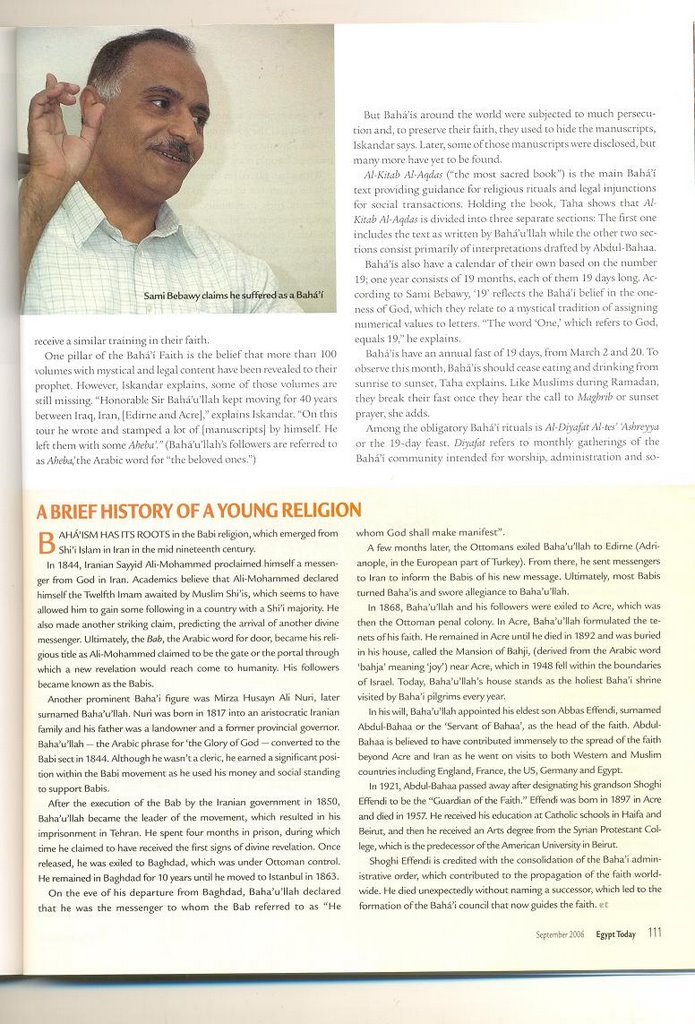
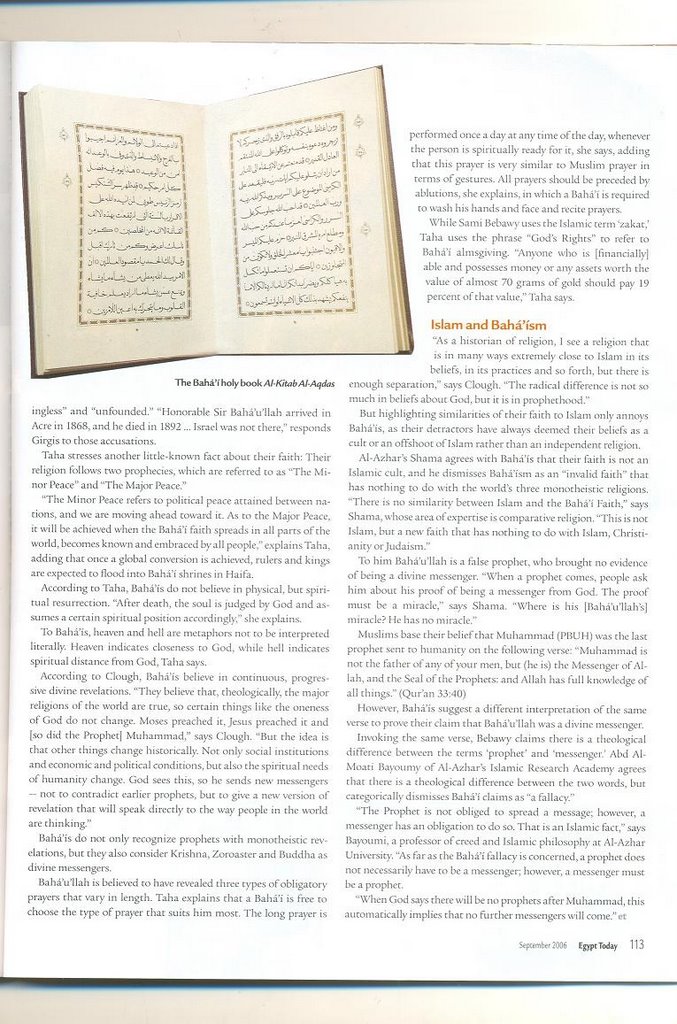
Some pages of the paper publication of the magazine are also included in this post.


The page to the left shows a photograph of Dr. Labib Iskandar Hanna, his wife Remonda and his two sons Ragi and Hadi.

The other page to the right shows a picture of Mr. Sami Bebawy who was interviewed in the article regarding his upbringing as a Baha'i. The story of how his father Nassif became a Baha'i after having been raised as a Coptic Christian was also told at the opening of the article.

The third page to the left shows a Baha'i symbol glorifying God and illustrating the covenant between God, His Messenger and man. It describes the Baha'i beliefs as well as the historical events related to the Baha'i Faith in Egypt since its introduction in that country in the late nineteenth century shortly after the declaration of its Founder Baha'u'llah.


The fourth page to the right shows a picture of an open book: al-Kitab el-Aqdas (Arabic) [the Most Holy Book (English)], which is the book of laws for the Baha'is revealed by Baha'u'llah, the Founder of the Baha'i Faith and the recipient of a vast revelation consisting of more than a hundred volumes of writings and guidance to humanity. For example, the equivalent of the Holy Qur'an in length was revealed in approximately six hours of time. In order to get a glimpse of the enormity of this revelation one can check these sites, in English and in Arabic.

Sunday, September 03, 2006

Egypt: TV Program On Religion & ID Cards (Part-4)

This is the last segment of the TV program on Dream-2 Channel regarding the issue of religious classification on Egypt's ID Cards. In this segment, the broadcaster talks with a caller who presented his case of being unable to obtain an ID Card unless he lies about his religion, which he could not do because it would have been immoral and illegal to make false statements on official documents. Ironically, this is what the government is asking the Baha'is in Egypt to do, i.e. deny their religion and falsify documents in order to be able to obtain ID Cards. Since the Baha'is will not lie, they are left without Identification Documents. One can easily imagine what it means to try to live in Egypt--as a citizen--without an ID Card!


Here is the translated transcript.

Broadcaster: go ahead Ustadh Dhiya' [a caller]....

Ustadh Dhiya': Good Evening!

Broadcaster: Good Evening Sir!

Ustadh Dhiya': I thank you for bringing up a topic such as this on your program. I am a Baha'i. Al-Baha'iyyah initially....

Ustadh Hamdi: his problem...[simultaneous conversation]....

Dr. Mona: sorry what was that?

Ustadh Hamdi: his problem is at your end...[Laughs]....

Ustadh Dhiya': ...the Baha'is never before wanted the section for religion to be removed from the ID [card], which is what I just heard mentioned on the program, that this subject was created for the benefits of the Baha'is. The Baha'is are not at all asking that the section for religion be omitted....

Broadcaster: no, when it was said that this would serve the Baha'is, it was meant that you will no longer have a problem....

Dr. Mona: no, a problem will still exist. It should still be in the database; that is why we can omit it on the card, this plastic card; there is a difference. However, they still should be allowed to put "other" in the database. [unclear simultaneous talking].

Ustadh Dhiya': in the government's computer [database], my religion is classified as "other". However, when I tried to obtain an ID Card, they refused to grant me one, and I was told to write "Muslim". [simultaneous talking]. In this way, I am being forced to either write "Muslim" in order to get the ID Card or not get the ID at all. I--till this day--am 25 years old and do not have a National ID Card. [simultaneous talking]....

Broadcaster: the problem of the Baha'is is a complicated one; I know that. A large part of the problem is that it appeared suddenly on the scene. At least for us in the media, we need to deal with it gradually; it appeared suddenly. And when other problems occur at the same time, like the issue of religion, I believe, that the situation becomes more complicated...Dr. Mona Zulfuqar!

Dr. Mona Zulfuqar: removing the section for religion from the ID card does not affect the religious identity or religious pride. It does not require that the religion be removed from the database. On the contrary, if we want to resolve the problems of all citizens, we should still, once again, allow them to put "other" in the space. This is so [that] the problem gets resolved. This is a proof that the issue is greater than being a mere complaint by the Baha'is or a complaint from other religious minorities. However, we are in dire need for a suggestion [an option] that has a powerful symbolic influence, so this problem can surface [get resolved]--the problem of discrimination on the basis of religion. This idea [discrimination] conflicts with the constitution which contains the text about preserving freedom of thought, freedom of belief and freedom of religious practices. Also, there is a problem with the idea of equal opportunities for all citizens that has a flaw [when] relating to all citizens, but there is also a particular flaw based on religion. This problem deserves attention and deserves that we think about it in terms of initiatives. The initiatives submitted by the National Council for Human Rights for discussion, are not only initiatives about removing the religious classification from the ID card. They also are about thinking within a general framework to support the idea of [equal] citizenship, to support that "religion is God's and the country is for all", to support the idea of justice and equal opportunity and equality before the law as a basis of interaction between the country and all its citizens.

Thursday, August 31, 2006

Tolerance In The Middle East

Qatar leads the way - Editorials/Op-Ed - The Washington Times, America's Newspaper


This editorial was published on 29 August 2006 in The Washington Times regarding Qatar's progressive and tolerant stance in the Middle East, and in particular the government's support of the various religious minorities including the Baha'i community.


Wednesday, August 30, 2006

Egypt: TV Program On Religion & ID Cards (Part-3)

The program that was aired on Dream Channel-2 regarding the matter of religious classification on Egyptian ID Cards continues in today's post. After having shown 15 interviews on the program, the broadcaster begins her discussion with three prominent invited guests after talking with telephone callers.


Here is the translated transcript.

Broadcaster: the last part of this report raises the question, or adds another question, did the idea of removing the religious classification result from the desires of some groups like the Baha’i group, for example, who appeared at the end of the interviews? Are there some religions or belief systems trying to declare their religious identity, but the law and society refuse that? As a result, do we cancel the religious classification altogether due to the pressure or demands of such groups? I believe this a logical question that I will add to the list of questions directed to our distinguished guests.

Firstly, Dr. Mona Zulfuqar, the prominent lawyer and head of the Complaints Committee at the National Council for Human Rights. Welcome Dr. Mona!

From the point of view of perhaps the security dimension or the possible legal dimension, General Farouq Al-Maqrahi, the former Minister of Interior. Welcome Sir!

General Farouq: a very welcome to you....

And finally Ustadh [Professor] Hamdi Abdul-Aziz Head of Research for Sawaseya [Equality] Center for Human Rights; Welcome Sir!

Broadcaster speaking to a caller:

Ustadha Olaa, Welcome!

Ustadha [Professor] ‘Olaa: hello, You are welcome. Firstly I support the removal of that section [religion from ID Cards], because I see this as a very private matter for the human being. However, if they have to keep it, I have one question. I am a Muslim and what I know is that my religion abhors lying. So, how could we as a Muslim nation force Baha’is to lie? We are forcing them into this! They have the right to have a different religion. They can write Baha'i, or they can write anything else, it is their right. However, I see that it would be shameful for us as Muslims to force people to write Muslim or Christian while they are not....

Broadcaster: no, let me please clarify more, Ustadha ‘Ola. Are you in favor of removing the space for religion or should it remain but, everyone writes....

Ustadha ‘Olaa: I am 100% in favor of removing it, but I was saying, in case it stayed….

Broadcaster: yes, yes, yes...I thank you, Ustadha ‘Olaa.

To be continued....

Tuesday, August 29, 2006

Egypt: TV Program On Religion & ID Cards (Part-2)

In today's post, the Dream-2 Channel program continues with interviews of 13 individuals randomly selected on the streets of Cairo, and with 2 members of the Baha'i Faith in Egypt. Again, for those who are not Arabic-speakers, the interviews are transcribed below in English.


Reporter: the space for religious classification on the personal ID Card is the latest story to stimulate debate in the Egyptian society lately. While some describe this [removing the religious classification from the ID] as a step towards secularism, and what was described as [eliminating] discrimination based on religious bases, others see it as an unnecessary step that will serve a religious minority like those adhering to the Baha'iyyah.

[Reporter asking first interviewee] Some people are asking that the section for religion be removed from the personal ID Card. Should it be removed or not?

Interviewee 1: no, it should not to be canceled. Assume someone needs to be known by others as Muslim or Christian. How could he be known if the religious classification is removed?

Interviewee 2: when someone is trying to get married, they have nothing to use other than the ID Card to prove their identity.

Interviewee 3: we are all Egyptians. There is no difference between Muslim and Christian. So, why do we need to write [our religion]? What is the value of doing that?

Interviewee 4: it is not possible at all to cancel it. Sometimes there are three or four Muslim names that match three or four Christian names. How is it possible to cancel it?

Interviewee 5: it [the religious classification] is not needed at all, whether I am today a Muslim or Christian. For example, when I go to a government agency, they don't care whether I am Muslim or Christian.

Interviewee 6: some people are kind of prejudiced--on both sides. When some see Christian on the ID Card, they complicate things for that person. When others see Muslim, they also complicate matters for that person. So, there is no need for this religious classification.

Interviewee 7: it is necessary that a person be known as Christian or Muslim, so he can be treated according to his own religion.

Interviewee 8: I prefer that the ID Card has no religious classification.

Interviewee 9: it is not conceivable to remove the religion from the ID Card.
It is necessary that when someone looks at the ID Card should know what the person's religion is; otherwise, it becomes a loose matter. No one would be able to know if it is this or that religion.

Interviewee 10: we are all one. There is no difference between this religion and that religion. Religions are all of God. If I am an Egyptian, I am truly not in need of anything else other than knowing that I am an Egyptian.

Interviewee 11: remove it? For what reason? It should remain in the ID Card.

Interviewee 12: I see that the section for religion [on ID Cards] in our country is a benefit enjoyed by Christian and Muslims of the same homeland. In my opinion, it won't make a difference if the religion is or is not written in the section for religion on the Card.

Interviewee 13: when I deal with you, I am supposed to know whether you are a Muslim or Christian. This is my right.

Dr. Basma Moussa: I am one of the Baha'is of Egypt. As far as we are concerned we have a big problem, the problem of the National [ID] Number. We at this time cannot obtain ID Cards, birth certificates or death certificates because we are Baha'is. After all, we are Egyptians first before being Muslim, Christian, Jewish or any other.

Dr. Labib Iskandar Hanna: [a Baha'i] we request from the Government not to force us to write-in any other religion. We cannot forge official documents when indicating religion. We can insert a line [dashes], omit religion on ID Cards, or write-in 'other', we have no objections to any of these solutions. Our problem is that we are being forced to choose another religion.

To be continued....

Monday, August 28, 2006

Egypt: TV Program On Religion & ID Cards (Part-1)

This, as well as future three posts, will provide viewing and (almost verbatim) translation of a program that was televised on the Egyptian TV channel Dream-2 on 13 August 2006 regarding the highly publicized, and critical, issue of Religious Classification on Egypt's ID Cards.

The blog's author would like to credit and thank Shahnaz for her hard work in translating the whole program.


The following is the translation of today's section of the program, which could be also viewed at this link.

Broadcaster: A common expression says that, sometimes, a person's humanity or existence is confirmed by papers or that papers are the real proof of his existence on earth.

One of the most important documents we deal with throughout our daily life is the personal ID card or the "National Number", that is if you have been transitioned [already] to the National Number. The main sections on the ID card are: name, birth date, social status, religion, and the nationality which is of course obvious when you are applying for an Egyptian ID.

Suddenly, the religious classification issue became a source of questions:
Should the ID have your religion written on it, such as Muslim, Christian, Buddhist or Sikh, or is this a matter that only concerns you? As a citizen, should anyone be concerned with what religion or what belief system you have or what beliefs you conceal in your heart?

The National Council for Human Rights [NCHR] conducted a workshop, and it was a heated one. There were many strong clashing opinions, because briefly this subject could be taken [or thought of] in two ways: the first way is why only now do they want to change the religion section? Is this issue related to the cancellation of the [religion section on the] ID card? Or is this idea about globalization and putting our nation in a state of distortion where you can't know its roots, future or other features? Is it related to the world-wide attack on Islam, meaning there is a problem [with Islam] so they want to remove the religion section [from ID Cards]?

The other way of thinking or dealing with the religious classification question:
How will citizenship benefit from including the religious section? In other words, you as a citizen--whether Muslim, Christian or Jewish--have the right to education regardless of anything else, the right to medical treatment regardless of anything else, to be provided an opportunity to work regardless of not only religion but any other social considerations.

Therefore, there is a group that supports the idea of [equal] citizenship and says remove the section for religion and another group that supports the idea of an "identity" and is disturbed by the mere thought of canceling the religion section on the ID, e.g. Muslim or Christian.

We went to the streets and randomly asked people about their opinions in regards to canceling the religion section [on ID Cards]. After broadcasting this, we will present the different and convergent ideas [about the issue].

To be continued....

Sunday, August 27, 2006

Egypt: Vicious Mosque Speech Attacking Baha'is

Early June during the Friday prayers sermon in a mosque in the Egyptian village of Damwa (Dakarnas Centre) located in the al-Daqahliyah province of the Delta region, Sheikh Muhammad Hassaan, a member of the fundamentalist Muslim Brotherhood movement, gave a speech (Khutba) viciously attacking the Baha'i Faith. As always in such speeches, it was extremely hateful, inflammatory, and full of flagrant misrepresentations. The speech was preceded with an annoying marketing clip against the Baha'is. The sermon went on for about 55 minutes (audio link below). The Sheikh spoke of the Central Figures and some of the historical events related to the Baha'i Faith, he then manipulated the truth and the well-known facts in order to paint a picture that serves his own purpose and motives. The statements he made were no more than the usual misrepresentations which have been circulating in Egypt for several decades.

These falsehoods have been repeatedly refuted by the Baha'i Institutions, several scholars and publications, one of whom is referred to in this link. Also, this website titled "Islam and the Baha'i Faith" addresses in Arabic all these misrepresentations. Another website specifically addressing all of al-Azhar's statements and accusations could be accessed here.

After inflaming his audience in the mosque, he then declared the Baha'is apostates, and called for their punishment according to his interpretation of Islamic Sahriah. He announced that their punishment must be the death penalty, and went on to justify that penalty in the name of Islam. He then started accusing the Baha'is of conspiring with every single government, agency, movement or religion that he hates, including the Western Civilization, America, Zionism, Communism, Europe, Israel, Masonic Organizations, and even Shi'ite Islam!

The Scream (Edvard Munch)

He called on the Baha'is to repent, become Muslims and follow all the teachings of Islam...God would then forgive them, otherwise they would be considered the same as birds infected with the "Avian Flu" virus and would be subjected to extermination!

He went on to instruct his congregation to only listen to the clergy and Sheikhs, not to science, not to the internet [the Sheikh operates several websites], not to any media source, not to philosophers, not to educational institutions, but to be totally submissive and obedient to their Muslim clergy.

P.S. Obviously, this example does not represent or reflect the opinion of the majority of Muslims, who continue to be appalled by this kind of radical thinking that does not serve the cause or reputation of Islam, a religion which promotes peace and submission to the will of God. The Holy Qur'an states: "la ikrah fel-deen" which means "no compulsion in religion." It also states "you have your religion and I have my religions", meaning that everyone is free to adopt and practice whatever belief system one wants.

Saturday, August 26, 2006

An Egyptian Baha'i: In Search Of Recognition (Cont. 3)

So far in this case, Mustapha had simply requested that he should be given a family allowance and cost of living increase after the birth of his son. Instead he had been declared an apostate, his marriage was considered null and void, and his son was declared illegitimate and also deserved to be killed!

Mustapha married in March 1947, the couple had a son in January 1948, and he filed his lawsuit in January 1950 requesting two family allowance adjustments to his salary on the account of his marriage and the arrival of his son, dating back to March 1947. Meanwhile he continued to work for the Egyptian Railways, being transferred from one train station to another in the Suez Canal region of the country.

He was moved from Ismailia to al-Qassasin, to al-Qantarah, to al-Tal el-Kabir, to al-Firdan, and back to Ismailia. Fortunately all these stations were a short free train ride to his home in Ismailia, allowing him to be as close as possible to his newly-founded family. He would always return home carrying fresh fruits that were locally grown where he was stationed. In season, he would bring large bamboo baskets filled with the delicious ripe mangoes for which the area has been well-known.

Because of his extreme kindness, affability, trustworthiness, competence and dedication to his work, he was loved and trusted by his co-workers and employees despite their awareness of his religious convictions and his ongoing struggle being in a litigation with his governmental employer. The Egyptian Railways has always been a government agency.

He was also able to maintain his balance as a husband and a father. He did not allow his entanglements with his employer or the threats to his own life, and to the continued existence of his family, interfere with his love and devotion to family, friends and Faith. Amazingly he was able to educate his child and insulate him from his worries and the constant uncertainties. In fact, his son had grown unaware of how serious his family's situation had been at a certain point. Only years later did he realize the sacrifices and the courage of his father, who had always remained silent and accepting of his fate and lot in life.

To be continued....

Thursday, August 24, 2006

Iran's Systematic Campaign Against The Baha'is Publicly Exposed

Baha'i World News Service - Text of secret Iran letter ordering "monitoring" of Baha'is made public

In order to read the full article, published on 24 August 2006, please click on the link above. You may also click on the audio link below to listen to a brief introduction to the text of the secret letter from Iranian military headquarters instructing commanders of various state intelligence services, police units, and the Revolutionary Guard to "identify" and "monitor" Baha'is, which has been now obtained and made available to the public.


this is an audio post - click to play

Wednesday, August 23, 2006

Baha'i World News Service Article on ID Cards In Egypt


Baha'i World News Service - Egypt hearing highlights ID card discrimination for Baha'is

In order to read the full article, please click on the link above. You may also click below to listen to a short audio introduction to the article.

this is an audio post - click to play

Monday, August 21, 2006

Egyptian ID Cards & Religious Classification Audio Interviews

In the post dated 17 August 2006, there was a link to Deutsche Welle Radio program and interviews with several individuals regarding Egyptian ID Cards and religious classification. Since radio stations leave such recordings on their websites for a limited period of time, this particular program is no longer available on the web. Fortunately because of the marvelous technology we have at our disposal these days, a recording of the program was possible to upload to this blog. Because of time limitations on audio blog postings, the recording is presented below in two segments. It is followed with a written translation into English.

this is an audio post - click to play


this is an audio post - click to play

It began with a brief history of the Baha'i Faith indicating that there are over Five Million Baha'is worldwide and a few thousands in Egypt. It also described the issue of new ID Cards in Egypt, allowing only three religions (Islam, Christianity and Judaism), and leaving the Baha'is as well as other denominations with no identity unless they falsify documents and lie about their religion in order to be recognized and obtain ID Cards. It then spoke of the recent NCHR workshop on the omission of religion from ID Cards.

First, Dr. Basma Moussa was interviewed. She indicated that the Baha'i Faith is an independent World Religion, that Baha'is have been viciously and falsely accused of all kinds of nonsense, and that they have not been heard in Egypt because of being a minority. She later commented that Baha'is in Egypt will accept any solution other than lying about their true religion. They will accept "other," "empty space," or even "dashes." She said: "we just want to live!"

Second, was Mr. Hafez Abou Seada, member of the NCHR who described the situation of the Baha'is in Egypt, and that the council had received a complaint from the Baha'i International Community, a member of the United Nations non-Governmental Organizations, regarding the inability of Egyptian Baha'is to obtain ID Cards. He said that the Ministry of Interior offered to provide passports to the Baha'is which do not show religious classification. The NCHR's response was that since this could be offered, why then the Government could not do the same with ID Cards, i.e. Cards without religious classification. He then discussed the discriminatory practices against Coptic Christians in Egypt. He also, later in the program, commented on the Coptic-Christian/Islamic conflict in Egypt and that it urgently needs a radical solution.

Third, was Mr. Morkos Aziz who indicated that the excuse for including religion in ID Cards has been that it is needed for matters inheritance, marriage and divorce. He said that all these matters could easily be handled in many other ways than using ID Cards, such identification can be provided by the religious organizations to which people belong.

Fourth, Ms. Monaz al-Faqar [sp?], a representative of the Civil Society Organization suggested two choices to solve this impasse: either omit religious classification from ID Cards, or leave it in and recognize all religions.

The interviewer, then closed by indicating that this Workshop has, at least, provided a forum for dialogue which is leading to further understanding of the rights of citizenship.

Sunday, August 20, 2006

Egypt: Part-2 On Human Rights With Saad Eddin Ibrahim

This is the conclusion of the interview with Dr. Saad Eddin Ibrahim in English. Dr. Ibrahim is a Professor of Political Sociology at the American University in Cairo, and Chairman of the Board of Trustees of Ibn Khaldoun Centre for Development Studies.


Today, the human rights activist and scholar discusses issues of religious freedom and tolerance in the Egyptian society, and his goal to see his children and grandchildren experience the same environment of a free and healthy society he had grown-up with in Egypt of the past.

The interview was conducted by Sally Bishai. (Credit: X Culture Films)

Saturday, August 19, 2006

Egypt: Interview on Human Rights With Saad Eddin Ibrahim

Thanks to Diane's suggestion who made a comment on the August 17 post, this is a video interview in English with Dr. Saad Eddin Ibrahim, Professor of Political Sociology at the American University in Cairo, and Chairman of the Board of Trustees of Ibn Khaldoun Centre for Development Studies.


This is the first part. The second one will be posted soon.

The human rights activist and scholar discusses several aspects relating to personal freedoms in Egypt and civil rights of several minority groups. He also describes the struggle of Egyptian Baha'is and their inability to obtain ID Cards as has been presented in previous posts on this blog.

The interview was conducted by Sally Bishai. (Credit: X Culture Films)

Friday, August 18, 2006

Egyptian Baha'is TV Interview On ID Cards

On 13 August 2006, an interview with two Egyptian Baha'is was broadcast on Dream-2 TV Channel. Interviewed were Dr. Basma Moussa, a Professor of Oral & Maxillofacial Surgery at Cairo University, and Dr. Labib Iskandar Hanna, an Engineering Professor at Cairo University.

The interviews were in Arabic and could be watched by clicking on the center of the image below. If difficulty is encountered in connecting, please click here. (Credit: Dream-2 TV)


The following is an English translation of the interviews:

1) Dr. Basma Moussa said that she is a Baha'i in Egypt and explained that there is a major problem: "we cannot obtain ID Cards, birth certificates or death certificates because we are Baha'is. After all, we are Egyptians first before being Muslim, Christian, Jewish or any other."

2) Dr. Labib Hanna said: "we request from the Government not to force us to write-in any other religion. We cannot forge official documents when indicating religion. We can insert a line [dashes], omit religion on ID Cards, or write-in 'other', we have no objections to any of these solutions. Our problem is that we are being forced to choose another religion."

Thursday, August 17, 2006

Egypt: Audio Interviews Following Workshop On Religion & ID Cards

There were several programs on radio and television in Egypt following the National Council for Human Rights (NCHR) Workshop/Symposium on omitting religion from ID Cards, held on 8 August 2006. This post will provide the reader with a radio program and interviews on Deutsche Welle Radio.

In order to listen to the program (in Arabic) please click here. When you connect to the website, click where it says: "Click to start RealPlayer and play your media." This will start your RealPlayer program, You can then scroll to the seventh minute if you wish to skip the introduction.

For those who are non-Arabic speaking, here is a summary of the program:

It began with a brief history of the Baha'i Faith indicating that there are over Five Million Baha'is worldwide and a few thousands in Egypt. It also described the issue of new ID Cards in Egypt, allowing only three religions (Islam, Christianity and Judaism), and leaving the Baha'is as well as other denominations with no identity unless they falsify documents and lie about their religion in order to be recognized and obtain ID Cards. It then spoke of the recent NCHR workshop on the omission of religion from ID Cards.

First, Dr. Basma Moussa was interviewed. She indicated that the Baha'i Faith is an independent World Religion, that Baha'is have been viciously and falsely accused of all kinds of nonsense, and that they have not been heard in Egypt because of being a minority. She later commented that Baha'is in Egypt will accept any solution other than lying about their true religion. They will accept "other," "empty space," or even "dashes." She said: "we just want to live!"

Second, was Mr. Hafez Abou Seada, member of the NCHR who described the situation of the Baha'is in Egypt, and that the council had received a complaint from the Baha'i International Community, a member of the United Nations non-Governmental Organizations, regarding the inability of Egyptian Baha'is to obtain ID Cards. He said that the Ministry of Interior offered to provide passports to the Baha'is which do not show religious classification. The NCHR's response was that since this could be offered, why then the Government could not do the same with ID Cards, i.e. Cards without religious classification. He then discussed the discriminatory practices against Coptic Christians in Egypt. He also, later in the program, commented on the Coptic-Christian/Islamic conflict in Egypt and that it urgently needs a radical solution.

Third, was Mr. Morkos Aziz who indicated that the excuse for including religion in ID Cards has been that it is needed for matters inheritance, marriage and divorce. He said that all these matters could easily be handled in many other ways than using ID Cards, such identification can be provided by the religious organizations to which people belong.

Fourth, Ms. Monaz al-Faqar [sp?], a representative of the Civil Society Organization suggested two choices to solve this impasse: either omit religious classification from ID Cards, or leave it in and recognize all religions.

The interviewer, then closed by indicating that this Workshop has, at least, provided a forum for dialogue which is leading to further understanding of the rights of citizenship.

Monday, August 14, 2006

Egypt: Interviews Regarding Religion & ID Cards

On Egypt's "Copts United" website one can view four interviews which were conducted with some participants in the symposium/workshop of the National Council for Human Rights (NCHR) on the elimination of religious classification from ID Cards.

The interviews can be viewed at this link. You will need to register (free) in order to download the video recording to 'Windows Media Player', or you can view the videos directly on the website if you find the specific files.

Look for the interviews with Mr. Madouh Nakhla, Mr. Gamal el-Banna, Mr. Hafez Abou Seada and Mr. Ahmad Shabaan.

For those who do not understand Arabic, very sorry.... The interviews are quite long and are beyond the capacity of this blog to translate, but if you have an Arabic-speaking friend, you can view it together so you would be able to share in enjoying its content.

To summarize, all those interviewed had emphatically and unequivocally promoted the acceptance and recognition of all religions in Egypt, including the Baha'is. They also asked for either the elimination of religious classification from ID Cards, or alternatively allowing every Egyptian citizen the freedom to indicate his or her religion on official documents, and without any discrimination or obstruction. They were concerned that Egypt might be the only civilized nation that requires stating religion on ID Cards.

They stressed the right of every citizen to freedom of belief and expression. They stated that religion is a personal and private matter which belongs to each individual and should never be interfered with, and that Islam had clearly instructed its followers to respect others' religious beliefs as had been revealed in the Koran. They stressed that Egypt needs to adapt to the modern world in upholding human rights for all its citizens regardless of their belief or their origin. That it is essential for the society as a whole to be accepting and tolerant in accordance with the respect for human dignity, the constitutional guarantees for all citizens, and the laws of the land.

When asked about the feasibility of applying the NCHR recommendations to solve the serious situation facing Egyptian Baha'is and their inability to obtain ID Cards without having to lie about their true religion, thy indicated that it is the Government's responsibility to do so, just as it did with previous recommendations advanced by Human Rights Organizations. A referendum would not be a possible alternative for enforcing such change in the law because minorities, like Baha'is, would never have a chance to prevail in such an environment.

When listening to these four individuals, one could not but firmly believe that Egypt is full of people that are sincerely committed to freedom for everyone, and it brings to light a silent majority that Egypt should be proud of. Their dedication and devotion to righteousness and equality is exemplary. It is clear that with such progressive and enlightened citizens, much could be gained by the country as a whole. This is the Egypt that had contributed to civilization and progress of the world, and it is obvious that it will resume to do so once it follows the path of tolerance, acceptance and civil liberties.

Friday, August 11, 2006

Egypt's NCHR Symposium On Religion & ID Cards Coverage


TV Coverage of Egypt's National Council for Human Rights (NCHR) symposium on omitting religious classification from ID Cards, held in Cairo on 8 August 2006. (Credit: ALHURRA TV)

If unable to view it above, click here.

The first interview is with Mr. Nabil Abadir, Director-General of the Coptic Christian Social Services Authority. He stated that "religion is a personal and private matter which does not need to be a component of the ID Card system."

The second interview is with Mr. Shehata al-Gharib, Professor of Law at Assyout University. He said that "there are no 'personal status' laws in Egypt that apply to both Muslims and non-Muslims alike. This creates a conflict when applying these laws, and there is a need for laws that would be applicable to everyone."

The third interview is with Dr. Basma Mousa, Professor at the Faculty of Dentistry at Cairo University and representing the Baha'is. She elaborated that "the Baha'is have been in Egypt for over 150 years without problems in relation to Egyptian society until the National ID number was introduced in 2004 allowing only three religions to be registered (Muslim, Christian or Jewish). When Baha'is applied for the number they were told to either change their religion or the government would have nothing to do with them."

Three options were proposed by the symposium:
1) Omit religion from ID Cards.
2) Leave religion on ID Cards with the recognized three religions.

3) Recognize all religions and leave it up to the individual to choose whether or not to enter his or her religion on the ID Card.


For further details please read previous post here.

Wednesday, August 09, 2006

Egypt: NCHR Symposium Supports Civil Rights of Baha'is

The National Council for Human Rights (NCHR) held its symposium yesterday in Cairo on Omitting Religion from ID Cards. Sixty-three agencies, four ministries, and 160 participants were present at the symposium. The ministries included the Ministry of Interior, the Ministry of foreign Affairs, the Ministry of Justice, and the Ministry of Legal Affairs. Also present were representatives of the Egyptian Parliament, all members of the NCHR, and several Baha'is who were officially represented by Dr. Basma Mousa.

While some participants opposed the omission of religious classification from ID Cards many others strongly supported it. Dr. Boutros Boutros-Ghali, NCHR President and former Secretary-General of the United Nations, said that "the three major religions (Islam, Christianity and Judaism) represent less than 50% of world religions, but other religions account for 51% of recognized religions." He also pointed out that "in the upcoming years Egypt will face further conflicts in religious relations, and newer religions will require recognition as they appear, so we should either approve and recognize all religions or eliminate religious classification from ID Cards."

Dr. Mustapha al-Faqi, President of External Affairs Committee of the Egyptian Parliament, indicated that "the elimination of religion from ID Cards is a pressing necessity that conforms to the spirit of the times and the evolution in history."

Dr. Hazem al-Harouni, representative of the Ministry of Interior said that "the Ministry neither supports nor opposes omitting religion from ID Cards since the Ministry is an executive branch of the government charged with executing the law, and that act would require a legislative amendment...."

Others indicated that "religious classification on ID Cards should remain because it deals with matters of marriage, divorce and inheritance. The society however will need to be tolerant, to promote freedoms and knowledge, and the elimination of ignorance and prejudice."

The well-known Egyptian writer Hussein Ahmed Amin elaborated on the injustice faced by the Baha'is and their long and respected history in Egypt.

Dr. Gamal el-Banna, an Islamic thinker and scholar, stated that "the case of religious belief is a personal matter, which has no connection to public order, and that no one should interfere with it. We should be examining the standards of ignorance and prejudice, as well as the publications that darken our lives," pointing out that "omitting religion from ID Cards would neither lead to progress nor regress."


Several Egyptian newspapers reported on the Symposium. These publications included: al-Wafd, al-Masry al-Youm and al-Gomhuria.

A day prior to the symposium the Egyptian Initiative for Personal Rights (EIPR) published an extensive commentary here, and the Arabic Network for Human Rights Information published more coverage here.

Friday, August 04, 2006

Egypt: A Baha'i Denied Inheritance Right

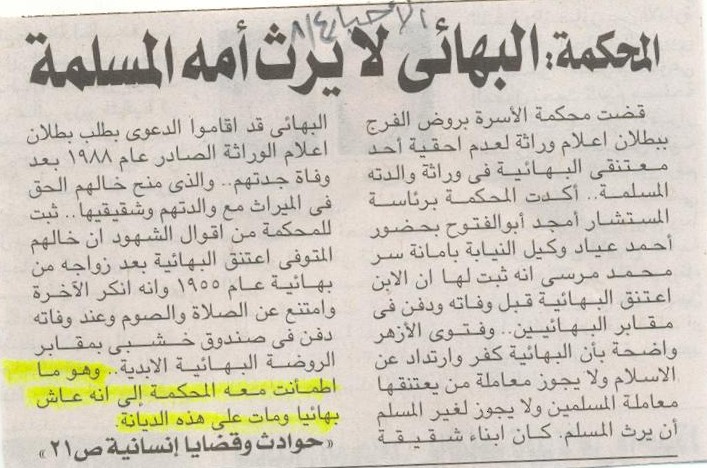
Today, in Egypt's al-Akhbar (The News) official newspaper, an article on its front page announced a Cairo family court's judgement that disallowed a deceased Baha'i man's inheritance of his deceased mother's property.

It stated that "the man had embraced the Baha'i Faith in 1955 after his marriage to a Baha'i woman. He had--along with his sister and brother--acquired inheritance from his mother after her death in 1988." A lawsuit filed recently by his Muslim nephews requested the reversal of his inheritance after he had died, so that his descendents would also be deprived of their inheritance and it would all be transferred to his Muslim nephews instead.

The court, headed by Justice Amgad Abu el-Fotouh and Assisted by Prosecutor Ahmad Ayad, had based its decision to reverse his inheritance on the reasons that "he was buried in a Baha'i cemetery, and that a 'Fatwa' by al-Azhar had already declared the Baha'is as heretics and apostates, allowing their shunning--preventing them from inheriting Muslims."

The court had also accused the deceased man of "not praying or fasting [like Muslims] and that he was buried in a wooden box in a Baha'i cemetery. Therefore the court was content and reassured that he had lived as a Baha'i and died in that religion."

It is clear here that the court, without intending to do so, had acknowledged that the Baha'i Faith is a Religion!

Thursday, August 03, 2006

Egypt: A Revealing Interview With Tantawi

An interview with Shiekh al-Azhar, Dr. Muhammad Sayyid Tantawi, was published in "al-Watany el-Youm" (The Homeland Today) on 1 August 2006 and entitled "I'll not resign, and I'll not shut down [al-Azhar's Islamic] Research Ecclesiastical College." The interviewer Samah el-Morsy asked Dr. Tantawi several penetrating and timely questions.

Here are some of the questions:

Q. What is your comment on the demand to remove the Second Article of the Egyptian Constitution stating: "Islam is the Religion of the State...and the principal source of legislation is Islamic Jurisprudence (Sharia)"?

A. "I see no reason for this request. Because all of the Constitution has been based on Islamic Sharia for a long time now. In particular, the Egyptian Constitution provides equality of rights and responsibilities for all citizens. There is no oppression of non-Muslims that would require the elimination of such Article...."

Q. al-Azhar's Islamic Research Ecclesiastical College called for elimination of Baha'is from Egypt, what is your response?

A. "They did not mean elimination by killing them, but they meant that we should not have any communication or collaboration with them [to shun them]...since they do not belong to one of the three religions...and a Fatwa considered them as heretics...."

It is quite revealing when one compares the answer to the first question with the answer to the second question!