Sunday, August 31, 2008

Egyptian Media Questions the Treatment of Baha'i Children

The question of child education is hitting the headlines again in Egypt. As was previously reported, two young girls from a Baha'i family were finally admitted to a private school in Egypt. Conditions regarding their continued enrollment in school were stipulated however.

Cairo's prominent newspaper, Al- Masry Al-Youm, took keen interest in their case and has been providing extensive coverage of the progress of their drama. The last of which was in yesterday's edition, both in Arabic and English.

The writer of these articles, Salah Eissa, questions the sanity of how these little girls are treated, as has been handled by the Egyptian educational authorities. These girls' only current need is their right to education, just like any other child in Egypt. Their parents resorted to pay for private education simply because there was no way they could have enrolled them in public schools due to their inability to obtain computerized birth certificates as mandated by law.

The entire English translation of this eloquent article is posted below.

Bahaism

By Salah Eissa 30/8/2008

Approximately three weeks ago, I raised the issue of two children, namely 6-year-old Nour and 3-yeard-old Hana. The British School in New Cairo refused to move Nour from the kindergarten to the primary stage and to admit Hana in the kindergarten. The reason was that their documents did not include an electronic birth certificate, but only a paper one.

There is no solution to that problem because their father, Wassim Kamal Eddin, is a Bahai, but his religion is not officially recognized as a religion by the Civil Affairs Administration, which therefore refuse to issue a national ID number for its followers.

No officials offered a solution to Kamal's problem. Yet, they just had to accept a simple solution suggested by Kamal, namely that the two children should be admitted with the paper certificate till a court ruling recently issued by the Administrative Judiciary Court is put into effect.

The ruling says that a dash will be put in the religion space in the certificate for those who embrace a religion other than those recognized in Egypt.

Last week, I received a message from Kamal saying that after the efforts made by the Secretary General of the National Council for Human Rights Mokhles Qotb and the Egyptian initiative for personal rights run by Hossam Bahgat, Education Minister Yosri el-Gamal sent two employees from his office and the head of the Primary Education Directorate in New Cairo to the school.

After negotiations, the school administration decided to enroll Nour again in the school and to admit Hana to the kindergarten, provided that they study one of the two recognized religions. This was accepted by their father. The school stipulated that the father brings the electronic certificates before mid-December.

Although el-Gamal deserves appreciation for his intervention to save those two innocent children's future, the problem is still unsolved, not only because the two children could be dismissed in a few weeks' time, but also because the problem concerns several other Egyptian Bahais. Indeed, administrative bodies insist on not giving them any official documents recognizing their religion.

These organs offer them to write one of the three recognized religions in the religion space in their documents, otherwise they will have no official documents. The bodies had taken official documents away from them that recognized their religion.

The gross error made by governmental organs is that they deal with the issue of Bahaism as a religious issue and adopts their views and take their decisions on the basis of statements and opinions by Al-Azhar Grand Sheikh and the Islamic Research Academy regarding Islam's stance on Bahaism.

As far as the State is concerned, this is a civil and constitutional, rather than religious, affair.

Followers of any religion do not recognize other religions and ideologies; Jews do not recognize Christianity or Islam, and neither do Muslims and Christians with other religions.

The State does not have the right to favor followers of a certain religion at the expense of other religions. This means that it deprives the others of freedom of belief and persecutes them.
A national State basically includes citizens of different colors, races, religions and political ideologies. These citizens agreed on protecting each other's freedom of belief. They are equal in rights and duties.

Their constitution is based on these facts and they elected a government to enforce it. This government does not have the right to impinge on the rights of any individual simply because he or she embraces a different religion.

This is the issue or, so to speak, the farce. When we failed to understand it, we deprived two Egyptian children from the simplest citizenship rights, namely having a birth certificate; and the reason is that they embrace a religion other than the one we follow.

Wednesday, August 27, 2008

Voices of Reason Continue to Emerge in Egypt

An article in Egypt's popular newspaper, Al-Masry Al-Youm, reported in its 15 August 2008 edition on a human rights training course for the youth that was recently held at the famous Library of Alexandria. Of great interest are the words of one of the speakers, Dr. Ali Eddin Hilal, who is a member of the policies committee of Egypt's ruling party. The article, in its original language, is attached here and a full English translation is posted below.

[TRANSLATION FROM ARABIC]

[Translator’s notes appear in square brackets [ ].]

Al-Masry Al-Youm [independent Egyptian daily newspaper], 15 August 2008

[Headline:]

Ali Eddin Hilal demands granting Bahá’ís full rights to practice their religion

By Huda As-Sa’ati, Alexandria

“What’s wrong with the presence of Bahá’ís in Egypt and giving them full rights to practice their religion?”… With these words, Dr. Ali Eddin Hilal, member of the policies committee of the Watani [National] Party [ruling Party in Egypt], began his address, yesterday, to the youth participating in a training course in the area of promoting the culture of human rights, organised by the Association for Building Human Rights and held at the Alexandria Library. He said, “Bahá’ís have been here in the country for the past thirty (30) years and no one paid them any attention.” He then asked, “If the one thousand (1000) Bahá’ís living in Egypt expressed their religion, in a peaceful manner and without proselytising, would this ruffle public serenity? And would this impinge on the strength of Islám?”

Hilal cited the Masonic religions that existed and were practiced in Alexandria and Cairo in the thirties. He maintained that in 1930 Ismail Adham published a book entitled Why I am an Atheist, yet no one demanded its confiscation and the author was not hanged—one of the Azhar sheikhs responded with a book entitled Why I am a Muslim. Hilal pointed out that this environment does not exist nowadays; if this book was published now it would be confiscated immediately. Hilal further asserted that a Christian becoming a Muslim, or vice versa, is not a problem—as the Islamic thinker, Mohamed Selim El-Awwa, has said: “If a Muslim converts to Christianity, to hell with him!” Likewise, building a church in a country which has a Muslim majority, and vice versa, is also not a problem, because the foundation of every society is “citizenship”.

This is yet another example of the many voices of moderation that are abundant in Egypt. It take a great degree of courage, independence and determination, however, for such prominent figures to publicly express these opinions in a charged environment that may not be as accepting of such enlightened views.

Wednesday, August 20, 2008

Baha'is of Egypt: Some Progress & Many Obstacles Remain

Even though there might be some progress regarding the condition of the Baha'is of Egypt, there continues to be challenges, particularly in regards to the education of children and youth.

A blog named Egyptian Baha'i confirmed, through direct personal contact, that the two sisters that were denied admission to preschool and first grade in a Cairo private school have been finally enrolled. The committee charged with the case decided to allow their admission to school using the old paper birth certificates instead of the required computerized ones. As a condition for their enrollment, the parents were requested to assure the committee and the school that they will not refuse that their daughters study religion classes (either Christian or Islamic) because of their Baha'i beliefs. It is a known fact, however, that all Baha'i students in Egypt have always attended these classes for nearly one and a half century. One wonders why, all of a sudden, this issue is being brought up by the Egyptian educational institutions!

There are also unconfirmed reports that a small number of Baha'is in Egypt were issued passports, and that Baha'i in Egypt might soon be able to receive the new ID cards as mandated by the administrative court.

On the other hand, IHT's Daily News Egypt reports that Baha'i students in the secondary and university education levels are confronted with serious obstacles to their educational continuum. The following article clearly illustrates these obstacles:

Religion dilemma follows Bahai university applicants

By Sarah Carr
First Published: August 19, 2008
CAIRO: In violation of a court order, the official university admissions office is denying Bahai applicants the right to leave the religious denomination field blank on applications, giving them the option to list their religion as either Muslim or Christian.

Abdel Hamid Salama, supervisor of the admissions office, refused parents’ requests that a ‘Bahai’ field be included in application documents, local media reported.

Salama reportedly told them to choose either Muslim or Christian and then change this to Bahai upon the student’s enrolment at university.

Adel Farag, whose daughter Latifa is currently applying, told Daily News Egypt that Coordination Office administrative staff listed her religion as Muslim despite the fact that she is Bahai.

“Since Latifa was born we have always been allowed to put a dash in the religious field of her birth certificate and other official documents,” Farag said.

“This changed when she went to sit her secondary school exams and we were told that we had to list her religion as either Muslim or Christian,” he continued.

Egypt recently replaced handwritten personal identification documents printed on paper with computerized ones, but the Ministry of Interior has reportedly been stalling on issuing them for Bahais.

While under the system involving paper documents the religious affiliation field on birth certificates and ID cards could be left blank, a 2006 Supreme Administrative Court decision held that Bahais had to either list themselves as Muslim, Christian or Jew (the only religions recognized in Egypt) or be denied the official documents necessary for them to access state services such as education and healthcare.

The Administrative Court overturned this verdict in January, stating that even though Bahais do not belong to one of the three religions officially recognized by the state, they enjoy the right to refuse to identify themselves as one of these religions. It also said that members of the Bahai faith have the right to access state services.

The Interior Ministry, however, has been slow in implementing the court decision and producing identity cards with a blank religious affiliation field.

Bahai parents attempting to enroll their children in state primary schools have also experienced similar problems.

Adel Ramadan, a lawyer with the Egyptian Initiative for Personal Rights (EIPR) told Daily News Egypt in July that the decision to refuse paper documents was taken in pursuance of the state’s policy of forcing people to issue the new computerized identification papers, but has the effect of discriminating against Bahais who either hold the old identification documents or have not been issued new documents following the Interior Ministry’s failure to implement the Administrative Court’s decision.

Latifa was eventually allowed to sit the secondary school exams without being forced to lie about her religion.

“I petitioned the minister of education and Latifa sat the exams and passed,” Farag told Daily News Egypt.

“However, I have now discovered that they have listed her as Muslim in her Coordination Office papers.

“I have contacted the National Council for Human Rights and the ministries concerned and I am waiting for them to take action.”

Farag says that if the Coordination Office does not change its position he will take legal action.

However, with the academic term scheduled to begin on Sept. 20, this may mean that his daughter will not be able to begin her university studies this year.

These developments show that on the one hand there are those in the Egyptian authority that, in good faith, are trying to solve the crisis facing the Baha'is, while on the other hand there are those that continue to intentionally place barriers in their path. There is obvious need for stability and conformity in granting Egyptian minorities, regardless of their beliefs, their full civil rights.

Friday, August 15, 2008

Another Powerful Video on the Persecution of Baha'is

MidEast Youth and the Muslim Network for Baha'i Rights have just released another powerful video about the distressful escalation of the persecution of Baha'is in Iran and Egypt.


The following is a press release announcing the publication of this video:

Safeguard The Innocent: Video in Defense of the Baha'i Minority

"I will not stand by while my neighbors are denied basic human rights just because they are Baha'is"

MideastYouth.com's Censeo
Productions and BahaiRights.org announce the release of their new video defending the rights of the Baha'i minority.

How many times have you heard people ask, where are the Muslim voices against discrimination and oppression? Here is your chance to write about a group of Middle Eastern youth who have come together in defense of minorities within their communities and to practice dialogue with one another. Their most recent effort is the creation of a video to bring attention to the rights of the Baha'is: a religious minority that has often found itself persecuted in predominantly Muslim countries.

Nowhere is the persecution worse than in Iran and Egypt where they have been denied basic rights and seen their sacred places destroyed and vandalized. In Iran, where the Baha'i Faith first emerged, Baha'i schools are shut down, leaders of the faith are arrested, executed, or harassed, and Baha'is are denied the right to higher education. In Egypt, Baha'is are not given identity papers, thus preventing them from attaining the basic rights of citizenship.

A group of predominantly Muslim youth have banded together to speak out against the discrimination. They formed a website, BahaiRights.org, which catalogues abuses against Baha'is and have now released a video which uses images from the film Persepolis to make a powerful statement against the persecution of the Baha'is. Their first video, called "Egyptian Tourism Ad," which edited a popular TV advertisement into an awareness campaign for the condition of Baha'is in Egypt, has been written about in a prominent Egyptian paper, Al Masry Al Yowm.
"When minorities are not given their rights, how can we ever expect to exercise our own?" says Kawthar Muhaib, a member of the Muslim Network for Baha'i Rights.

Watch the video here:
English: http://www.youtube.com/watch?v=LEI8RxFL7Zs
Farsi: http://tinyurl.com/63kpze

For more information contact:
Esra'a Al Shafei, Director, MideastYouth.com, director@mideastyouth.com
Kawthar Muhaib, Project Coordinator, MideastYouth.com, kaw@mideastyouth.com

More about our efforts to defend the rights of the Baha'i minority:

BBC Persian:
http://tinyurl.com/6q4f3x

Muslim Arab Youth Defend Baha'i Rights:
http://tinyurl.com/6odhqw

MideastYouth.com in the Press:
http://www.mideastyouth.com/press-room/

Thursday, August 14, 2008

More Fraudulent Claims & Threats Against Nobel Peace Prize Winner

An article in the Baha'i World News Service exposes the recent propaganda and "fraudulent claims" in the Iranian news media intended to stir up "irrational fears and prejudices" among the masses towards anyone who attempts to defend the rights of the Baha'is. Furthermore, in today's AsiaNews.it there was a report on additional accusations and threats in the Iranian media directed at Mrs. Ebadi.

The full text of the BWNS article is posted below:

Iranian media attacks on Baha'is and Nobel Prize Winner Shirin Ebadi seek to stir “irrational fears and prejudices”
12 August 2008

NEW YORK — Fraudulent claims in the Iranian news media about seven imprisoned Baha'i leaders and the efforts of Nobel Peace Prize winner Shirin Ebadi and others to defend them represent an effort by the government to prevent Baha'is from having adequate legal representation – and also to stir up “irrational fears and prejudices,” the Baha'i International Community said in a statement today.

“Reports published in government-run news outlets point to an effort on the part of the authorities to use the mass media to spread accusations that the seven prisoners have engaged in subversive activities, and to continue to deprive these Baha’is from any access to legal counsel by maligning Mrs. Shirin Ebadi, the well-known Iranian human rights lawyer and Nobel Peace Prize winner who, together with her colleagues, has stated her readiness to defend the Baha’is,” said the statement.

The statement, posted to the Baha'i International Community’s United Nations Office Web site, responds to allegations that Mrs. Ebadi’s daughter has become a Baha'i, that Baha'is are agents of Zionism, and that when Iranian Baha'is communicate with the Baha'i Faith’s international governing body in Israel, it is somehow a “conspiracy.”

“The Iranian government seizes every means at its disposal to stigmatize the Baha’is and then, within the poisoned atmosphere it has itself created, when it wants to discredit someone, it asserts that the person is a Baha’i,” the statement said. “Mrs. Ebadi is not the first individual upon whom this tactic has been used. As a lawyer, Mrs. Ebadi defends individuals and groups of many different backgrounds; this does not mean that she necessarily espouses their beliefs. What, then, is the state-sanctioned press trying to insinuate when it contends that her daughter is a Baha’i?”

The full statement can be read at:

http://bic.org/statements-and-reports/featured/Iran-Intensifies-Disinfor...

Monday, August 11, 2008

"Mona's Dream" is Becoming Reality

Payvand's Iran News has recently published an extensive article on the progress of the feature film, Mona's Dream.

As to the genesis of the film project, the article states the following:
Canadian musician and composer, Jack Lenz, was asked to collaborate with Mel Gibson a few years ago on the musical score of the movie "The Passion of the Christ". Lenz spent more than a year traveling around the world and researching ancient instruments, cultures and their music to come up with an idea of what kind of music would be historically accurate and appropriate for Mel Gibson's magnum opus. It was widely expected that he would be named as composer for the movie but later on, Mel Gibson and his associates ended up naming John Debney to that role. Nevertheless, Lenz continued to work on the project and ended up contributing to many of the original titles and songs in the movie.

Late last year, Mel Gibson and the other producers of "The Passion of the Christ" met with Jack Lenz in Los Angeles. They wanted to communicate their appreciation for the hard work that he had put into the project and asked Lenz how they could return the favour. Jack Lenz replied that it had always been a lifelong dream of his to make an original motion picture about the martyrdom of Mona, a 17 year old Iranian Baha'i youth.

He then proceeded to tell Mel Gibson and his associates who were there, about Mona's story; how she had been taken away by Iranian authorities and interrogated; how she had been told that she would be, along with nine other women, summarily executed; how she had asked to be hung last so that she would be able to pray for the other women; and how she had met her death with serenity and strength, never wavering in her faith. Lenz also showed them a letter that Mona had written herself ...

According to a recent interview on VOA Persian Service the finished script was finally approved and shooting is supposed to start in Malta by early Fall 2008 and complete post-production is due in March 2009.

Regarding the shooting of this film due to start soon in Malta, The Malta Independent wrote the following:
The true story of Mona Mahmudnizhad, the courageous young Baha’i teacher who was martyred in 1983 along with 10 other Baha’i women in the Iranian city of Shiraz, a particularly resounding echo of the painful reality of human rights violations in today’s Iran, is due to start filming in October/November in Malta.

The film, entitled Mona’s Dream, is a $10 million project that entered pre-production last May with the financial backing of Mel Gibson’s Icon Productions film company.
In order to read the full story regarding this film, please click here.

Thursday, August 07, 2008

Nobel Peace Laureate Will Defend Baha'is of Iran

Shirin Ebadi, the Iranian (Muslim) Nobel peace laureate announced that she will defend the seven detained Baha'i leaders who have just been wrongly accused of "setting up an illegal organization in Iran that took orders from Israel and others to undermine the Islamic system."

In an article published in Agence France Presse (AFP), Ms. Ebadi announced:
"In court I will defend the Bahais. Two colleagues of mine and I have accepted their case, although they were not able to see their families."
In retaliation, harsh accusations were made by Iranian state media against her daughter. The following news release in AFP reports on her plans and and her response to these accusations:

Iran's Ebadi denies state media report on daughter
16 hours ago

TEHRAN (AFP) — Iran's Nobel peace laureate Shirin Ebadi has denied a state media report that her daughter had converted from Islam to the outlawed Bahai faith and suggested it was prompted by her legal defence work.

Ebadi told the reformist Kargozaran newspaper that she believed the allegation against her daughter had to do with her decision to defend seven Bahais arrested on charges of having contact with Iran's arch foe Israel.

"I am proud to say that my family and I are Shiites," she said in the comments published by the paper on Thursday.

"In court I will defend the Bahais. Two colleagues of mine and I have accepted their case, although they were not able to see their families."

On Wednesday, Iran's official IRNA news agency reported that Ebadi's daughter had converted to the Bahai religion nearly a year ago, citing what it called "an informed source."

The allegation is a serious one in Iran. Not only is the Bahai faith outlawed but any conversion away from Islam is regarded as apostasy, an offence punishable by death.

On Saturday, Tehran deputy prosecutor Hassan Hadad announced that seven Bahais had been arrested.

"They had formed a group and were having contacts with Israel and were getting orders from them to act against our interest," he charged.

In May, the European Union expressed "serious concern about the continuing systematic discrimination and harassment of the Iranian Bahais on the grounds of their religion."

The EU presidency said it was "deeply concerned" by reports that ministry of intelligence officers had arrested six members of the Bahai faith and were holding them in jail.

Iran said in January it had sentenced 54 Bahais for anti-regime propaganda, three of them to four years in jail while the rest received suspended one-year terms.

The Bahai faith originally developed in Iran in 1863 but is not recognised by the government. Its followers are regarded as infidels and have suffered persecution both before and since the 1979 Islamic revolution.

Bahais consider Bahaullah, born in 1817, the last prophet sent to Earth by God. He was banished and spent 40 years in exile before dying in the Holy Land in 1892. His tomb lies just outside the Israeli port city of Haifa.

Sunday, August 03, 2008

Baha'i International Community Categorically Rejects Statements By An Iranian Prosecutor

Immediately following a report in today's Iranian Resalat newspaper that "the seven detained Baha'i believers have confessed to setting up an illegal organization in Iran that took orders from Israel and others to undermine the Islamic system," the Baha'i International Community responded:
"we deny in the strongest possible terms the suggestion that Baha'is in Iran have engaged in any subversive activity," said Bani Dugal, principal representative of the Baha'i International Community to the United Nations. "The Baha'i community is not involved in political affairs. Their only 'crime' is the practice of their religion."

"The seriousness of the allegations makes us fear for the lives of these seven individuals," she said.

Click on the Reuters article for the story. The full text of the response of the Baha'i International Community is posted below:

Baha’is reject allegations of subversive activity in Iran
3 August 2008

NEW YORK — The Baha’i International Community categorically rejects statements by an Iranian prosecutor that seven Baha’is detained in Tehran have “confessed” to operating an “illegal” organization with ties to Israel and other countries.

“We deny in the strongest possible terms the suggestion that Baha’is in Iran have engaged in any subversive activity,” said Bani Dugal, principal representative of the Baha’i International Community to the United Nations. “The Baha’i community is not involved in political affairs. Their only ‘crime’ is the practice of their religion.”

“The seriousness of the allegations makes us fear for the lives of these seven individuals,” she said.

She was responding to Iranian newspaper reports of statements by Hasan Haddad, deputy prosecutor general for security at the Islamic Revolutionary Court in Tehran.

Ms. Dugal said that seven Baha’is arrested earlier this year were members of a committee that helped attend to the needs of the 300,000 Baha’is in Iran.

“That is no secret – the government knew perfectly well about the existence of this committee long before its members were arrested, just as the government knows perfectly well that these people are not involved in any underhanded activity,” she said.

Ms. Dugal said the detentions are part of a well-documented, decades-long campaign to stamp out the Baha’i community in Iran, and that the latest accusations follow the same pattern as previous unfounded charges.

“Suggestions of collusion with the state of Israel are categorically false and misleading. The Iranian authorities are playing on the fact that the Baha’i world administrative center is located in northern Israel,” she said.

“The Iranian government completely ignores the well-known historical fact that the Baha’i Faith was centered in Iran until 1853 when the authorities there banished the Baha’i prophet-founder, who was forced into exile and eventually imprisoned in Acre on the Mediterranean coast under the Ottoman Turkish regime. That area happens to be in what is now Israel.”

Ms. Dugal said many Baha’is in Iran – including members of the coordinating committee before their imprisonment – are frequently detained for questioning about their activities. The Baha’is, she said, have nothing to hide and try to answer truthfully whenever they are interrogated.

Saturday, August 02, 2008

Egypt's Islamic Leader Desperately Attempts to Discredit Baha'i Religion

In yesterday's edition of Egypt's, official, Al-Akhbar newspaper, Sheikh Al-Azhar, Muhammad Sayyed El-Tantawi was quoted to repeat his recent assertion that "the recognition of the Baha'i community in Egypt would be regarded as a departure from Islam and the teachings of divine religions...and that no one can be allowed to recognize it as a religion...."

It also referred to a 1986 Fatwa by former Sheikh Al-Azhar, the late Gad El-Haq Ali Gad El-Haq, which claimed that "the Baha'i Faith has no relation to divine religions, but that it is a newly invented religion that appeared in the late 19th century under the protection and blessings of English occupation with the aim of disintegrating Muslim unity and denying Islamic principles...."

Beside the total lack of validity to any of the statements made in this article, it goes further in claiming that the Baha'is do not believe that Muhammad (PBUH) was a messenger of God. In reality, however, the Baha'i religion is the only one, other than Islam itself, known to recognize the divinity of Prophet Muhammad (PBUH) and that He is indeed a messenger of God.

We may never find out what is exactly behind this recent desperate escalation of rhetoric, intended to discredit the Baha'i religion, by top Egyptian Islamic leaders. But in making such false claims and repeating these uncalled-for statements, it appears that His Eminence Sheikh Tantawi was made to stir a process, intended to deceive the masses in believing that the Baha'i Faith is out there to devour Islam--a scheme that has the potential of fomenting, uninformed, Islamic public fury towards the Baha'is.

Conveniently, these statements made no mention of the fact that Egypt's highest ecclesiastical court in Cairo, in the 1920s, was the first to ever recognize the independence of the Baha'i religion. As was previously posted regarding Egypt's role in the emancipation of the Baha'i religion, one can find the court's most emphatic statement that reads: "The Baha'i Faith is a new religion, entirely independent, with beliefs, principles and laws of its own, which differ from, and are utterly in conflict with, the beliefs, principles and laws of Islam. No Baha'i, therefore, can be regarded a Muslim or vice-versa, even as no Buddhist, Brahmin, or Christian can be regarded as Muslim or vice-versa."

This early decision, in Egypt, asserted the independence of the Baha'i Faith in the heart of the Islamic world, and led to its acceptance as an independent religion, and the official recognition of its elected Institutions initially in Egypt, Palestine, Persia, and the United States of America. Currently there are several millions of Baha'is found in at least 218 countries and 116,000 localities worldwide.

Friday, August 01, 2008

US Congress Passes a Bill Condemning the Persecution of Baha'is in Iran

The United States Congress passed this morning, with an overwhelming majority, H. Res. 1008 condemning the State-sponsored persecution of the Baha'is of Iran. The resolution passed with 408 (94%) Ayes, 3 (1%) Nays and 23 (5%) No Vote [did not vote]. The breakdown of the vote can be seen at this site.

The full text of the vote is available in various formats at this site. The resolution was submitted and sponsored by Representative Mark Kirk of Illinois. The bill, after passing the Foreign Affairs Committee, was submitted to the full congress and was cosponsored by 56 Congressional Representatives.

It should be also remembered that the committee of seven Baha'is, who were attending to the minimal needs of the Iranian Baha'i community, remain incarcerated without any charges since March and May 2008. They have no access to legal representation and have not been heard from since the initial one telephone contact with their families. Because their arrest was more recent, they have not been mentioned in this particular bill which was introduced on 28 february 2008, prior to their detention.


For ease of access, the full text of the bill is also posted below:


110th CONGRESS

2d Session

H. RES. 1008

Condemning the persecution of Baha'is in Iran.

IN THE HOUSE OF REPRESENTATIVES

February 28, 2008

Mr. KIRK (for himself, Mr. ANDREWS, Mr. WILSON of South Carolina, Mr. WEXLER, Mr. WOLF, Mr. CANTOR, and Mr. MCNULTY) submitted the following resolution; which was referred to the Committee on Foreign Affairs
______________________________________________________________________

RESOLUTION

Condemning the persecution of Baha'is in Iran.

Whereas in 1982, 1984, 1988, 1990, 1992, 1994, 1996, 2000, and 2006, Congress declared that it deplored the religious persecution by the Government of Iran of the Baha'i community and would hold the Government of Iran responsible for upholding the rights of all Iranian nationals, including members of the Baha'i faith;

Whereas on March 20, 2006, the United Nations Special Rapporteur on freedom of religion or belief, Asma Jahangir, revealed the existence of a confidential letter dated October 29, 2005, from the chairman of the command headquarters of Iran's Armed Forces to the Ministry of Information, the Revolutionary Guard, and the police force, stating the Supreme Leader, Ayatollah Khamenei, instructed the command headquarters to identify members of the Baha'i faith in Iran and monitor their activities;

Whereas the United Nations Special Rapporteur expressed `grave concern and apprehension' about the implications of this letter for the safety of the Baha'i community;

Whereas in May 2006, 54 Baha'is were arrested in Shiraz and held for several days without trial in the largest roundup of Baha'is since the 1980s;

Whereas in August 2006, the Iranian Ministry of the Interior ordered provincial officials to `cautiously and carefully monitor and manage' all Baha'i social activities;

Whereas in 2006, the Central Security Office of Iran's Ministry of Science, Research, and Technology ordered 81 Iranian universities to expel any student discovered to be a Baha'i;

Whereas in November 2006, a letter issued by Payame Noor University stated that it is Iranian policy to prevent Baha'is from enrolling in universities and to expel Baha'i upon discovery;

Whereas in 2007, more than two-thirds of the Baha'is enrolled in universities were expelled upon identification as a Baha'i;

Whereas in February 2007, police in Tehran and surrounding towns entered Baha'i homes and businesses to collect details on family members;

Whereas in April 2007, the Iranian Public Intelligence and Security Force ordered 25 industries to deny business licences to Baha'is;

Whereas in 2006 and 2007, the Iranian Ministry of Information pressured employers to fire Baha'i employees and instructed banks to refuse to provide loans to Baha'i-owned businesses;

Whereas in July 2007, a Baha'i cemetery was destroyed by earthmoving equipment in Yazd, and in September 2007, a Baha'i cemetery was bulldozed outside of Najafabad, erasing the memory of those Iranian citizens;

Whereas in November 2007, the Iranian Ministry of Information in Shiraz detained Baha'is Ms. Raha Sabet, 33; Mr. Sasan Taqva, 32; and Ms. Haleh Roohi, 29, for educating underprivileged children;

Whereas Mr. Taqva reportedly was detained while suffering from an injured leg which required medical attention;

Whereas on January 23, 2008, the State Department released a statement urging the Iranian regime to release all individuals held without due process and a fair trial, including the 3 young Baha'is being held in an Iranian Ministry of Intelligence detention center in Shiraz;

Whereas the Government of Iran is party to the International Covenants on Human Rights; and

Whereas in December 2007, the Iranian Parliament published a draft Islamic penal code, which violates Iran's commitment under the International Covenants on Human Rights by requiring the death penalty for `apostates', a term applied to Baha'is and any convert from Islam: Now, therefore, be it

Resolved, That the House of Representatives--
(1) condemns the Government of Iran for its state-sponsored persecution of Baha'is, calls on the Government of Iran to immediately cease activities aimed at the repression of the Iranian Baha'i community, and continues to hold the Government of Iran responsible for upholding all the rights of its nationals, including members of the Baha'i community;

(2) condemns the Government of Iran's continued imprisonment of individuals without due process and a fair trial;

(3) calls on the Government of Iran to immediately release 3 Baha'is: Ms. Raha Sabet, Mr. Sasan Taqva, and Ms. Haleh Roohi; and

(4) calls on the Government of Iran and the Iranian Parliament to reject a draft Islamic penal code, which violates Iran's commitments under the International Covenants on Human Rights.

Thursday, July 31, 2008

Egyptian Media Interviews US Baha'i External Affairs

In today's edition, Cairo's Al-Masry Al-Youm newspaper published an interview it had recently conducted with representatives of the Office of External Affairs of the National Spiritual Assembly of the Baha'is of the United States.

The article is titled, "American Baha'i leaders demand that [Egypt's] government enforces the 'dashes' verdict for the identity document, and estimate the number of Baha'is in Egypt to be 2,000." The subtitle reads, "Kit Bigelow: the Egyptian Baha'i cannot obtain the ID card without his declaration of becoming a Muslim or a Christian...enforcemnt of the verdict allows him normal life."

The paper reports that it interviewed Ms. Kit Bigelow and Mr. Aaron Emmel at their offices in Washington, DC. The reporter was quite impressed with the design of their offices, being walled with glass as a symbol and a representation of the transparency of that office's work.

The article is quite extensive, objective and accurate as to the facts presented regarding the history, teachings, laws, principles and the administrative structure of the Baha'i religion. It reports that Kit Bigelow stated that the Baha'is of Egypt request nothing more than being granted identity documents, just like any other Egyptian citizen, that would allow them normal livelihood. It also reports that while there are about 160,000 Baha'is in the United States, there are approximately 2,000 Baha'is in Egypt.

The print version of the newpaper shows a photograph of Mr. Aaron Emmel, who is also quoted in the article and is referred to as the person responsible for human rights in the office of external affairs. The online version shows a picture of Ms. Kit Bigelow seated at the conference table, who is referred to as the director of the office of external affairs.

The comment section in the online version is another story! It contains a flood of comments (54 as of the writing of this post), presumably by extremist elements, attacking the Baha'i religion and the newspaper for its objective reporting. Some of these comments have been responded to by others but, in brief, these ferocious attacks betray how deep rooted is the hatred expressed by these extremists. By carefully analyzing these remarks, one cannot come up with any substantial or relevant arguments presented by them, but rather, as has always been the case in the past, blind antagonism without addressing the facts presented in the article. There is abundance of groundless hate messages...just like blowing words in the wind...no intellectual discourse there!

In conducting this interview and publishing this very well-written article, Al-Masry Al-Youm is to be commended on its courageous, objective and intellectually honest show of journalism.

Please see full English translation of the article at Barnabas quotidianus blog and here....

Tuesday, July 29, 2008

The Irony of Denial

Another comic by Mideast Youth clearly illustrates the unfortunate situation facing the children of Baha'is in Egypt in their desperate attempts to enter school. One clear observation was that the Ministry of Education official denying the admission of a child to school wrote her denial on an apparently disposable piece of paper. The irony is that this poorly presented denial requests a computerized birth certificate from the child.

The comic speaks for itself (click on it to enlarge):

Monday, July 28, 2008

Baha'i Homes & Properties Torched in Iran

According to the Baha'i World News Service (BWNS), Baha'i homes in Iran are now being targeted by arsonists. This story, officially released today, reports on several episodes that clearly illustrate a pattern of selectively aiming these serious attacks at Baha'is and on their properties and homes in several locations around the country. This is yet another proof of the systematic activity undertaken by extremist elements in Iran in their attempts to intimidate, isolate, and eradicate the Baha'i population of Iran. Baha'is, accounting for over 300,000 in Iran, are the largest religious minority in that country.

The seven members of the committee in Tehran that sees to the minimum needs of the Baha’i community of Iran are still in prison – six of them since May and one since March – and are among at least 22 Baha’is being detained in Iran solely for their religious belief.

No formal charges have been filed against the seven, and none of them have been allowed contact with an attorney. Since their initial one telephone call shortly after their detention, they have been held incommunicado. No word on their current condition has been received since the initial contact.

The following incidents were reported today on the BWNS website:
Arsonists in Iran target Baha’i homes, vehicles
28 July 2008

NEW YORK — Acts of arson targeting homes and vehicles are the latest violent tactics directed against the Baha’is of Iran.

“In the early hours of the morning of 18 July, the house of the Shaaker family in Kerman went up in flames, only weeks after their car had been torched and in the wake of a series of threatening phone calls,” said Bani Dugal, principal representative of the Baha’i International Community to the United Nations.

“As would be expected in the light of the mistreatment Baha’is in Iran are routinely receiving, the officials who investigated the fire either ignored or dismissed obvious signs of suspicious activity, including a muffled explosion, simply saying that it was the result of an electrical problem,” she said.

At least a dozen cases of arson that target Baha’is have been reported in Iran in the last 15 months, Ms. Dugal said. She gave the following examples:

-- On 15 July at 1:15 a.m., Molotov cocktails were thrown into the front courtyard of the home of Khusraw Dehghani and his wife, Dr. Huma Agahi, in Vilashahr, only months after anonymous threats directly related to her being a Baha’i forced Dr. Agahi to close her clinic in nearby Najafabad where she had practiced medicine for 28 years.

-- On 25 July, the car of a prominent Baha’i in Rafsanjan, in Kerman province, was torched and destroyed by arsonists on motorbikes. Soheil Naeimi, the owner of the car, and 10 other Baha’i families in the town had received threatening letters from a group calling itself the Anti-Baha’ism Movement of the Youth of Rafsanjan that, among other things, threatened jihad (holy war) against the Baha’is.

-- On 10 June, an outbuilding on the property of the Mr. and Mrs. Mousavi, elderly Baha’is living in the village of Tangriz in Fars province, was destroyed by fire when it was doused with gasoline. The Mousavis, along with their two sons who were sleeping close to the building, narrowly escaped injury when the gasoline tank used to start the fire exploded. The Mousavis believe that the perpetrator thought they were all sleeping in the hut when he set the fire. Mr. Mousavi issued a formal complaint against the person they suspected, but the legal office has declined to pursue the case because the suspect swore on the Qur’an that he was not guilty. Out of respect for the Qur’an, the Mousavis have dropped the charges.

-- On 4 April, the home of a Baha’i was set on fire in Babolsar, in the north of Iran.

-- In February in Shiraz, a 53-year-old businessman was attacked on the street, chained to a tree, doused with gasoline, and assaulted by unknown persons who then attempted to throw lighted matches at him.

-- Also in Shiraz in February, several arson attempts were made against vehicles and a home belonging to Baha’is.

-- On 1 May 2007, arson destroyed the home of ‘Abdu’l-Baqi Rouhani in the village of Ivil, in Mazandaran.

-- In Karaj, the burial section of a Baha’i cemetery was set on fire.

“These latest attacks follow the authorities’ attempts to deprive the Iranian Baha’i community of its leadership,” Ms. Dugal said, referring to the arrests in March and May this year of the seven members of Iran’s national Baha’i coordinating group, all of whom are still locked up in Evin Prison in Tehran without any charges and without access to an attorney or to their families.

“As Baha’is worldwide watch with alarm this escalation in violence,” she added, “their fears that a sinister plan of persecution is unfolding become increasingly confirmed. Their only hope is that enough voices of protests are raised around the world to compel the government in Iran to put an end to this violence.”

Thursday, July 24, 2008

Egypt's Ministry of Education is Put to Test

The recent statement of Egypt's Ministry of Education regarding the admission of Baha'i children to schools was put to test. An Arabic language blog named "Egyptian Baha'i" wrote about this recent development and expressed the rising degree of frustration caused by the inability of Baha'i parents to enroll their children in schools in Egypt.

As was posted recently here, the Ministry of Education had clearly expressed its position regarding this matter, that is, admission to schools will be based on citizenship alone, and that there will be no discrimination in the admission process based on religion. The Ministry went further by stating that it will accept children of Baha'is with (--) "dashes" in their documents.

The parents at the center of this controversy were unable to register their daughters to begin their formal education in a private elementary school because of their religious affiliation and the consequent administrative hurdles. They were referred to the Ministry of Education for an appeal. The Ministry, which had just publicized its position against discrimination, responded today with rejection of admission to the child. The reason given is that the child in question does not hold the newly issued computerized birth certificate, but rather presented them with the old "paper" birth certificate. None of the Baha'is were able to obtain the new computerized certificates (or ID cards) as had been mandated in the 29 January 2008 court verdict that allowed them to insert (--) dashes instead of their religious identification.

The handwritten response of the Ministry to the parent (in Arabic) is attached with this post. Its translation reads:
Governorate of Cairo
New Cairo Education Administration

Elementary Education


In response to the request presented by the [student's] guardian, Wassim Kamal El-Deen Nosseir regarding the admission of his daughter, Hana Wassim, using a paper birth certificate. The paper birth certificate cannot be accepted and will not be used for that purpose. A computer birth certificate must be presented instead. The signature of the Director-General is taken [as a confirmation] to reject the student's paper birth certificate.

[signed:]
Mona Abd El-Aziz Abd El-Hafez
Director of Elementary Education
24/7/2008
[official stamp]

Based on this new development, the Ministry of Education has already abandoned its declaration of not discriminating based on religion. The Ministry has clearly stated that the only condition is "Egyptian citizenship." It did not make any mention of what kind of proof of identity is required, i.e. paper, computerized or any other form. The parents of this child submitted a proof of citizenship: an Egyptian birth certificate. Now the Ministry returns with rejection of this proof and requires that the certificate must be computerized. The Ministry knows very well that none of the Baha'is were able to obtain any of the newly-issued computerized documents, even though the court had ordered the Ministry of Interior to issue them such documents. The Ministry of Interior did not appeal the court's verdict, but has been slow to implement the ruling. Actually, so far, it did not issue any documents to any of the Baha'is of Egypt (including the individual litigants).

This current crisis requires immediate attention by Egypt's senior leadership. Depriving helpless children of their right to education can be seen as, yet another, serious violation of standard international human rights. This matter is now in the public eye...the facts are clear, and it cannot be ignored. There is no other choice but to issue the Baha'is of Egypt their identity documents. In the interim, the schools and other agencies must accept whatever documents these citizens currently hold.

Monday, July 21, 2008

Egypt's Sheikh Tantawi in a Balancing Act

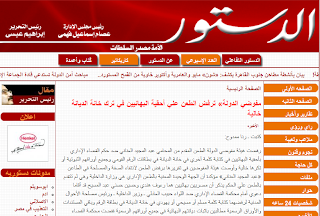
Many were too quick to be critical of Sheikh Muhammad Sayed Tantawi, the head of Al-Azhar, Islam's supreme institution in Cairo. The reason for this was his recent warning to university students participating in a leadership preparation institute, and published in Cairo's daily Al-Dostoor newspaper today, in which he declared that the Baha'is of Egypt should never be allowed to state their religion in official documents since that act would automatically imply the recognition of the Baha'i religion in Egypt.

What led this recent declaration of his to trigger so much controversy was the fact that, approximately two years earlier, he had pronounced the exact opposite by stating that there was no harm at all in allowing the Baha'is to have their religion indicated correctly in official documents.

The fact that he changed his mind does not disturb me whatsoever. This act in itself shows that the man can indeed change his mind, which is, in my opinion, a commendable and positive trait rather than a sign of indecision or weakness. The worst scenario is when a person in that important capacity would adhere--tenaciously--to only one stance and remain completely inflexible, a position that has the potential of leading to disastrous consequences as history had repeatedly taught us. In reality, he had also shown that he was able to change his mind about religious minorities in Egypt, a third time, when he promoted "acceptance and dialogue" as was reported in this previous post.

What is revealing, however, in this recent pronouncement of Sheikh Tantawi, was not the fact that he changed his mind, but rather that in this same discourse with the students, he stated that men of religion should never get entangled in politics, and that, just the same, politicians should never get involved in religious decisions.

Considering his thoughtful opinion on religion and politics, and if we go beyond what he just did--that is in changing his mind on Baha'i rights--and try to understand why he did so, doesn't it become very clear that the reason behind changing his mind could have been a political one? This would be indeed something to ponder!

Thursday, July 17, 2008

Egypt's Ministry of Education Will Not Refuse Admission of Baha'i Students

According to an article published in Cairo's Rose Al-Youssef newspaper published two weeks ago (4th of July), "Egypt's Ministry of Education affirmed that acceptance of students into Egyptian schools will not be conditioned on their religion, but the only necessary condition that will be adhered to is citizenship." [emphasis added]

The article which was titled, "[Ministry of] Education: Section of Religion [on IDs & birth certificates] is Not a Barrier to Admission of Students to Schools," referred to an announcement that was made by Dr. Redha Abu-Sareyh, first deputy to the Minister of Education. The article states that the Deputy Minister pointed to the fact that "Egyptian schools cannot refuse the admission of any student based on his religion, but the only condition is Egyptian citizenship."

The article continues by stating the following:
He [Dr. Redha Abu-Sareyh] clarified that Egyptian schools during the current year has accepted "Baha'i" students, or those with the symbol (--) instead of the word Christian or Muslim, remarking that this crisis began when the parent of a student requested that the school issues him an official certification that he is a Baha'i, which cannot be issued by the school because it is outside the scope of its responsibility.

He also said that if the students need an official certification confirming that they are Baha'is, it is their responsibility to resort to the Ministry of Interior because it has the specific authority [to do so]....

Based on this announcement, the official position of Egypt's Ministry of Education, concerning the admission of Baha'i students to schools, is very clear. They cannot be denied admission based on their religion.

This development must be seen as a very important step towards the normalization of the status of the Baha'is of Egypt. The Ministry of Education deserves respectful recognition for its firm stance on this critical issue.

Tuesday, July 15, 2008

An Egyptian Poem of Praise

Before embarking on a new post that will bring very interesting news about the case of the Baha'is of Egypt, it is probably timely to take a little break and listen to some good authentic Egyptian music.

Those who know Egypt well, must also know its legendary singer who is beloved by millions, not only in Egypt, but throughout the Arabic-speaking world.

The late Umm Kulthum has been keeping the Middle East, for many years, mesmerized by her beautiful and powerful voice, her artistic talent, her majesty and her soul-stirring songs.

The US-based National Public Radio (NPR) has recently produced an extensive report on this once-in-a-lifetime talent, calling her "the Voice of Egypt." To read this report and/or listen to it, you may click here.... It also includes short video and audio clips from some of her concerts as well as from a documentary film, narrated by Omar Sherif, about her life.

In 1996, a Harvard scholar wrote a manuscript titled "Listening to Umm Kulthum" which gives western listeners a glimpse of the life, talent and accomplishments this unique and phenomenal persona.

As an example, the song below is, in my opinion, her best. One can’t forget though that she did have many “bests,” but this one is very special.

This song, Nahj Al-Burda is derived from a poem by AL-BUSIRI (13th century Alexandria). In 1948, Umm Kulthum sang this 20th century version of the poem. The rhythm and style of the song are derived from the Sufi tradition in the manner of “Burda.” The modern poem was introduced by Ahmed Shawqi, the prominent Egyptian poet. The poem is a tribute to Prophet Muhammad (PBUH).

Please click on the player below in order to listen to the whole song.


Powered by Podbean.com


Salu Qalbi is another Qasidah (poem) by Ahmed Shawqi and music composition by Riyadh El-Sunbati. It was first released in 1946 along with few other masterpieces of the period. Click on the player below to listen:


Powered by Podbean.com

Thursday, July 10, 2008

Baha'is of Egypt Submerge into More Confusion

As time passes, the Baha'is of Egypt continue to find that they are in a state utter confusion. The recent (29 January) court decision has clearly supported their rights in becoming recognized for the purpose of obtaining their civil status documents.

According to the court's decision, which was recently supported by the State's Commissioner Council, they were granted the right to obtain identity documents and birth certificates. The ruling fell short of allowing them to enter their true religious identity on these documents, but instead it allowed them to leave it blank or enter [--] dashes. Even with this, not quite favorable compromise, the Baha'is have been content with such middle of the road solution to their dilemma.

To this day, not a single one of them has been able to obtain any documents. Even worse, more recently, their children have been denied admission to elementary schools. Their older children are now being subjected to further obstacles in their attempts to register for the final secondary education examinations required for entry into the university education system.

As recommended in yesterday's accompanying article--written in Al-Ahaly newspaper by Amina Al-Naqash, who explained the struggle of the Baha'is very clearly and objectively--the Baha'is cannot even obtain Egyptian passports (that do not identify the person's religion) because they have no ID cards, a requirement for processing passport applications.

In the meantime--as the status of the Baha'is of Egypt is approaching a crisis level because of their inability to obtain their basic citizenship rights--to make matters worse, the Ministry of Religious Endowment, headed by Mr. Zaqzouq, has just instructed all mosques in Egypt to launch an attack on the Baha'is. The second, attached, Rose Al-Youssef newspaper article, published today, proudly announces this fresh piece of news.

In brief, the article states that the Ministry has distributed to all Mosque leaders (Imams) a book called "Baha'iy'ah and the position of Islam," aimed at telling people to watch-out for those Baha'is who are out to get them and destroy Islam in the process.

The book, and the article, repeat the usual falsehood that has been propagated in Egypt (and Iran) about the Baha'is, that is: the usual unfounded propaganda about connections to Zionism, etc.... It accuses the Baha'is of being apostates, and explains how Sheikh Al-Azhar in 1947 had classified them as such, and had declared their marriages to be null and void. It even incites Egyptians "to warn their youth about the dangers of 'Baha'iy'ah' so that they don't fall for its entrapment."

Fascinating indeed.... One doubts, however, that Egyptians can be that gullible! On the other hand, if the audience at these sermons of Friday mosque gatherings is not well informed to begin with, or if they were easily influenced by this persuasive and superfluous talk because of their lack of education, this can easily lead to a state of public unrest and can disrupt "Public Order."

Why would the Ministry of Religious Endowment begin this hateful campaign at this juncture, exactly to coincide with the Ministry of Interior's--and the court's--attempts to find a just solution to the status of the Baha'is of Egypt? This is indeed very disturbing, and to put it mildly, irresponsible.

Sunday, July 06, 2008

Baha'i Children in Egypt & Iran: A Comic That Depicts Their Dilemma

In an attempt to make a point, the Muslim Network for Baha'i Rights has been at it again. This time by producing yet another penetrating and thought provoking comic (click on the comic to enlarge).

In their post, published today, the authors state:
Baha’is in Egypt and Iran are being denied their right to education. Why? Simply because of their faith. On the Muslim Network for Baha’i Rights, we have written about the discrimination that Egyptian Baha’is have been receiving, which right now is comparable to what Iran has been putting its Baha’i students through for decades.

Inspired by these human rights abuses we have created a comic to raise awareness on the absurdity of this crisis. Why do I call it a crisis? Because this is intellectual abuse. Baha’i youth are being victims of intellectual starvation, they are unable to acquire an education which is their given right as citizens. They are being isolated and humiliated on a daily basis. These governments, instead of protecting them, are denying them the chance to learn, which means that they are robbing them of their dreams, of having a career, a future, a life.

Don’t all children deserve an education no matter who they are? The Egyptian and Iranian authorities have no right to treat the Baha’is so differently.

This comic should make you laugh first. And then it should make you think. It’s available in four languages so far: Arabic, Farsi, French, Portuguese and English.

This comic also points to the innocence of children. Recent experience shows that classmates of persecuted children in Iran and Egypt are beginning to take notice and resent the the way their friends are being treated. At times, even siding with their cause. It also shows the obvious: that children look at life through different lenses than adults--their priorities are not always the same!

Wednesday, July 02, 2008

Egypt: Children of Baha'is Are Denied Admission to Schools

As a follow up to the recent news concerning the Baha'is of Egypt, discussed in the last post on this blog, the Egyptian media is currently engaged in bringing this critical matter to the attention of the public and the Egyptian authorities. International Herald Tribune's Daily News Egypt has published yesterday an article regarding this most recent crisis affecting the Baha'i childern in Egypt. They are being denied admission to schools because of their religious affiliation.

The article, which is quite self explanatory is reprinted below. It is followed, near the end of the post, by a brief commentary:

SCHOOLS REJECT ENROLLMENT PAPERS OF BAHAI CHILDREN

By Sarah Carr
First Published: July 1, 2008

CAIRO: Local schools are denying Bahais the right to enroll their children, five months after an Egyptian court recognized the right of members of the minority religion to leave the religious affiliation field on birth certificates and ID cards blank.

Adel Ramadan, a lawyer with the Egyptian Initiative for Personal Rights (EIPR) — which brought the case that was ruled on in January — says that schools are refusing to accept personal identity documents printed on paper.

Egypt recently replaced handwritten personal identity documents printed on paper with computerized ones, but the Ministry of Interior has reportedly been stalling on issuing them for Bahais.

While under the system involving paper documents the religious affiliation field on birth certificates and ID cards could be left blank, a 2006 Supreme Administrative Court decision held that Bahais had to either list themselves as Muslim, Christian or Jew (the only religions recognized in Egypt) or be denied the official documents necessary for them to access state services such as education and healthcare.

The effect of the policy was to force Bahais to commit fraud by falsely listing a religious denomination in order to obtain the documents necessary for them to open bank accounts, apply for jobs and enroll in school.

The Administrative Court, which overturned this verdict in January, stated that even though Bahais do not belong to one of the three religions officially recognized by the state, they enjoy the right to refuse to identify themselves as one of these religions. It also said that members of the Bahai faith have the right to access state services.

The Interior Ministry, however, has been slow in implementing the court decision and producing identity cards with a blank religious affiliation field.

EIPR director Hossam Bahgat told Daily News Egypt in April that the Interior Ministry had asked for more time in order to prepare for the implementation of the decision.

According to a report published in Arabic-language daily Al-Masry Al-Youm, school officials claim that they cannot accept identity papers in which the religious affiliation field is left blank.

Ramadan says that the decision was taken in pursuance of the state’s policy of forcing people to issue the new computerized identity papers, but has the effect of discriminating against Bahais who either hold the old paper identity documents or have not been issued new documents following the Interior Ministry’s failure to implement the Administrative Court’s decision.

“In pursuing this policy the Education Ministry is in breach of the constitution,” Ramadan told Daily News Egypt.

“The ministry is obliged to accept what are valid, official documents produced by the Interior Ministry.

“The Interior Ministry itself must implement the Administrative Court ruling and issue identity papers with a blank religious affiliation field,” he continued.

This sad development must be seen by all Egyptians as a disgrace. Identity cards or not, these children belong in the schools, not the streets. How can a civil society tolerate such atrocities directed at innocent children? Unfortunately this is the exact same strategy that has been pursued in Iran against its children. Is this what Egypt--a nation endowed with so much great heritage--wants to be remembered for? One would certainly doubt that!

Tuesday, July 01, 2008

Baha'is of Egypt Continue Their "Roller Coaster Ride"

The state of uncertainty and confusion continues for the Baha'is of Egypt, just like a "roller coaster ride," when on a given day they might become elated at the news of progress and vindication, and on another they are brought down very rapidly by set-backs and regress.

A case in point is this most recent important piece of news that was announced yesterday in Cairo's Al-Dostoor newspaper (attached), which affirmed that Egypt's Judicial State Council has just upheld the 29 January 2008 court verdict, permitting the Baha'is to obtain identification documents with dashes "--" inserted in the religion section of these documents. The 29 January verdict was previously challenged by an Islamist lawyer who, in an attempt to stall the ruling on procedural excuses, attacked the judge and questioned his competence. This stalling tactic was discussed before in this post.

In addition to that, the 29 January ruling had also faced another legal challenge by another lawyer. This second challenge was indeed an appeal of the ruling itself, intended to penetrate its core and reverse it altogether. This appeal was filed shortly after the 29 January verdict by another Islamist lawyer, named Abd El-Mageed El-Aanany. As a result of that appeal, the case was referred to the judicial State Council, which is a panel of judges at the highest level of the State, charged with acting on such judicial matters and appeals.

This council rejected the appeal by El-Aanany and upheld the administrative court's ruling to allow the Baha'is obtain identification documents. In its decision, the Council affirmed that the only authority that has interest in this case is the Ministry of Interior, not this lawyer or any others for that matter.

Since the defendants in these cases, i.e. the Ministry of Interior, its Minister, General Habib El-Adly, as well as the head of the civil [personal] affairs authority had not appealed the verdict during the alloted time period, that in itself led to the enforcement of the verdict. Thus the independent appeal by this lawyer was rejected by the State Council.

This is a very significant ruling that affirms that the administrative court verdict must stand and cannot be challenged, implying that the Baha'is of Egypt can now obtain ID cards and birth certificates as ruled by the court.

On the other hand, a day after this announcement, another newspaper, Al-Masry Al-Youm (attached) published an article that reported on cases when Baha'i students were refused admission to schools simply because of their religion.

When the parents of these students went to the schools to enroll their children, they were told by the schools' administrators that they were instructed to accept students only if their religion was stated as "Muslim" or "Christian," and that they will not accept any students with dashes "--" entered in the religion section of their birth certificates.

When the parents went to the Ministry of Education to complain, they were given the usual "run around" by placing the blame on other agencies, such as the Ministry of Interior. Of interest, one of these schools is a French private school and the other is a British private school--both report directly to the Egyptian Ministry of Education.

According to these new developments, it is clear that the "right hand does not know what the left hand is doing." These developments betray a state of chaos, with some individuals, who think that they are in "authority," are making their own arbitrary decisions without evidence of any sort of accountability. Those responsible for the citizens of Egypt must step-up and stop this state of madness and anarchy. They are under the absolute obligation to enforce the laws.